One of our B2B clients offers survey software that helps businesses collect high-quality data from target audiences.
Their goal was simple: generate qualified leads from both traditional SEO and AI search.
To achieve this, we:
- Applied Pain Point SEO to rank for high-buying-intent keywords in Google
- Built a GEO Topic Map that teaches LLMs when to recommend them in AI search
So whether prospects search on Google or ask LLMs (like ChatGPT or Claude) about survey software, they have a strong chance of being recommended as a solution.
Below, we explain the principles behind our GEO and SEO strategy and share examples of our results.
Our Strategy for Gaining Both Traditional SEO & AI Search Visibility for Our Client
The core principle of Pain Point SEO is prioritizing high-buying-intent keywords over the top-of-funnel informational content most brands focus on. Our data shows these bottom-of-funnel keywords convert 10x to 25x better than low-intent queries.
For example, instead of targeting keywords like “What is a net promoter score” or “What is a focus group,” where the reader still has a lot of learning to do before buying, we prioritize keywords like “best survey software for enterprises” or “best customer research tools.”
The same principles apply to AI search visibility, since LLMs rely on web results when users ask for product or service recommendations. But there’s an important distinction.
Unlike Google, where people type short, predictable queries, LLM conversations are longer, more detailed, and often informed by prior interactions. In many cases, these systems have weeks or months of context about a user, which they factor into their recommendations.
As a result, LLM recommendations are more personalized than Google search results.
Take two users evaluating our client’s survey software: a startup running feedback loops with early users and an enterprise looking for affordable scale. If both search “best survey software” on Google, they’ll see similar results. But the same query in an LLM would factor in previous conversations, and the recommendations would differ based on each user’s context.
In AI search, it’s less about ranking for well-defined keywords and more about being a brand the model recommends when a relevant topic comes up.
That’s a fundamentally different challenge than ranking for short keywords. LLMs need enough context to make a compelling case for your product — and that context has to be relevant to each user’s situation.
We call this approach Topic-Based GEO.
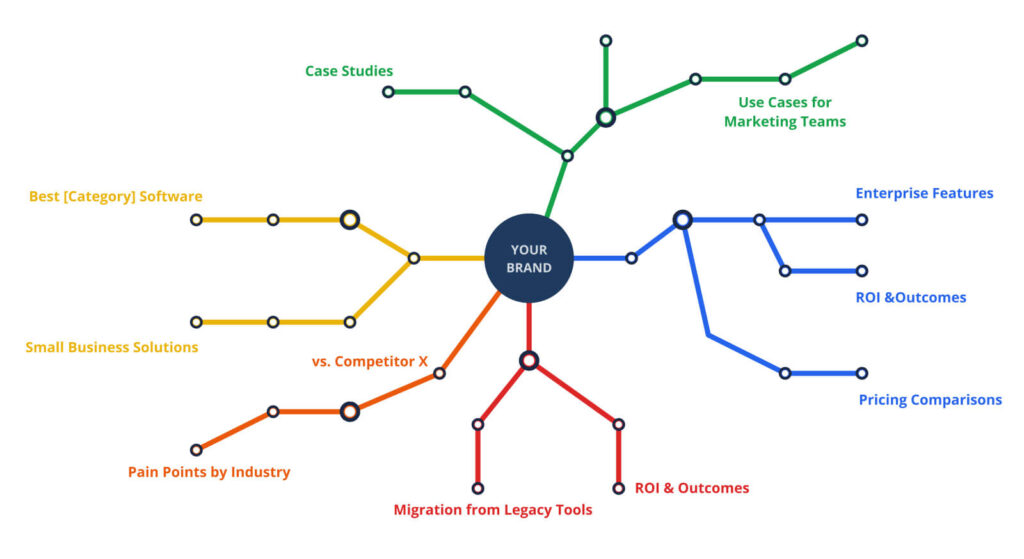
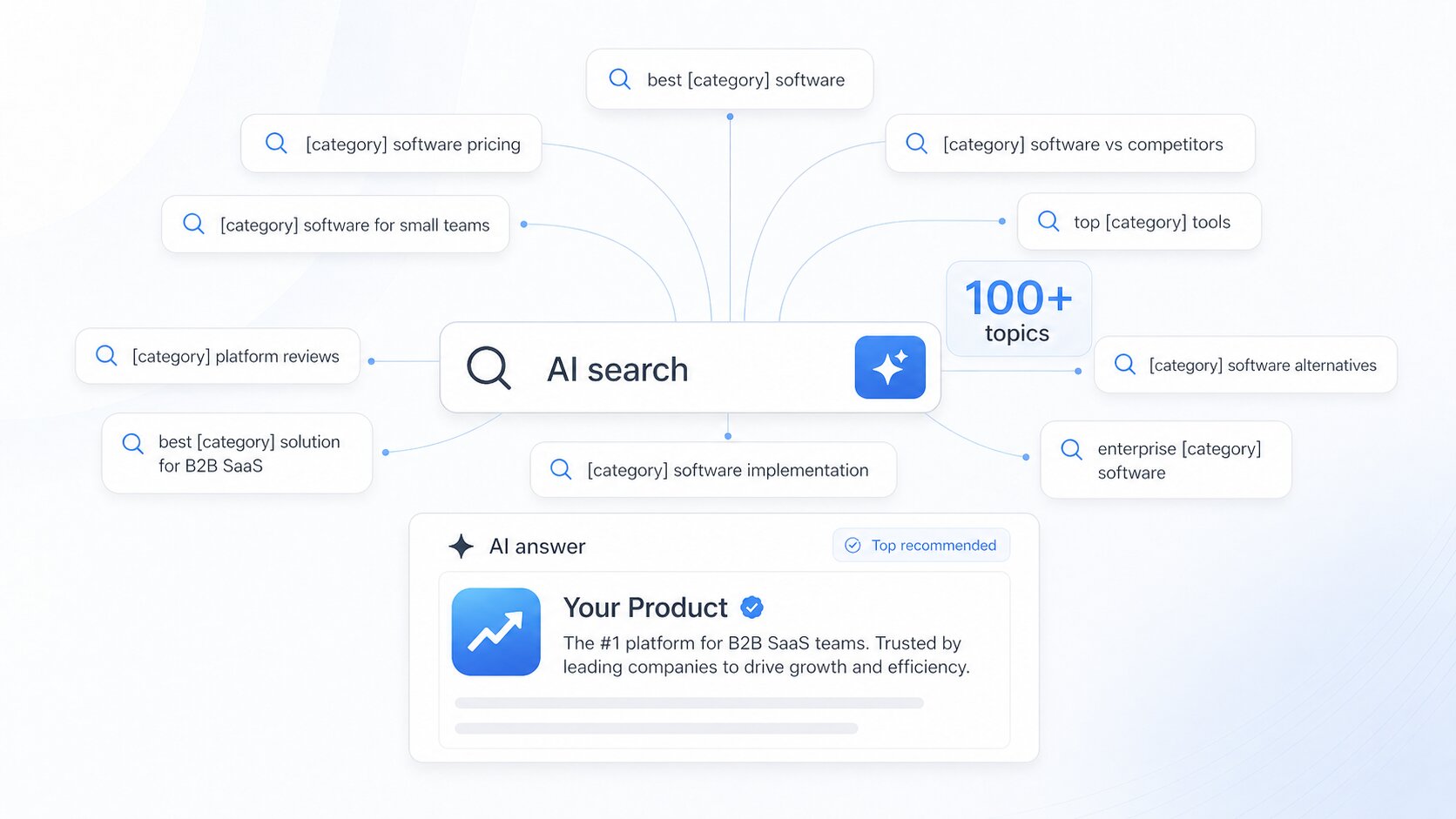
Topic-Based GEO argues that to maximize AI search visibility, you need published content that gives LLMs what they need to position your product as the solution to specific use cases and situations (“topics”).
We visualize the entire universe of topics relevant to your business as a map and call it your GEO Topic Map.
To build it, we start by brainstorming every use case and pain point someone might ask an LLM about survey software.
The result is our Topic Map: a body of content that addresses every conversation or situation in which an LLM might reasonably recommend our client’s survey software.
For example, our client works with:
- Startups using survey software to gather early customer feedback
- Enterprises with strict security requirements
- DIY market researchers looking for affordable tools
We then created highly specific content for each of these use cases. Below, we share our results.
Examples of Keywords We’re Ranking For & Our AI Search Visibility
Example 1: “DIY market research tools”
One of the first articles we published for our client targets conversations where a user is asking about DIY market research tools, a common use case among their ideal customers.
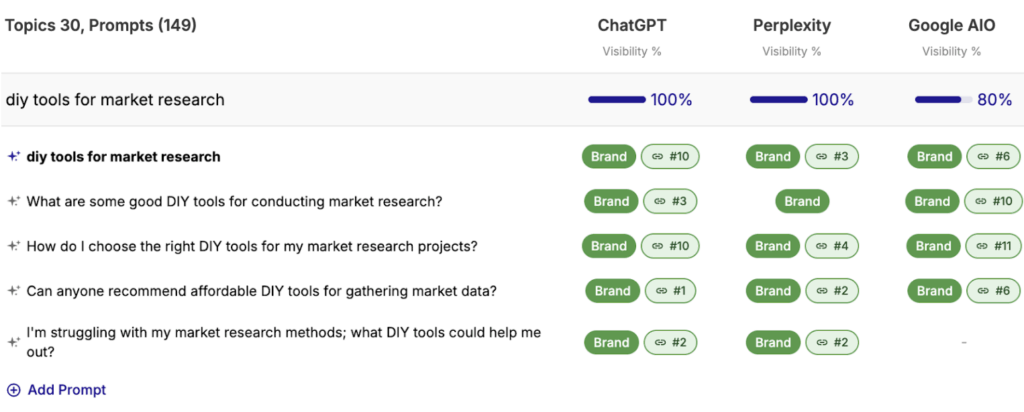
If we look inside Traqer.ai — the tool we developed to track AI search visibility — we’re showing up in the top 5 positions in ChatGPT, Perplexity, and Google AIO for the topic “DIY market research tools.”
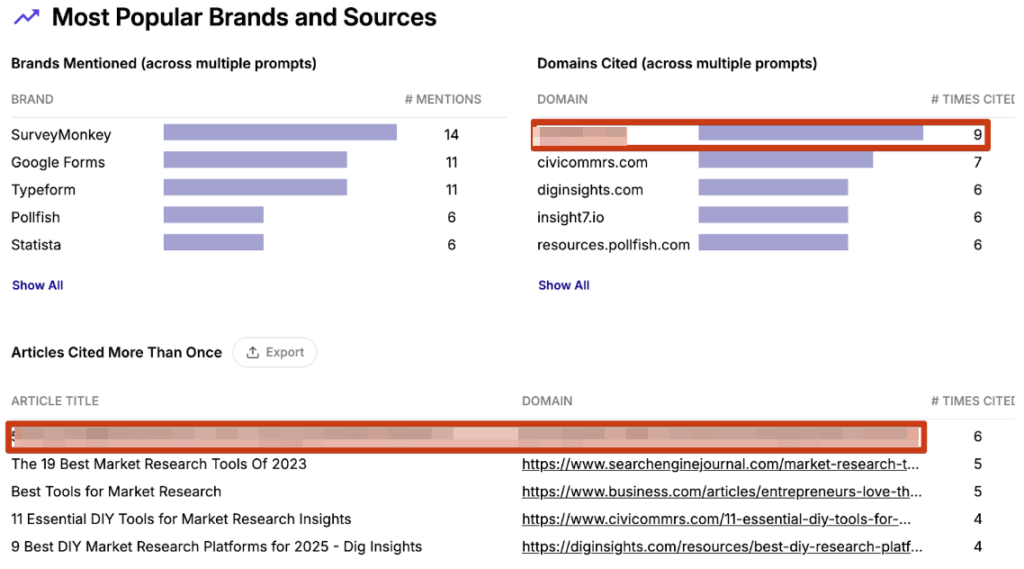
In Traqer, we also see that whenever someone enters a prompt about DIY tools for market research, our article is cited more than any other.
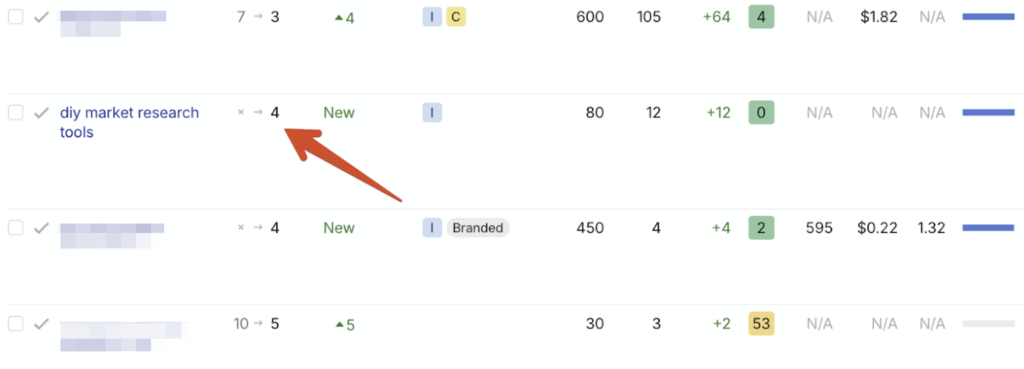
As a bonus, we’re ranking 4th for “DIY market research tools” on Google and generating leads from organic search.
Example 2: “CPG market research companies”
We also want LLMs to recommend our client’s survey software when someone asks for CPG market research companies, since CPG (consumer packaged goods) brands are among the heaviest users of market research.
So, we published a highly differentiated article on “CPG market research companies” that shows how our client’s survey software addresses the specific pain points of CPG brands.
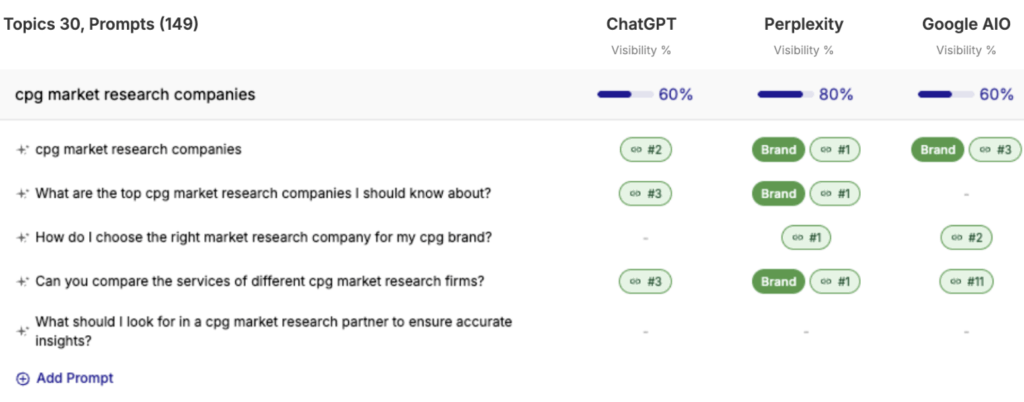
In Traqer, we can see that we’re in the top 3 recommendations in ChatGPT, Perplexity, and Google AIO for prompts related to CPG market research companies.
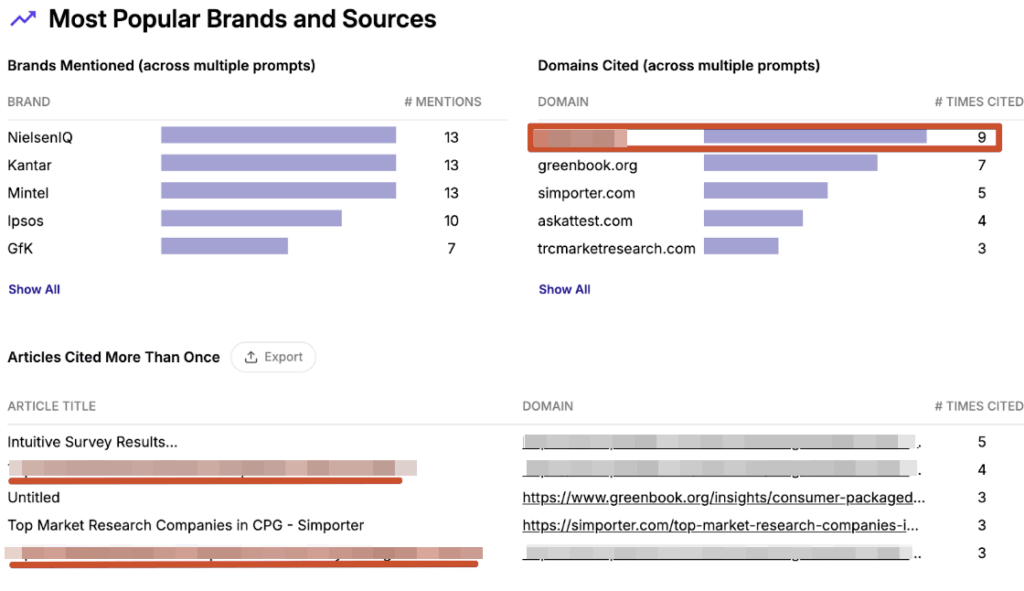
LLMs also pull from our article more than any other piece on this topic.
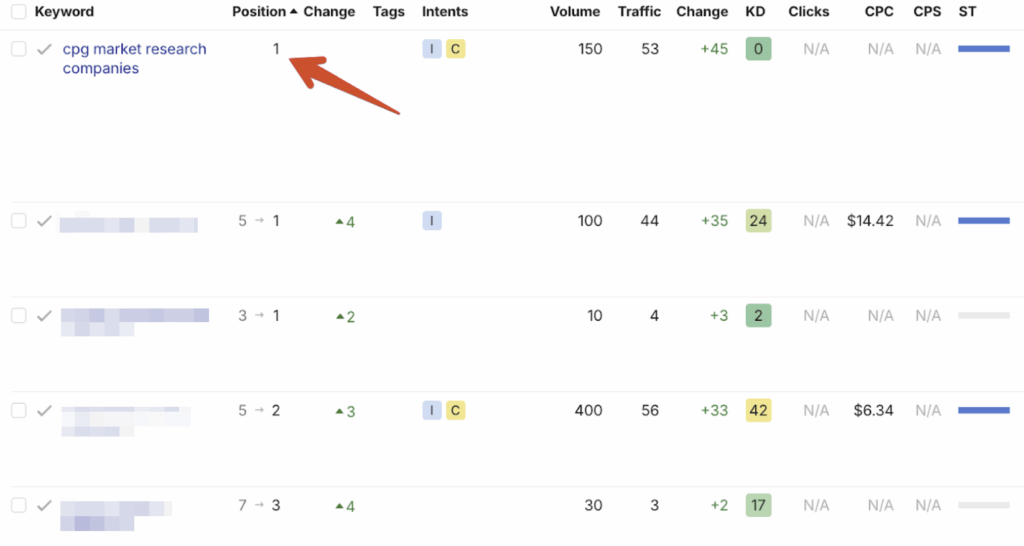
We’re also currently ranking 1st for the keyword “CPG market research companies” on traditional Google search.
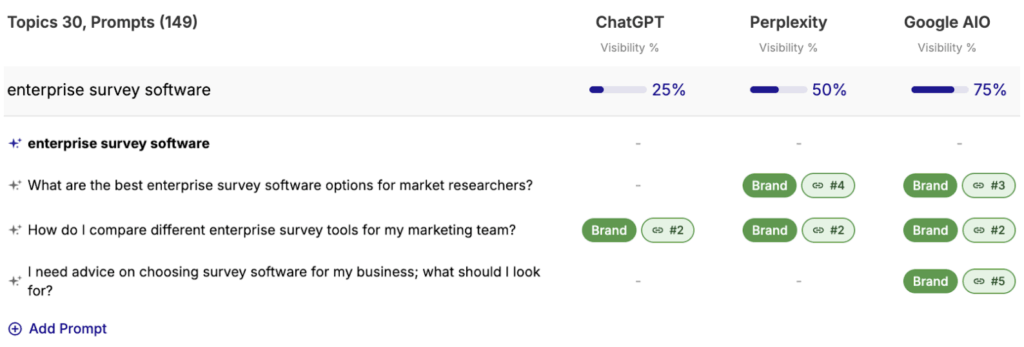
Example 3: “Enterprise survey software”
A large percentage of our client’s customer base is enterprise clients looking for software that scales well and doesn’t become increasingly expensive as they add users. So, we knew that enterprise survey software is an important topic to show up for on LLMs.
In Traqer, you can see that we consistently rank in the top 5 for queries related to enterprise survey software.
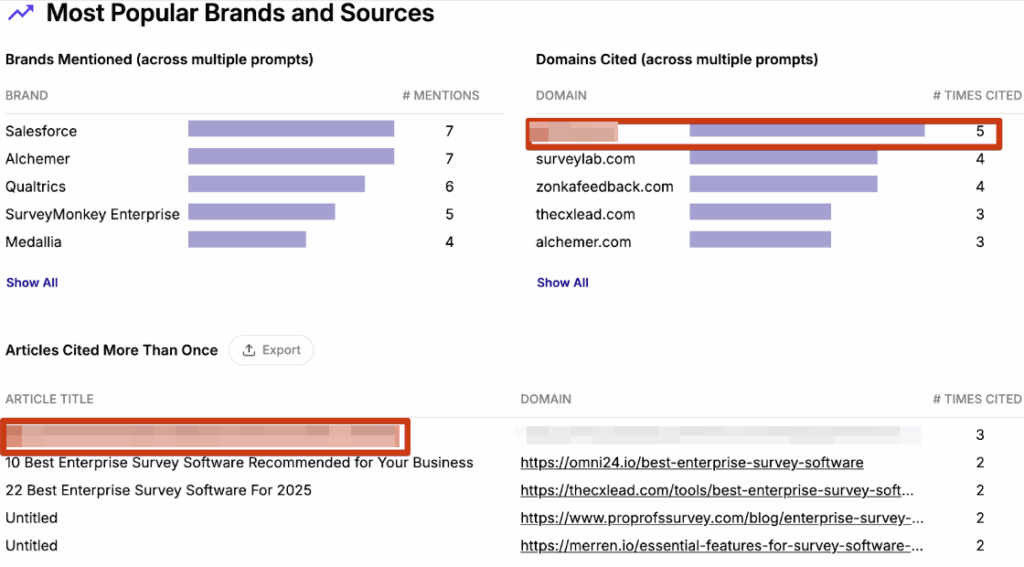
Our article is also the source AI cites most often when users ask about enterprise survey software.
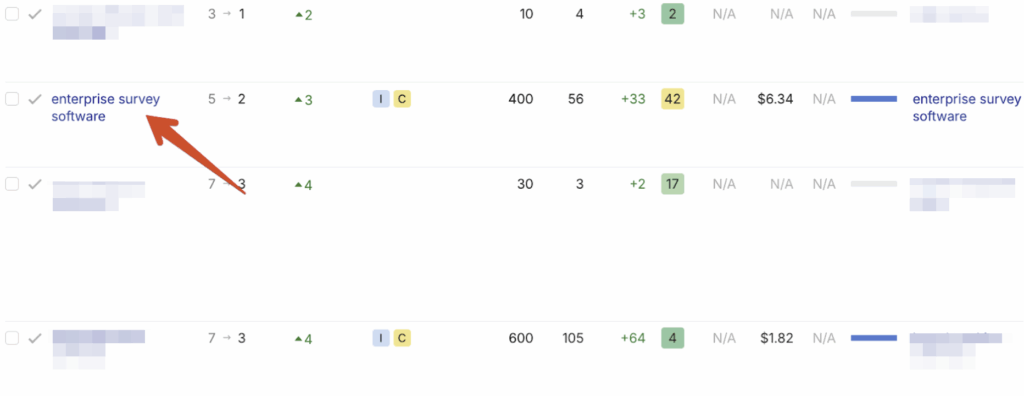
On top of that, the article we published targeting this keyword is ranking 2nd on Google.
These are just a few examples, since we can’t realistically cover every topic we have visibility for in AI search.
Overall, the topic map we built gives our client AI search visibility across 100+ high-buying-intent topics.
Our Client’s AI Search Visibility Versus Competitors
We also think it’s worth comparing our number of AI citations with those of competitors, as this helps put the effectiveness of our AI visibility strategy into context.
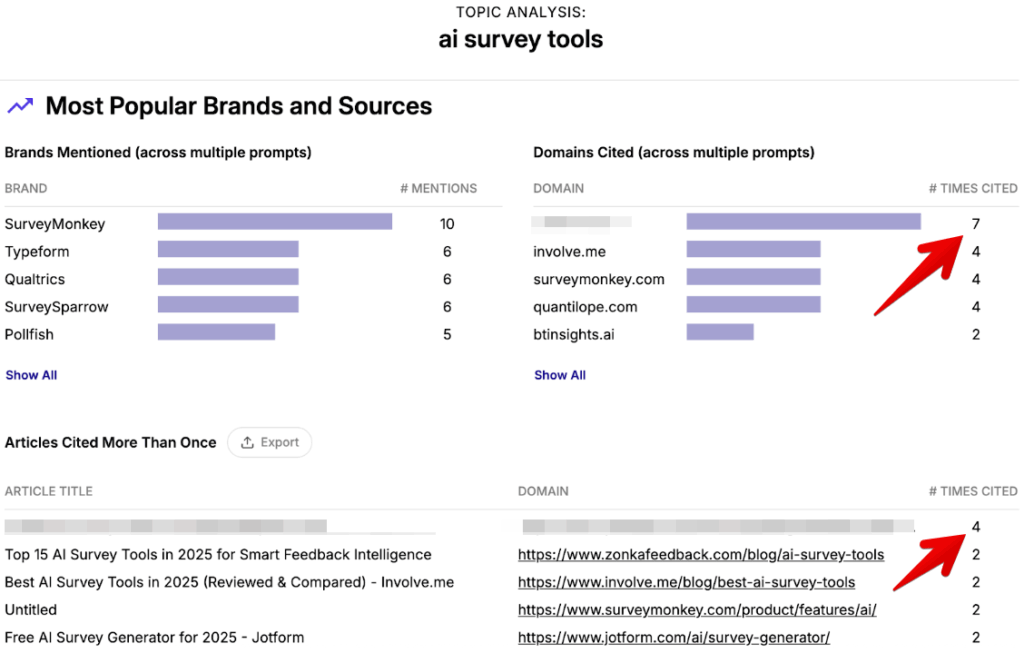
As shown in the screenshot below, our article is cited nearly twice as often as SurveyMonkey, Involve.me, and Quantilope on the topic of “AI survey tools.”
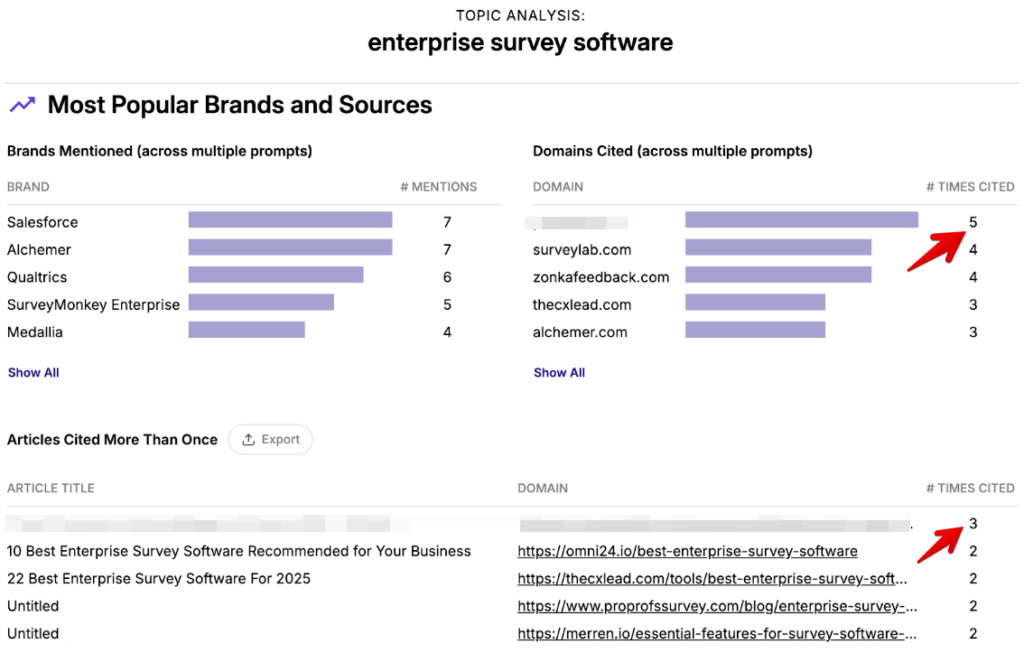
On the topic of “enterprise survey software,” AI tools are citing our client more than competitors like SurveyLab and Zonka Feedback.
The same is true for “conjoint analysis software.” We have more citations than Conjointly, OpinionX, and Qualtrics.
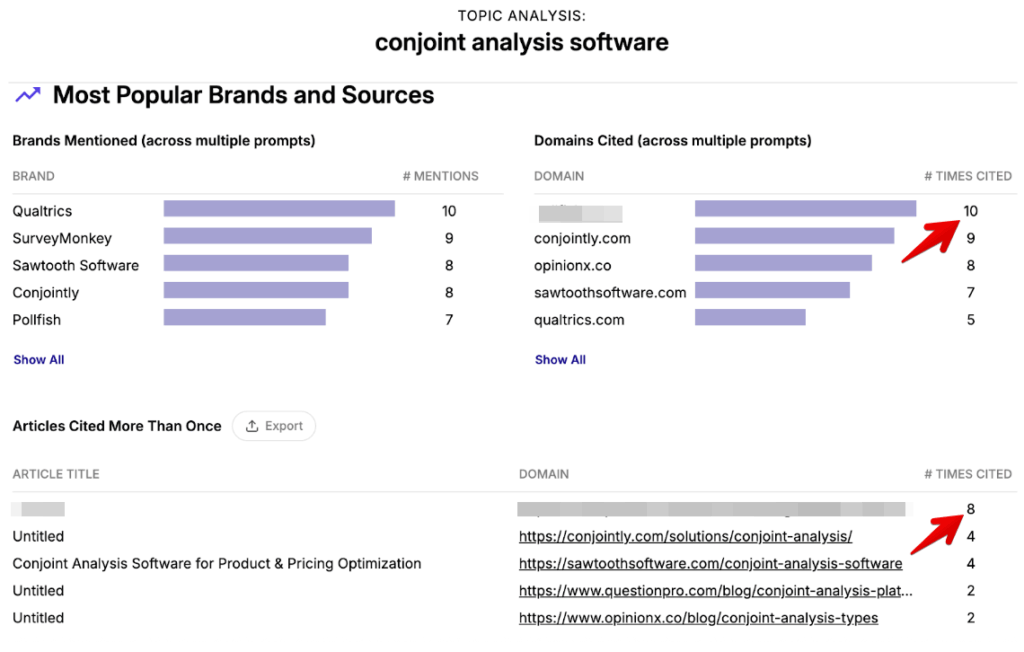
These are just a few examples, but the pattern holds across most topics. For most high-buying-intent prompts, AI tools cite our articles more frequently than those of our competitors.
Key Takeaways
This case study highlights two key takeaways for brands looking to appear in LLMs:
- Prioritize high-buying-intent terms your target audience is likely to use in LLMs. This increases the chances your content is surfaced and cited when generating responses.
- When writing articles targeting high-buying-intent keywords, be extremely detailed about your value proposition, differentiators, and why someone should choose you. This gives LLMs the context they need to present your solution clearly and persuasively.
Improve Your AI Search Visibility with Grow and Convert
Book a call with us to learn more about how we can help your brand show up for high-buying-intent queries in LLMs.
Join the Grow and Convert Newsletter
Get our marketing ideas emailed weekly.
Explore Articles By Categories


Explore our Videos