In February, Lily Ray, a respected voice in the SEO community, published an article on her Substack titled “Is Google Finally Cracking Down on Self-Promotional Listicles?”
This made some waves. It was syndicated or summarized by outlets like Search Engine Land, which spurred more articles from smaller brands like this agency who straight up called this a “black hat SEO” tactic (eye roll).
We also heard about it directly from clients who sent us the article or told us other advisors told them these product category list posts weren’t helping.
We saw Lily’s article when it came out and discussed it in depth internally. Lily Ray is a well-respected voice in the SEO community, including us, but in this case, our evidence strongly suggests her takeaway is wrong.
Across dozens of clients and hundreds of articles, we see no evidence of Google cracking down on self-promotional listicles. We also think the evidence in her article itself doesn’t support this thesis, as we explain below.
What we think is actually happening is simpler: Google is cracking down on bad content. AI slop or human slop. Bad content absolutely hurts your SEO long term, whether it comes in the form of self-promotional listicles or anything else. And frankly, this isn’t new. It’s been true for decades.
In our client data, we’re seeing self-promotional listicles be just as effective now as they were years ago when we first started talking about the importance of this kind of bottom-of-funnel content. The key is that, like all content, they need to be written well. They need to be honest, and they need to be specific and detailed enough to be genuinely useful.
We discuss all of this with data and examples below.
Issue #1: Product List Posts Don’t Have to Be ‘Self-Promotional Listicles’
Before we get into the data, there’s an important detail that dictates whether your category list post is a misleading “self-promotional listicle” or not: force ranking your list and calling yourself the best.
This is how Lily defines a “self-promotional listicle”: “ranking the best companies or products in their niche and placing themselves in the #1 spot. The common thread is that the company publishing the blog post ranks themselves, and/or their own products, in the top position.”
Even worse is if you then pretend like the list is based on some objective analysis where you evaluated all the options and ended up “objectively” concluding your product is the best.
We absolutely agree with Lily that this type of content is misleading. It’s also unnecessary.
We routinely get all the benefits of ranking for these valuable “best X software” type keywords without positioning our clients’ articles as a ranked list of the best products. Searchers of these keywords are just looking for a list of good options, with clear explanations of which product is good for which situations. That doesn’t need to come with a ranking.
In fact, we think not force ranking your list better fits the search intent of these keywords because not every product is good for all situations. You don’t know the specifics of every reader’s situation, so it’s presumptuous to call any product “the best”.
Discussing Your Product First Doesn’t Have to Mean Saying It’s The Best
Now, as a marketer, you should discuss your product first, simply because eyeballs drop the further down the page you go. You’re just giving yourself less exposure if you put yourself last.
But as our examples below show, you can do that honestly and transparently. Many of our introductions include some version of “We’ll start with a deep dive into our own product and how we designed it to fulfill the criteria above.”
That’s simply telling the reader: “We’re proud of our product. Here are the choices we made when building it, who it’s a fit for, and why. And if it’s not right for you, here are other major players in the space.” What’s misleading about that?
We’ve ranked for hundreds (maybe even a thousand or more) keywords like this over the years for 100+ clients. We never position them as force-ranked lists, and our articles rank for the keywords and convert extremely well (examples below).
Issue #2: There’s No Evidence That List Posts Are Being Dinged by Google
The core evidence in Lily’s article for a possible Google “crackdown” on list posts is showing declining traffic graphs of SaaS company blogs and noting that those blogs happen to have hundreds of “self-promotional listicles”.
But the self-promotional listicles only make up a tiny fraction of the total content on those blogs. She never isolates and examines the rankings and traffic of just those listicles.
Here’s a table summarizing the traffic decline, but importantly, the number of self-promotional listicles versus total posts of every example in her article:
| Company Type |
Blog Traffic Decline |
Total Posts |
Listicles |
Listicle % of Total |
|---|---|---|---|---|
| B2B SaaS | -49% | 30,000 | 191 | 0.6% |
| SaaS | -85% | 2,780 | 228 | 8.2% |
| B2B/B2C SaaS | -42% | 1,980 | 76 | 3.8% |
| B2B SaaS | -38% | 2,790 | 267 | 9.6% |
| SaaS | -34% | 7,700 | 340 | 4.4% |
| Software | Unspecified | 1,420 | 61 | 4.3% |
| SaaS / Digital Marketing | -29% | 1,700 | 10 | 0.6% |
Look at the last column. In all of the examples, the self-promotional listicles make up less than 10% of the total posts; for most, less than 5%. For some, less than 1%. So if the overall blog traffic is declining, how do we know it’s because of these listicles?
We don’t.
To Lily’s credit, she never directly says any of this data proves anything is wrong with self-promotional listicles. It’s just insinuated. But the insinuation is strong.
I mean, just look at the title and subtitle:

It’s not ambiguous what this is implying.
And as I mentioned in the intro, even though her post is implying and not proving, it got picked up by a bunch of other outlets. Many of those outlets went further than her to conclude outrageous things like saying these listicles are “black hat SEO”. The insinuation is strong enough to get people to jump to that conclusion. That matters because people will start changing their marketing strategy based on these insinuations.
So what data would we need to see to really prove this?
Well, to start, if Google is indeed cracking down on self-promotional listicles, you should see a decline in their rankings. Otherwise, what does a “crackdown” by Google even mean if those pieces aren’t being pushed down or off the SERP?
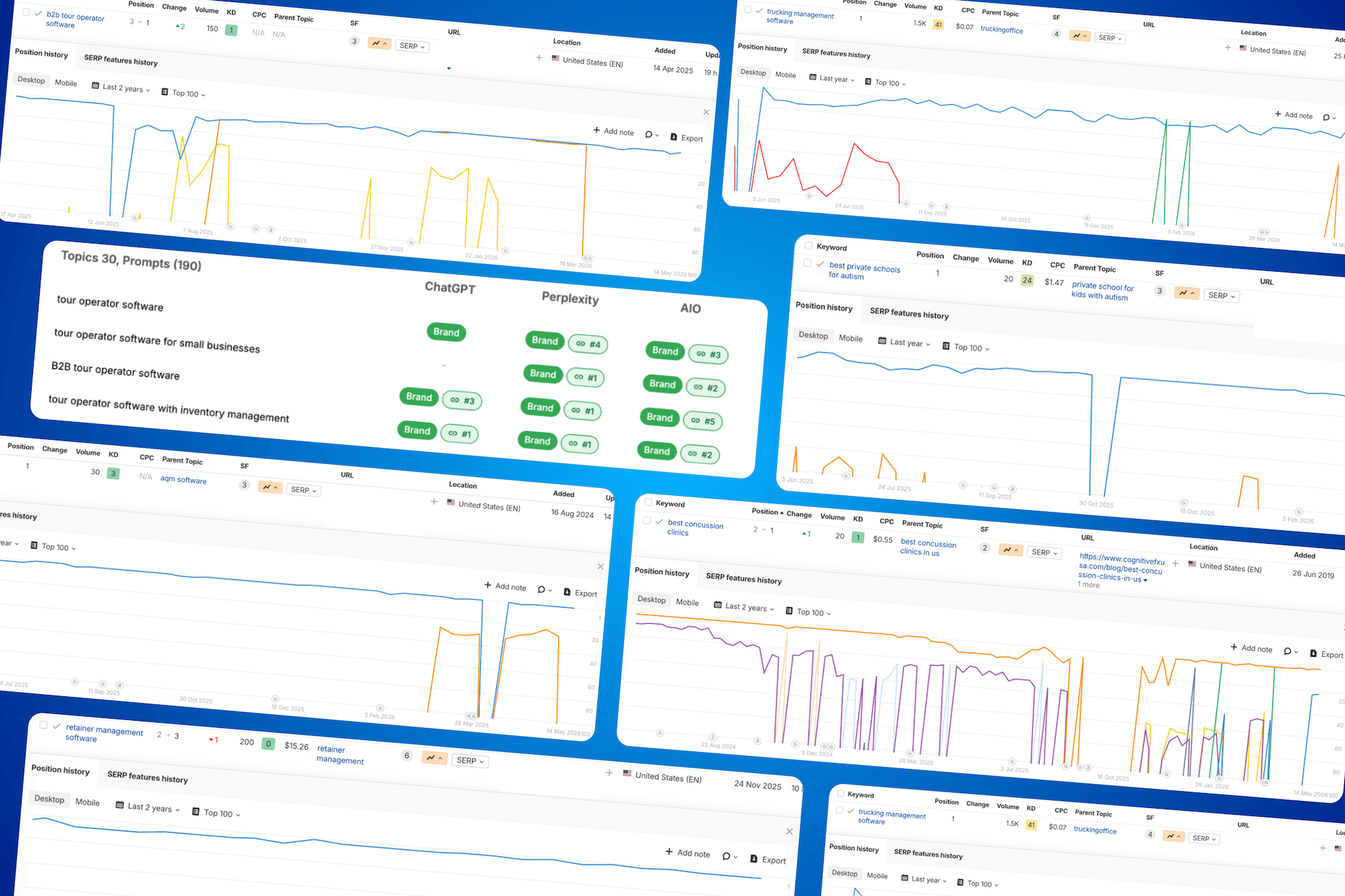
We have that data from dozens of clients, and we’re simply not seeing any kind of widespread rankings hit on these articles. We’ll show a few examples to illustrate.
Our Data: Multiple Examples of Self-Promotional Listicles Doing Just Fine
Here are multiple examples of actual rankings of product category list posts from many of our clients. The data is from Ahrefs rank tracker, which we use internally. It’s never perfect, but directionally good enough. I’m showing a graph of the ranking position over the past year or so, including the late Jan 2026 period where Lily is saying all of the declines in her examples occurred.
B2B tour operator software
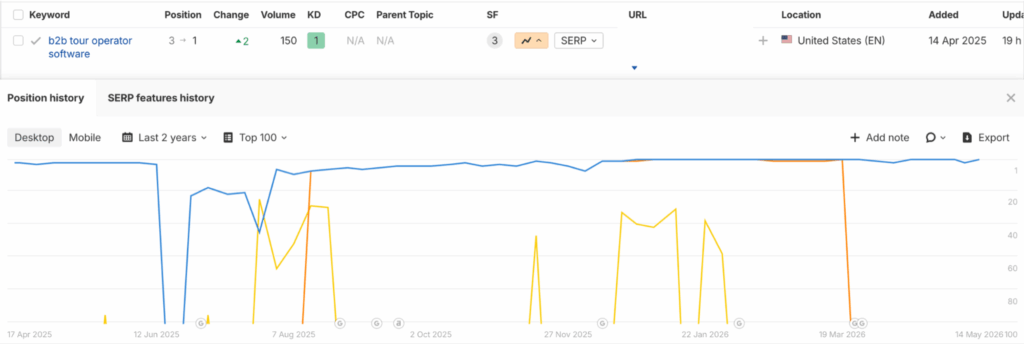
This one has been ranking number one since the spring of 2025. You can see that over the course of a year, it’s been sitting at #1 almost the entire time.
It’s also performing well on AI visibility, being cited and getting our client a brand mention for various variations of that term:

Trucking management software
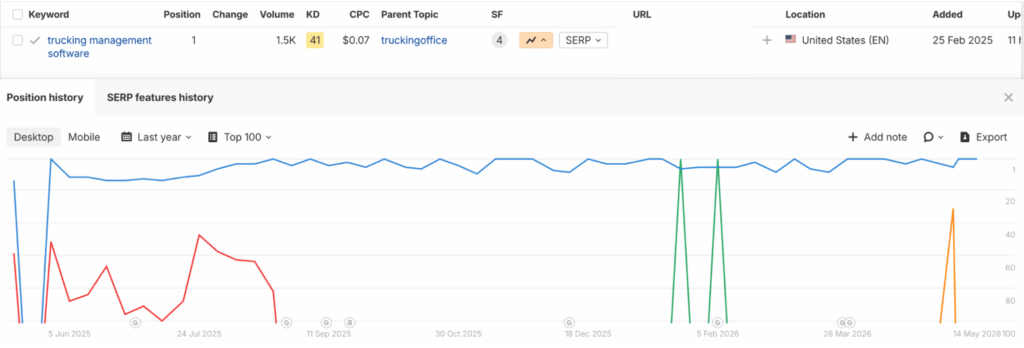
Also published in the spring of last year (about a year before I’m writing this) and after the first month, it consistently hovered in the top 10 for the entire year. No signs of any cracking down.
Retainer management software
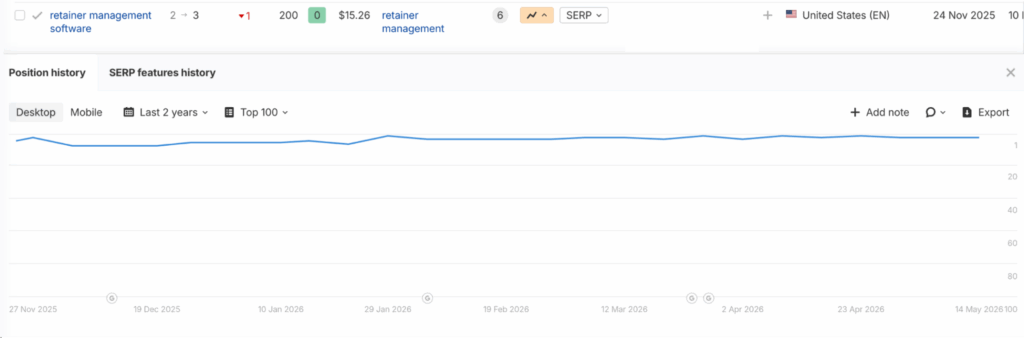
Steady for Nov 2025 to now. Not a sign of a dip in late January 2026. If anything, it seemed to move up a couple of spots then.
AQM software
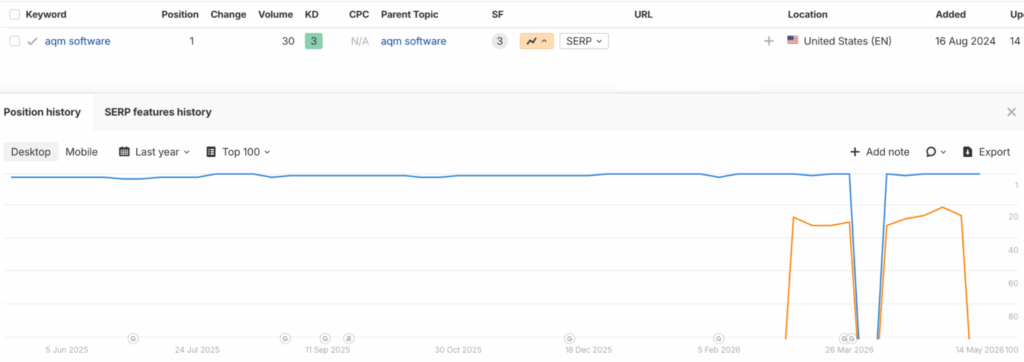
Totally steady. I included this to show an example of natural ranking fluctuation, which you can see in April 2026 here. Google briefly removes the blog post, but after a few weeks, it moves right back to its #1 spot. This is normal fluctuation.
Best private school for autism
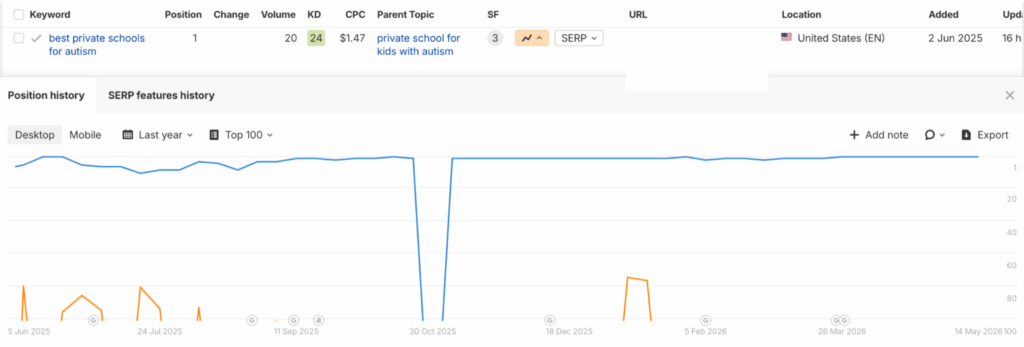
Here’s a non-SaaS example. Also a natural ranking fluctuation in October 2025, but it goes right back to #1. No sign of any crackdown in late January.
Best concussion clinics
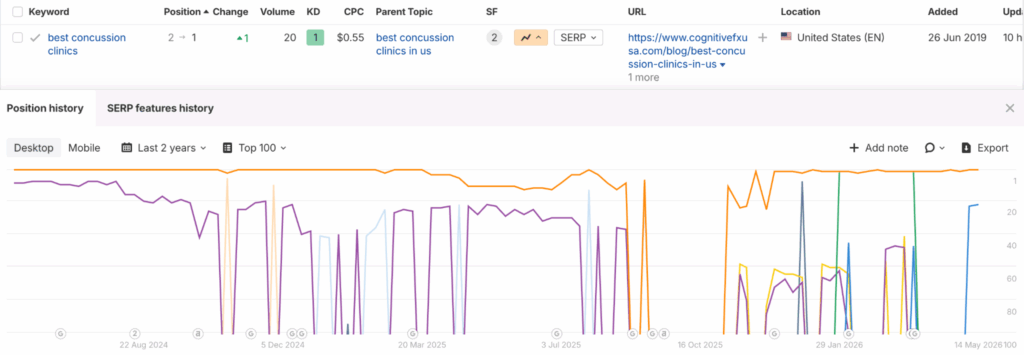
Here’s one in healthcare, a field where Google is notoriously strict. This one has a bunch of other URLs Google tests for this keyword, and an entire month in Oct 2025 where the blog post fell off the SERP. But once again, it came right back. No late January dip.
There are more…
These are just a few examples. We have tons of others. We debated how to show this data and whether we needed some large statistical analysis of hundreds of these posts in case people wondered if we cherry-picked the few that happened to maintain their rankings. We ultimately decided it wasn’t worth the effort or the downside of exposing a massive amount of client content strategy just to prove the point.
We think these six examples across different industries are enough to show that no widespread crackdown on these types of posts appears to be happening. You can absolutely still achieve strong, stable rankings for valuable category keywords without seeing signs of decline.
If you don’t trust our data, that’s fine; we urge you to just look at your own. Either you’ve never published product category list posts, in which case, why are you even reading this far? Or you have, which means you can look at your own rankings; you don’t have to trust us.
What If It’s Just AI-Generated Content That’s Getting Dinged?
One of the most notable parts of Lily’s article is at the end, when she notes a couple of other common characteristics of the blogs she examined. One key pattern is that she ran them through an AI writing detector, and it said all had a 100% confidence that the text was AI-generated.
That’s a massive red flag. Folks have published studies showing ample evidence that Google is cracking down hard on sites with a heavy amount of low-quality AI-generated text.
That alone could explain the blog-wide traffic declines in her examples.
But I also want to highlight qualitative differences in writing quality between her examples and the posts we write for clients. This could also be hurting long-term ranking ability, whether or not a human or AI wrote them.
Most ‘Self-Promotional Listicles’ Are Just Bad Writing (Examples)
Lily shares a few examples of specific posts in her article, which show clear examples of how not to write these bottom-of-funnel product category posts.
First, there’s a post on top-rated test management tools.
Look at the opening sentence:
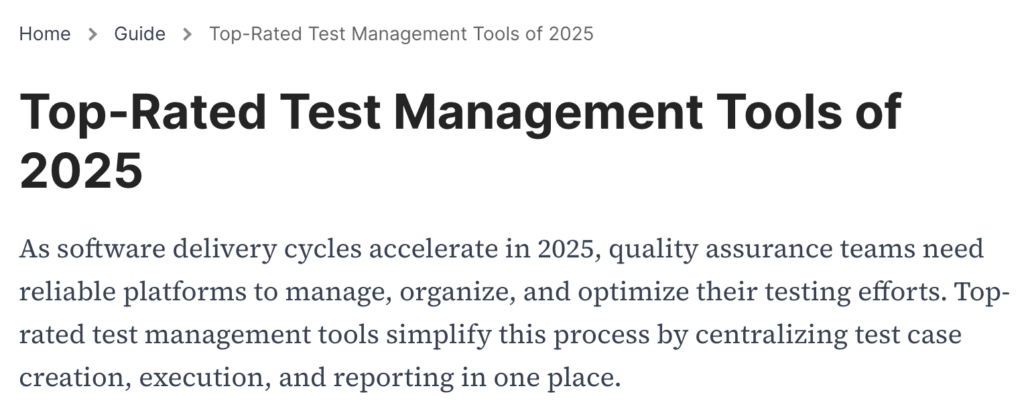
This is corporate marketing gobbledegook that doesn’t say anything useful. It also has questionable claims and unnecessary insertions of “2025”:
- No evidence or reasoning is given to support the claim that software delivery cycles started accelerating in 2025. It’s almost certainly not true.
- In fact, test management tools have been a thing for a long time. Why are we even talking about 2025?
- Is “software delivery cycles accelerating” really the reason people need these tools? Software testing tools have been around for decades.
The first two H2s continue this largely non-informative, corporate jargon writing:
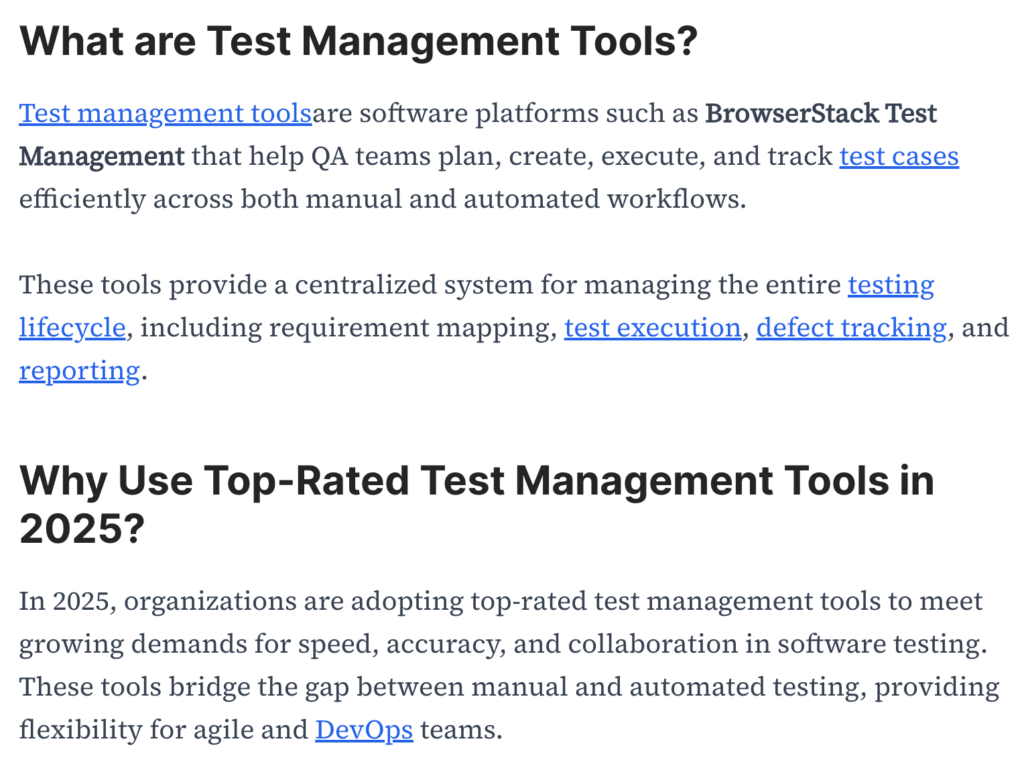
Issues:
- No one Googling “top test management tools” needs to be told what they are.
- Even more inane is asking “Why use them?” The searcher is already looking for them; they know why they’ll use them.
- Once again, nothing magical happened in 2025. They’re just blatantly forcing the date into it because someone must have told them “it helps SEO”.
- So much corporate jargon: “organizations are adopting…to meet growing demands.” No one talks like this.
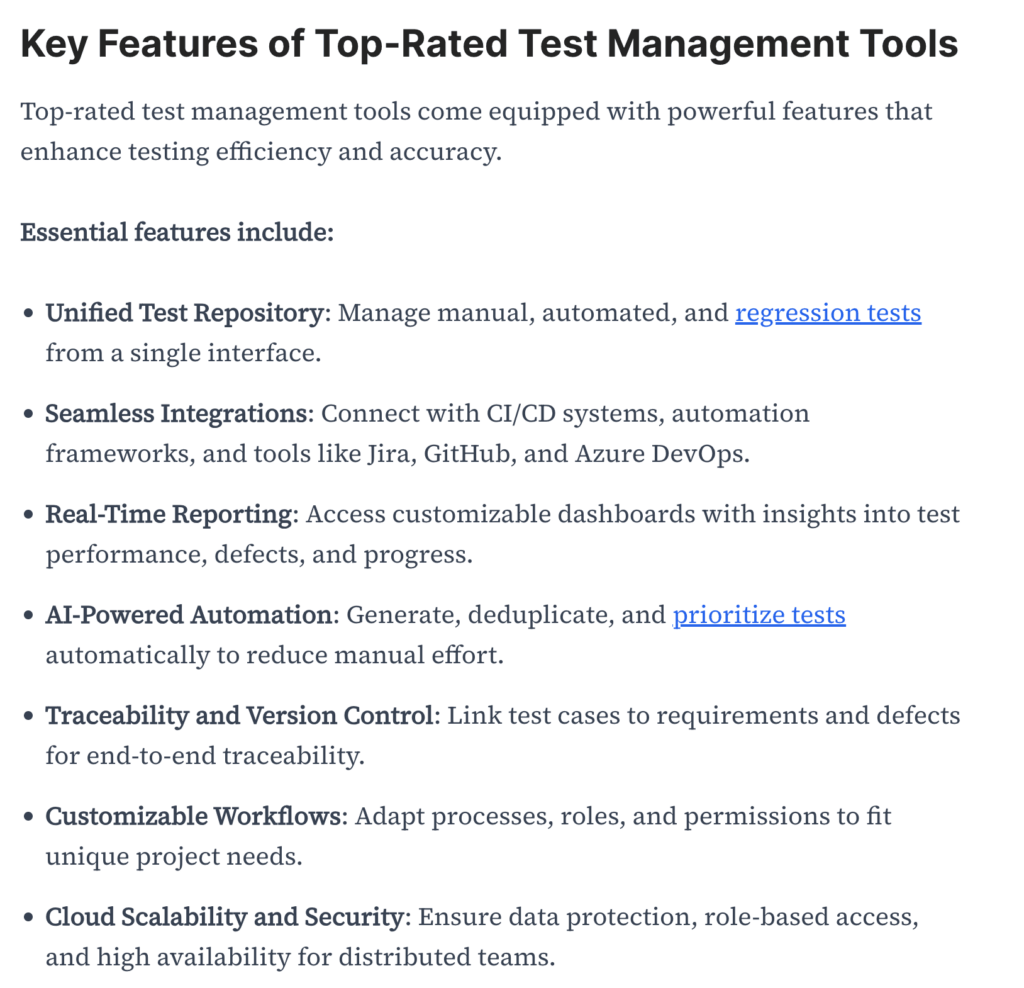
This “Key Features” section is similar to something we’ve included in our bottom-of-funnel pieces for a long time: help the reader understand what they should look for when evaluating options.
But the above list is not useful. The descriptions are too short and generic. You can contrast this with how we do it in our examples below.
Overall, this is just bad content, and bad content hurting your SEO long term is a tale as old as time.
This kind of writing exists throughout the examples Lily shares in her post. We won’t critique all of them. You can go find those articles if you want to read more.
Our Examples: How We Write These Bottom-of-Funnel List Posts
Here’s an example of one of our bottom-of-funnel list posts, in this case targeting the keyword “trucking management software” (full article if you want to read it).
Here’s the full intro and the start of our client’s section:
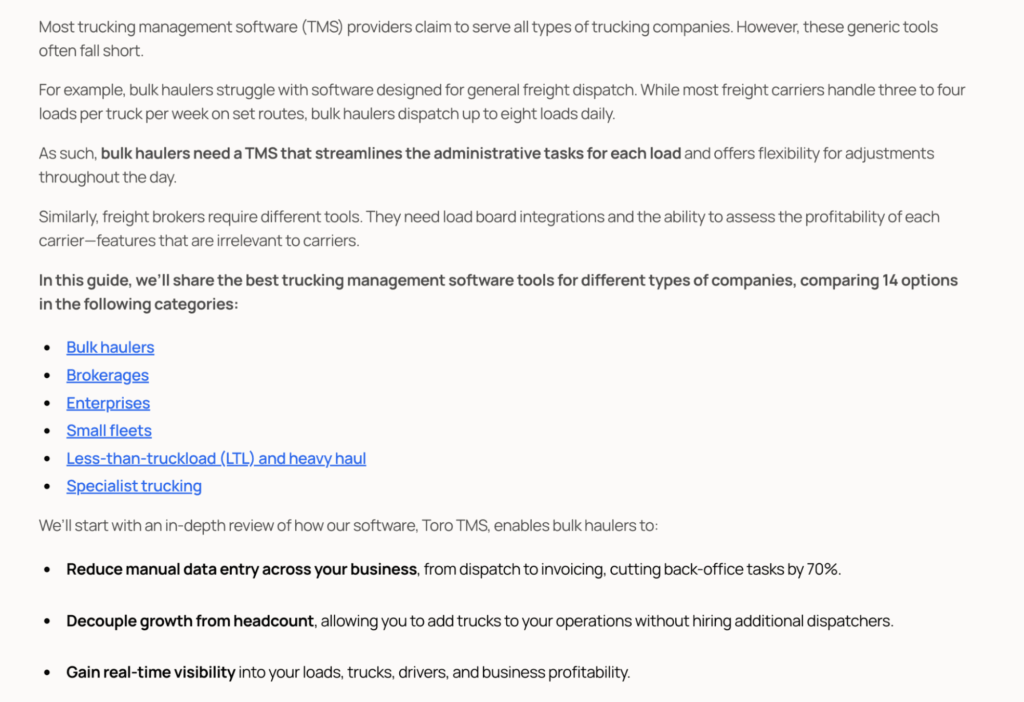
A few important things to note in how we position this piece in the intro:
- We never say this is a ranked list
- We never say Toro’s software is “the best”
- We never say we’ve “tested” all the others
- We never allude to any sense that this is an objective third-party evaluation
Instead, we just describe what we know about the space (trucking management software, TMS) and steer the discussion to the needs of Toro’s target customer: bulk haulers, a subset of truckers.
You can see this directness in the first H2. It doesn’t say “Toro is the best!” It says it’s software for bulk haulers, which is both true and notable. Most trucking management software is generic, so our discussion of what bulk haulers need is genuinely valuable to the reader. Their needs are different, and that discussion doesn’t exist online.
If you are a bulk hauler looking for a TMS, this is genuinely helpful content, even though it’s clearly selling Toro.
See how the “self-promotion” isn’t, by itself, a negative? It’s if the company lies or pretends to be objective, or pretends they “tested” all the options, that it comes across as cringey (at best) or dishonest (at worst).
In fact, for these bottom-of-funnel queries (like “trucking management software”), it’s our strong belief that the searcher is looking to be sold to. When you’re researching products, in particular complex or expensive options like many B2B purchases are, you want to understand the features, benefits, and differentiators of each option at a deep level. So if one of the brands has an article that basically lays out:
- Here’s our view on what matters in this space
- Here’s how we designed our product to align with that view
That’s genuinely useful. It doesn’t matter that the content lives on the brand’s site. The reader knows where you are. They know the brand is selling their product, and that’s fine; they’re expecting a sales pitch and will use that pitch to help their decision-making.
You can see this in action later in the piece when we introduce Toro:
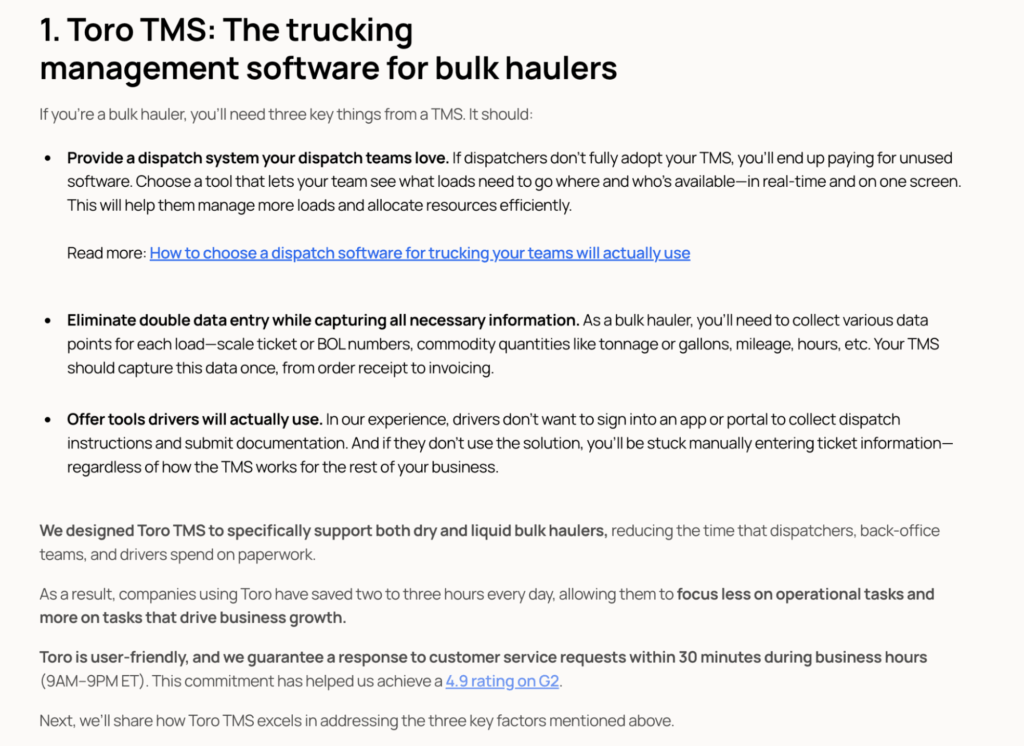
We list what features you need as a bulk hauler, with real explanations, not just AI-sounding generic descriptions (see the second bullet as an example), and say how Toro meets those criteria.
Then, throughout that section, we go into extreme detail about exact features and how they help bulk haulers:
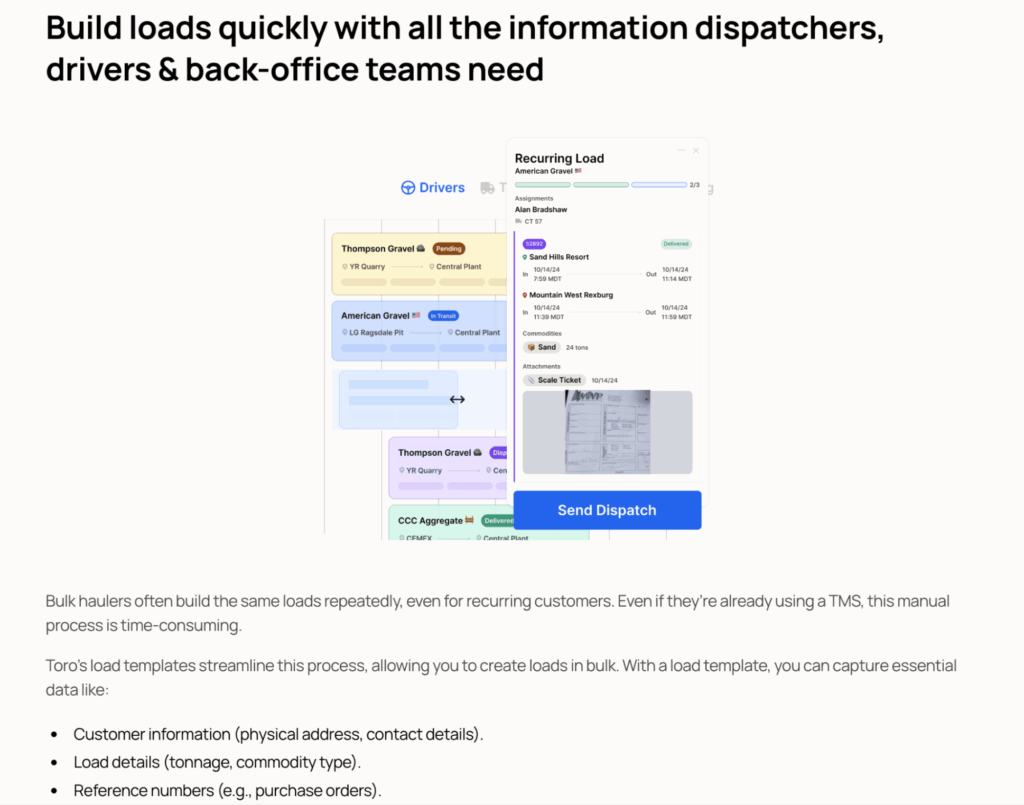
This level of detail helps AI search in particular because AI recommendations rely on matching detailed pain points with solutions.
This is genuinely useful content for the target audience without any of the unnecessary pretending that you won some contest and ended up first.
We think content like this is aligned with Google’s long-term goals (provide truly valuable content to users for each keyword), and we’ve written content for these bottom-of-funnel category keywords in this way for 8+ years. All of them have survived countless Google updates.
And even though this piece isn’t a listicle, it wouldn’t feel complete without a little self-promotion. So if you want to talk about publishing honest, valuable content targeting high-converting keywords for your brand, you can reach out here.
Join the Grow and Convert Newsletter
Get our marketing ideas emailed weekly.
Explore Articles By Categories


Explore our Videos