ChatGPT has, to date, been the most popular LLM in terms of measurable AI traffic to most websites — we see it as the top LLM referrer for every one of our clients. As a result, marketers have become obsessed with how to get ChatGPT to cite your content. People have proposed all kinds of theories around this, from “add bullet point summaries of your content” to “find the fanout queries ChatGPT uses and target those in your SEO”.
Fanout queries, in particular, deserve special attention. These are queries ChatGPT supposedly searches to help generate its response, and if you look in the right parts of your browser’s console, ChatGPT tells you what they are. So, the logical conclusion folks have reached is that if you rank for them, you’ll have a good chance of ChatGPT seeing, and possibly citing your article. On the surface, this makes sense.
But fanout queries cannot fully explain how to get cited by ChatGPT, for two reasons:
- A simple manual check can show you that there are tons of sources in a ChatGPT response that aren’t ranking for the fanout queries. Where does ChatGPT get those from?
- Fanout queries shift with subtle changes in the user’s prompt. And as we’ve established before, you can’t predict users’ prompts to ChatGPT. So that means you also can’t predict the fanout queries. Then how do you know what to target in SEO?
So, in trying to figure out how to get cited by ChatGPT, we wanted to look beyond fanout queries and ask a more practical question:
Does ranking for traditional SEO keywords help you get cited by ChatGPT?
To answer this, we took 70 sources that ChatGPT cited across 10 BOTF prompts and ran them through Ahrefs to see what organic keywords each URL was already ranking for.
(We focused on BOTF prompts only because, as we’ve written about before, those are the only AI search topics where ChatGPT mentions brands. And most of the time, these are the only queries where it cites sources rather than relying solely on its training data. So, that’s where the opportunity is for brands to get traffic and conversions.)
Of these 70 sources, 60% were ranking organically for at least one relevant keyword, and most of them were ranking for three or more. These are traditional, common-sense SEO keywords that one can easily discover doing traditional keyword research in any SEO tool.
Additionally, half of them were ranking on page one and a third were in the top three positions.
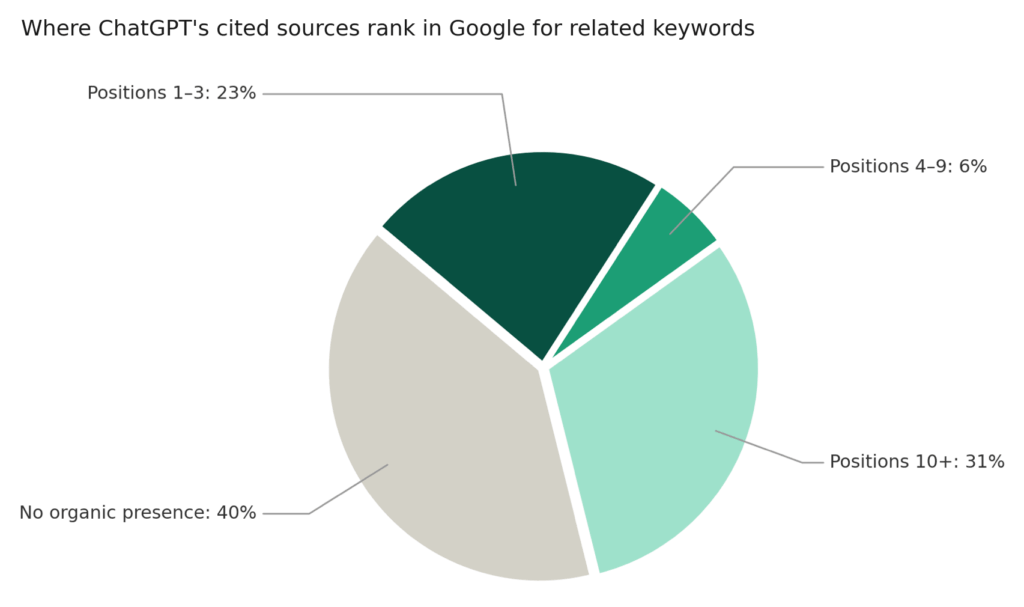
That’s good evidence that ranking for bottom-of-funnel keywords related to your customers’ pain points helps you get cited by ChatGPT.
You don’t need to guess what fanout queries to target. You just need to understand the underlying intent behind them and focus on that, which is what successful BOTF SEO already does.
Below, we look more closely at where ChatGPT citations appear to come from, what this means for your GEO strategy, and where the sources that don’t appear in live web search may be coming from.
Every source ranking for a fanout query also ranked organically for a traditional SEO keyword
While our main takeaway from this study is that you don’t need to know the exact fanout queries in order to get mentioned by ChatGPT, looking at the fanout query data adds a layer that helps us understand the relationship between traditional SEO and cited sources.
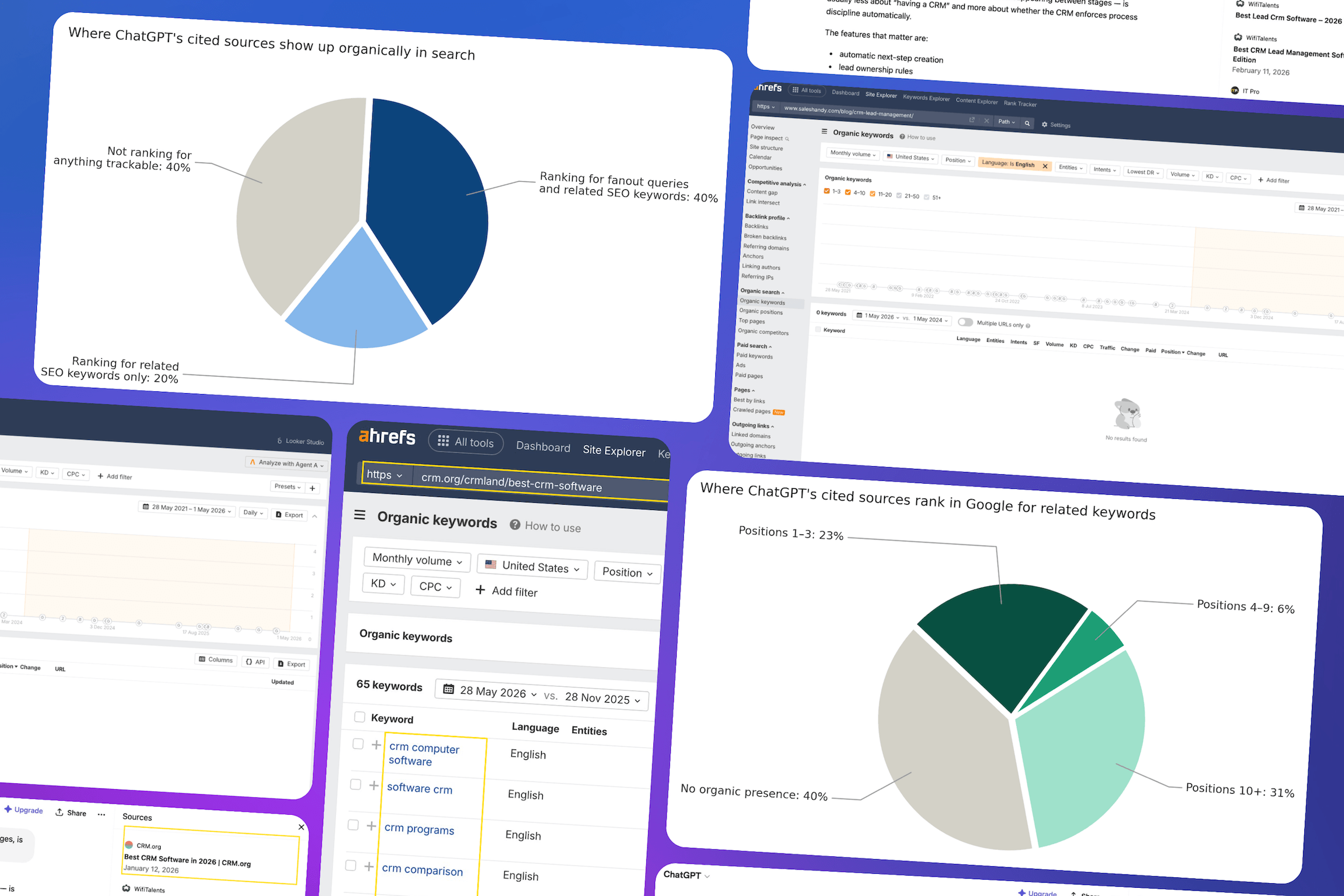
We’ll start with the sources that did rank for fanout queries. 40% of the sources we studied were ranking in the top 10 pages of the SERP for known fanout queries and every one of them also ranked for relevant, more traditional, SEO keywords.
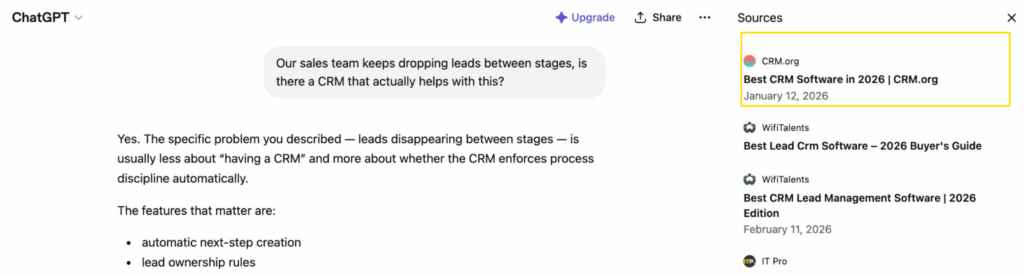
For example, one of the fanout queries for the prompt shown in the screenshot below was “CRM software that helps reduce dropping leads between stages best CRM lead management features”. And the article outlined in yellow below ranked in Google’s SERP for that fanout query.
Of course no SEO would intentionally go after a query that long and specific. But checking in Ahrefs, we see it also is ranking for extremely normal keywords related to CRMs.
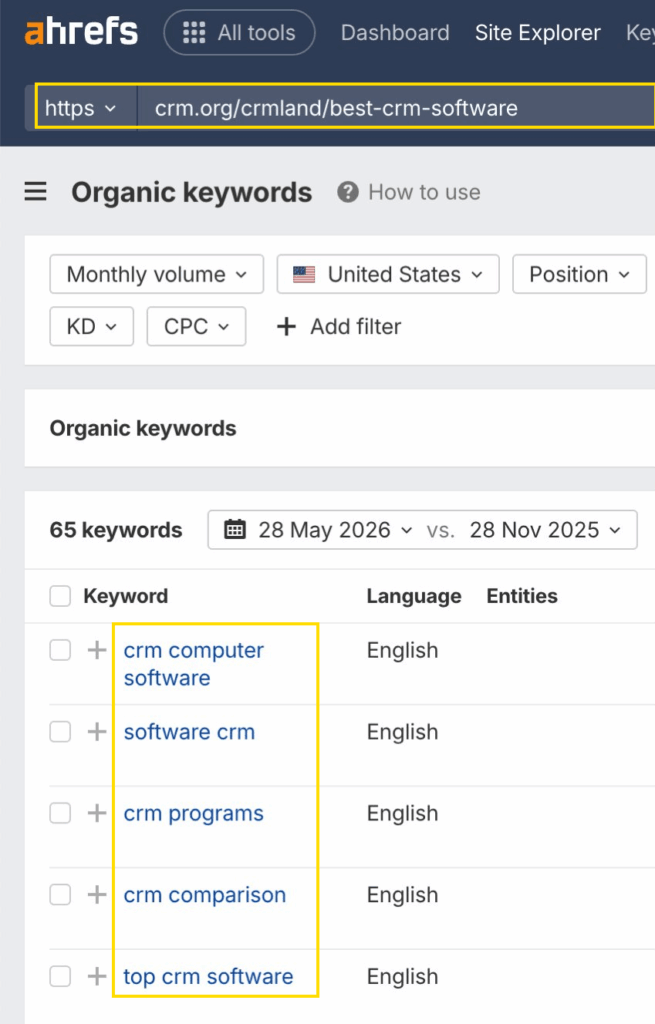
Every source ranking for a long, hard-to-guess fanout query was also ranking for more traditional, discoverable SEO keywords.
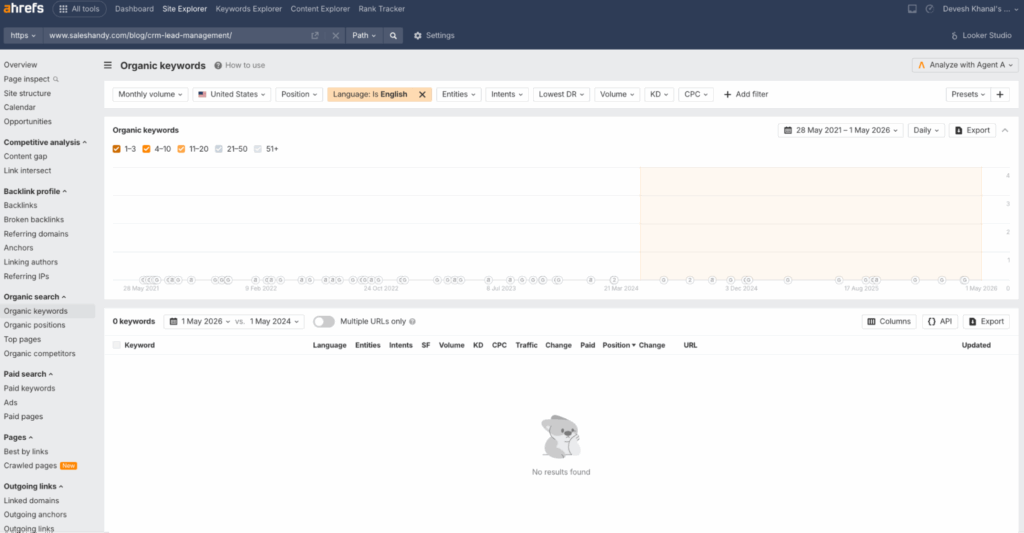
Another 20% of the sources we studied also ranked for relevant SEO keywords but weren’t found in the SERPs for fanout queries. And the last 40% didn’t have any trackable organic presence at all.
Here’s what that looks like at a glance:
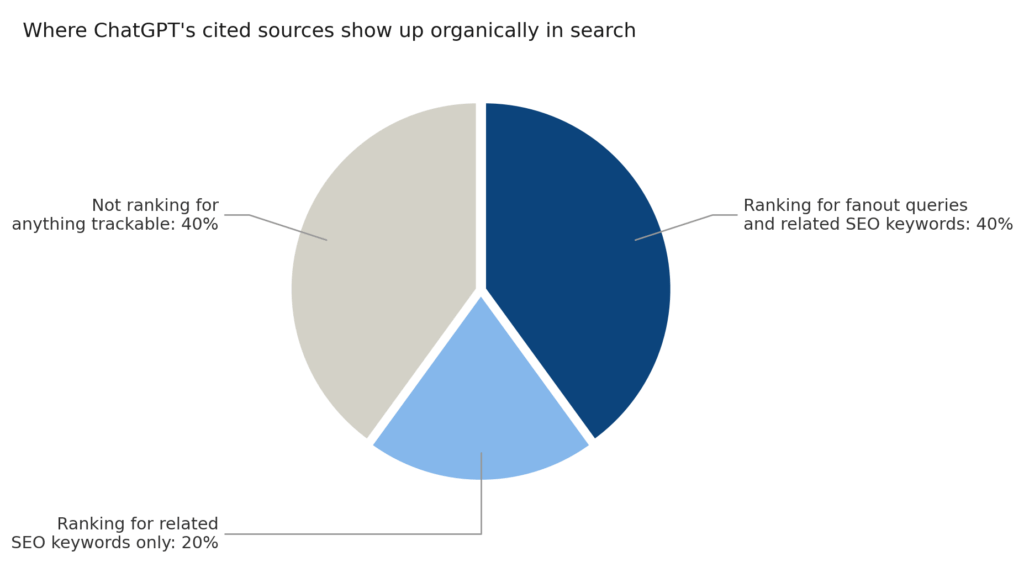
We draw two conclusions from this:
- The 20% with organic presence and not in the SERP for fanout queries was likely drawn from fanout queries we can’t see. This isn’t a new idea. Others have also noted that it’s highly likely that we are only able to see some of the fanout queries ChatGPT uses.
- If you aren’t ranking for traditional SEO keywords, it’s highly unlikely that you’ll get in the SERPs for fanout queries, and therefore won’t be found via live search.
Overall this data supports the key thesis of our Prioritized GEO strategy: that ranking for relevant, bottom-of-funnel SEO keywords is a key mechanism by which you can get noticed and cited by LLMs (in this case, ChatGPT). However, as we’ll discuss in a later section, citations may not necessarily influence ChatGPT’s answers.
But very few of the cited sources are ranking for the same keywords
We also checked whether cited sources were ranking for the same organic keywords. If most of them were ranking for the same one or two terms, those keywords would likely be worth targeting.
But we didn’t find any significant overlap, meaning most of the cited sources were ranking organically for different keywords.
There was some overlap where one or two URLs were ranking for the same keyword, but overall there wasn’t enough of a pattern to tell us anything useful. So, our conclusion is that the more relevant keywords you rank for, the better your chances of getting picked up, but no single keyword seems to be the magic ticket to ChatGPT citations.
This continues the trend we keep seeing: GEO or AIO seems to be less hackable than SEO, you just need to do the work of publishing helpful content on the topics your customers care about and, slowly, more of them start to be found by LLMs.
Not all cited sources come from live search
It’s a common assumption that if ChatGPT cites a source, it found it through a live web search. But as we found in our fanout query SERP study, that’s only true about 40% of the time.
So where do the other 60% of cited sources come from? We covered the full picture in that study, but the short version is that no one really knows for certain.
The leading theories are:
- Additional queries running behind the scenes. Like we covered in the previous section, the fanout queries that we can see are likely just a subset of what ChatGPT is actually searching.
- Response caching. ChatGPT may be reusing sources from past queries rather than running fresh searches every time, particularly for common buying-intent prompts.
- Training data. There’s evidence that suggests ChatGPT can remember specific URLs from its training data.
- Hallucinations. Roughly 10% of citations in our study led to error pages. Some sources simply don’t exist.
The honest answer is that there’s a randomness to it. We tend to assume AI is operating logically and systematically, but in reality it’s trained on patterns and probability and that makes its behavior harder to predict and control than traditional search.
Cited sources don’t necessarily influence answers
This entire article has been focused on where citations come from, and overall, we’re interested in anything that helps us understand how LLMs work and gives us practical information to work off of. But, as we’ve written about before, being mentioned has way more impact on traffic and conversion than being cited as a source.
So the question is does getting cited correlate to being mentioned?
We’re currently working on a separate study to answer this more directly, but for now we can say that having worked with dozens of clients to increase AI visibility over the past few years and looking at the evidence we’ve seen from other studies, we’ve come to the conclusion that that’s not the case.
No one really knows for sure how these LLM chats work, but evidence tells us that tools like Perplexity and Google AIO retrieve sources first and then build the answer. ChatGPT on the other hand seems to rely much more heavily on training data and generates the answer before adding citations. Because the answer is already written before sources get attached, those citations aren’t shaping what users read. And because your brand is tucked away as a citation (rather than a recommendation ChatGPT is including in its answer), it’s not driving meaningful traffic back to you.
We do track citations for our clients, but we put more weight on mentions because that’s where conversions actually come from.
To learn more about how we increase and track mentions for our clients, reach out. Or you can sign up for our mailing list and we’ll send you studies and articles about what we’re learning as we go.
Join the Grow and Convert Newsletter
Get our marketing ideas emailed weekly.
Explore Articles By Categories


Explore our Videos