There’s no shortage of advice about how to show up in ChatGPT, Perplexity, and Google AI Overviews. But most of it is organized around the same goals: getting cited and making your content more accessible to LLMs. While these aren’t necessarily bad goals, they miss the point.
The question worth asking instead is: How do I get LLMs to recommend my brand to someone who’s ready to buy?
That might seem like a subtle distinction. You might even be thinking that’s exactly what those other goals are already optimizing for. In our experience, reframing the question this way gives you a very different read on most of the tactics that get passed around as “LLM SEO.”
For example, just because an LLM cites you as a source doesn’t mean your brand is going to show up in its list of recommendations.
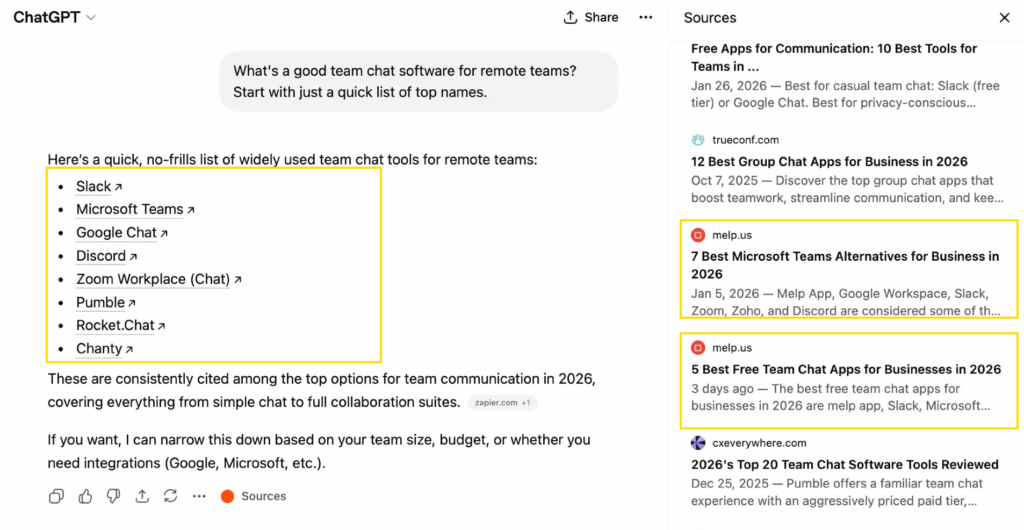
In the screenshot above, Melp App (a Microsoft Teams alternative) was cited twice. Being cited once for a prompt this core to their business — good team chat software — would be celebrated as a win by their agency or marketing team. Cited twice? People might pop champagne. But they didn’t show up in the final list of recommended products in ChatGPT’s text output. This happens all the time. We didn’t have to run a bunch of different prompts to find this example; we found it on the first try.
The user experience reality that people aren’t emphasizing enough is that most users aren’t going to dig into the citations. They’re just going to act on whatever’s recommended in the AI response.
Think about your own behavior using LLMs: How often are you scrolling through citations and clicking in to read those articles versus just asking ChatGPT or Claude a follow-up question if you have one?
We’ve been running Grow and Convert since 2017, working with dozens of SaaS and B2B clients. Our focus has always been on bottom-of-funnel content that drives leads and conversions, not traffic. Over the last few years, we’ve found the same principle applies in AI search.
In this article, we’ll share our thoughts on the most common tactics for showing up in LLM chats through the lens of getting more leads. We’ll also explain the framework we use with clients to build AI visibility that actually produces results, and finally, we’ll cover how to measure results.
The common recommendations (and what we actually think)
Below, we walk through the most widely circulated LLM SEO tactics. For each one, we cover what’s being recommended and what the evidence and our experience actually show. Then, we’ll show you where we’d prioritize your time instead.
Note: You’ll see this work labeled a dozen different ways, including GEO (generative engine optimization), AEO (answer engine optimization), AIO, LLMO, or just “AI SEO”. We use GEO, but the label matters less than the approach.
1. Target fan-out queries to get cited
When ChatGPT searches the web to generate a response, it doesn’t run a single search. It breaks the user’s prompt into smaller sub-queries, sometimes called fan-out queries, to pull information from multiple sources simultaneously. A number of SEOs have argued that if you can identify these sub-queries and rank for them, you’ll reliably earn LLM citations. The pitch is essentially: treat fan-out queries like target keywords in traditional SEO, and citations will follow.
But there’s a big problem with the fan-out query approach: you can’t reliably identify the true prompts your buyers are entering in the first place or the fan-out queries that ChatGPT is using for those prompts.
Any software claiming to show you the real prompts driving AI traffic is working with incomplete data at best. LLM providers don’t share this information. Some tools use panels of real users to get an idea of the types of prompts people are typing into LLMs, and that does provide some useful data.
But this misses a larger point about prompts and AI-generated answers: even if you guess the exact prompt a real user types into an LLM, their answer and your answer may be completely different because of context and personalization.
This idea of “we’ll show you what prompts users are typing into ChatGPT” is traditional SEO thinking misapplied to AI search. In AI search, first of all, users don’t enter short, predictable, or repeatable prompts like they do with SEO keywords. They have long conversations, many of which are unique to that user.
But beyond that, the reality is it doesn’t matter much whether you know the exact prompt a user is entering because their response and the responses recorded by your AI visibility tool won’t be the same.
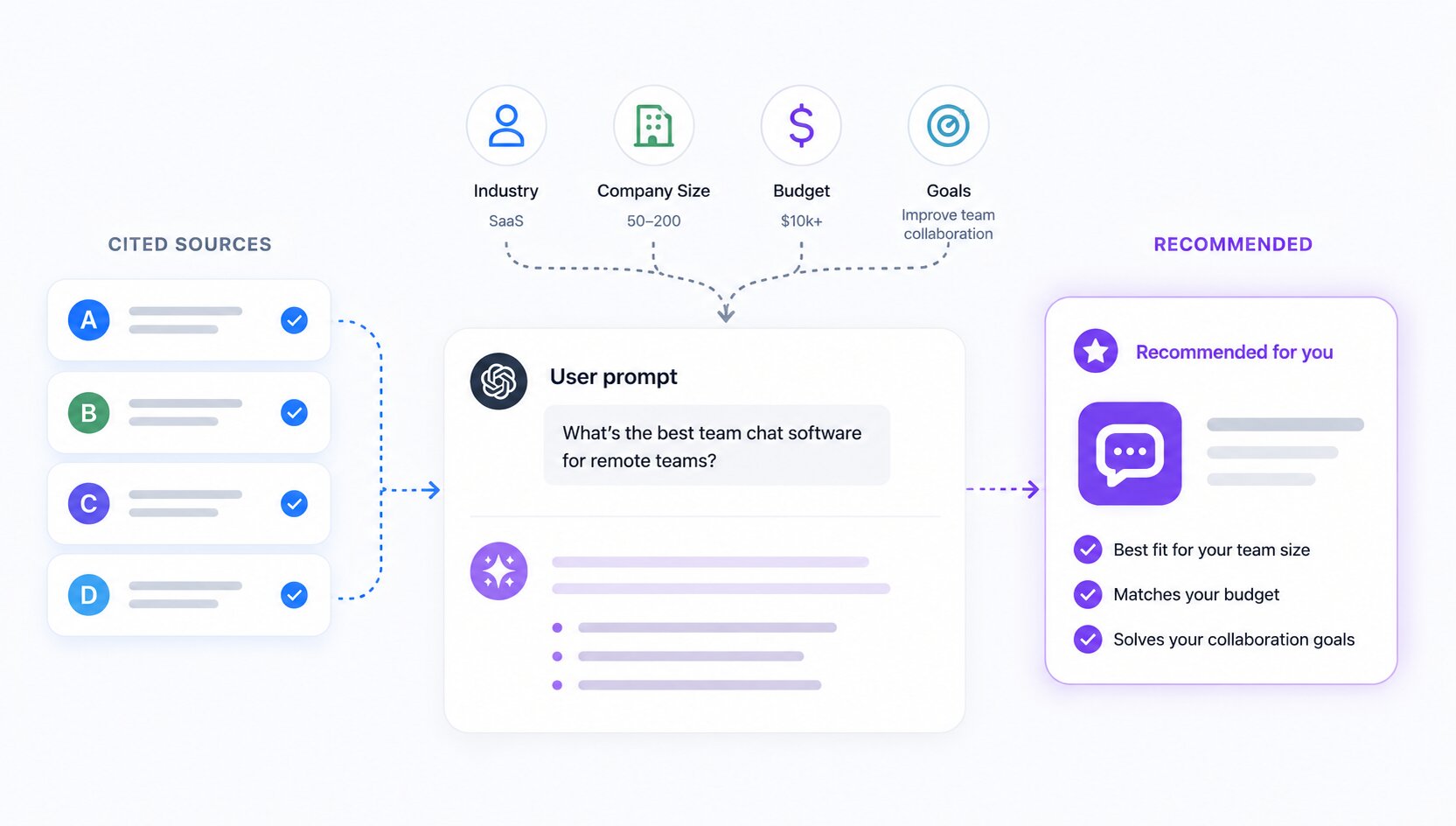
When ChatGPT generates a response, it factors in everything it knows about that user: their industry, company size, budget, tools they’ve used before, goals they’ve mentioned in past conversations.
We call this the difference between the literal prompt and the effective prompt. The literal prompt is what they typed. The effective prompt is what ChatGPT actually uses to generate the answer, and it can be the equivalent of a thousand-word brief on that person’s specific situation.
We cover this idea in more detail here.
This is why the old SEO mental model of “prompts as keywords with search volume” doesn’t translate to AI search. The personalization is deep enough that in a meaningful sense, every user’s effective prompt is unique. Truly optimizing for all of them would mean producing thousands of pieces of content targeting an infinite number of specific scenarios. That’s not a strategy.
Later, we’ll cover what to do instead.
2. Publish comprehensive, quotable content
There are variations of this advice, but the general consensus is that if you publish in-depth content that covers a topic thoroughly, fill it with statistics, and format it correctly, you’re giving LLMs both the authority signals and the citable material they need to surface your brand.
We agree that in-depth content is the right call. That’s been our philosophy for years.
But the version of “in-depth content” that gets passed around in GEO advice is typically vague and missing important points because the advice is focused on getting citations, not on getting recommended as a brand.
Most importantly, almost none of it tells you to write about your product, which is the most important part of a good LLM SEO strategy. So while in-depth content is good, if it’s on top-of-funnel topics (not related to products), LLMs may cite it. But it won’t help your cause of getting recommended as a product or solution by LLMs.
Now, if you do write about product-related, bottom-of-funnel topics, then yes, writing in detail matters because buyers describe their situations to LLMs in great detail. Someone using Google types “best project management software.” Someone using ChatGPT might explain that they’re running a 12-person remote engineering team, their current process is a spreadsheet, they need GitHub and Slack integrations, their budget is around $500 a month, and they’ve tried Asana and found it too rigid.
The LLM takes all of that rich context into account and matches it against everything it knows about available solutions. The solutions it recommends will be ones it thinks can help that user’s highly specific pain points. So, you need to provide LLMs with content that helps make the connection between specific use cases, pain points, and your product or service.
One note before moving on. Original data and specific customer outcomes make good content better, and they give LLMs concrete, verifiable material to draw from. But statistics are a layer on top of a good content strategy, not a substitute for one.
Statistics embedded in top-of-funnel explainers don’t produce brand recommendations. Statistics that help an LLM explain why your product is the right fit for a specific buyer, inside detailed BOF content, do.
Is talking about your product penalized by LLMs?
There’s a widespread concern that writing specifically about your product hurts AI visibility, that LLMs prefer neutral editorial content and deprioritize anything that looks promotional. In our experience, that’s just not the case.
We always put our clients first in listicles and spend way more time going into detail about the product and how it solves specific pain points than any other competitor on the list. Our clients continue to report getting leads from ChatGPT and other LLMs.
You read more about it here: Self-Promotional Listicles Aren’t the Problem. Bad Content Is
3. Add llms.txt to your site
llms.txt is a file proposed in 2024, similar in concept to robots.txt, intended to give AI systems a curated guide to your site’s most important content. A number of SEO tools added support for generating it, and several widely read publications recommended it as a way to improve how LLMs index and cite you.
We, and others, have tested this, and it makes no measurable difference in AI visibility. Plus, no major AI platform has publicly confirmed they use llms.txt in any meaningful way. A study analyzing 300,000 domains found no correlation between having an llms.txt file and AI citation frequency. Even Squirrly, an SEO tool that added llms.txt support specifically because users requested it, was transparent about what they found, saying there’s “currently zero proof that it helps with being promoted by AI search engines.”
This tactic is alluring because it gives you something concrete and quick to do, but there’s little to no evidence that it actually does anything. The real path to LLM visibility is the harder work of building brand authority and writing detailed content about your product.
4. Use schema markup and structured data
Schema markup (FAQ schema, HowTo schema, Organization markup) is commonly recommended as a way to help LLMs parse your content structure and signal authority. The argument is that structured data makes your content easier for AI systems to extract and understand, improving your chances of being cited.
As we covered above, this misses the point. Schema may be worth implementing eventually as part of general site hygiene, but as far as we’re aware, it doesn’t move the needle on AI recommendations and shouldn’t be prioritized over product-specific content. Similar to llms.txt and some of the other items on this list, even if it did work, it’s simply a method of helping LLMs better understand the content on your site, not a way to expose your site to LLMs in the first place.
5. Rewrite headings as questions and add FAQ sections
Many guides recommend rewriting H2 headings as questions and adding FAQ sections to articles. The reasoning is that LLMs process conversational, question-formatted content more naturally than keyword-style headings, and that FAQ structures provide clean, extractable answer blocks that are easy to cite.
However, LLMs don’t need easy-to-read content the way a casual human reader might.
They can sift through dense, unformatted information more capably than most people, and our client results back this up. The content we produced for Constitution Lending, for example, is long, dense material because that’s what the topic calls for. But it appears in the top three AI recommendations for over 50 bottom-of-funnel prompts across ChatGPT, Perplexity, and Google AI Overviews, and none of it relies on FAQ sections or question-formatted headings.
Formatting choices might help give LLMs something to cite, but again, conversions are the end goal, not citations. If you have time to invest in improving your content, use it to expand your coverage of product-specific topics rather than reformatting existing headings.
6. Get mentioned on Reddit and third-party sites
Getting your brand mentioned on community platforms like Reddit and Quora is widely recommended based on the premise that LLMs pull heavily from user-generated content. There’s also a more general assumption that there’s a list of domains LLMs go to for nearly every search.
We ran the numbers on this. In our study analyzing over 100 prompts across five industries, we found that 86% of LLM citations came from industry-specific domains (often the vendors’ own blogs), while generic sites like Reddit and Wikipedia were cited only 16% of the time.
The assumption that there’s a universal list of high-value domains that applies to every business just isn’t how it works. When someone asks ChatGPT for the best dispatch software for trucking companies, it’s not pulling from Reddit — it’s searching for sources that are actually relevant to that query.
The broader version of this advice is a “be everywhere” digital PR push — the idea that you should get your brand mentioned across as many channels as possible so LLMs encounter it frequently. That may actually work because the more your brand name is mentioned (particularly in association with your product space or vertical), the higher the chances that LLMs will know your brand and associate it as a credible solution in your space. But a “be everywhere” strategy is expensive and time-consuming, something most brands can’t afford.
Below, we cover how to get more specific and target the third-party sources that are actually important for your brand.
7. Build E-E-A-T signals and author credentials
A widely repeated recommendation is to strengthen E-E-A-T signals (Experience, Expertise, Authoritativeness, and Trustworthiness). In practice, this usually means adding named authors with stated credentials, including expert review notes on content, and producing material that demonstrates firsthand experience rather than generic research.
This is directionally right, but the mechanism is still Google. E-E-A-T signals help you rank in traditional search, and because LLMs find your content through web searches, better Google rankings increase your LLM visibility. LLMs likely aren’t independently evaluating your author bio and deciding to trust your content more because of it. The credibility signal runs through rankings.
One of the main ways we address this in our own client work is by conducting in-depth interviews with product and sales teams before writing anything, extracting the specific features, differentiators, positioning, and customer outcomes that make each product distinct. That product knowledge is what lets LLMs use as content to match brands to buyers. When ChatGPT recommends a client using language that closely mirrors what’s on their site, it’s because the content taught the LLM specifically when and how to make that recommendation.
8. Optimize for Bing
This one is for ChatGPT specifically, since it’s widely understood that Bing and ChatGPT have a tight relationship. The idea is that since ChatGPT uses Bing for web search, you need to appear on Bing, not just Google.
We looked at this directly in our fan-out query study. We analyzed 100 buying-intent prompts and compared ChatGPT’s cited sources against both Google and Bing SERPs. Only 8% of citations appeared in Bing but not Google, meaning if you’re ranking on Google, you’re already capturing almost all of the search-driven ChatGPT visibility that Bing would add. Optimizing specifically for Bing has minimal marginal value.
However, submitting your sitemap to Bing Webmaster Tools isn’t much work. Just don’t expect it to be the quick fix everyone wants.
What We Recommend Doing Instead: Prioritized GEO
We’ll briefly cover the strategy we use for clients here, but if you want a more in-depth explanation, read this article or reach out to us.
Tier 1: Owned BOF content that ranks on Google
Owned content is the foundation of any AI search strategy, for a few reasons:
- You control the narrative. Your site is where you can go as deep as you want on the specific features, pain points, ideal customers, and competitor differentiators that LLMs need in order to match you to a buyer’s situation. You don’t get that kind of depth on a Reddit thread or a third-party roundup.
- It doubles as SEO. Traditional search still drives more traffic than LLMs for most businesses, and it’s the foundation of Google AI Overviews. Producing BOF content to rank on Google gets you both inbound channels in one effort.
- Less update risk. If your AI SEO strategy relies on showing up in one or two third-party sources, you’re one algorithm change away from losing your visibility. That’s exactly what happened when ChatGPT quietly de-prioritized Reddit in September of 2025. Your own domain is part of the bulk of the internet LLMs pull from and is much harder to “update away.”
- It’s easier to execute. Most companies already know how to produce a blog post for a keyword. Very few know how to earn placements reliably in industry publications or Reddit threads. Owned content is the faster, cheaper starting point for most teams.
It’s tempting to default to a keyword list (the way traditional SEO strategies always have), but that falls short in AI search, where users describe highly specific, context-rich situations no keyword list can fully anticipate.
The way we think about it is a topic map: a coordinated set of product-specific content covering every angle that matters for your business, including your categories, competitors, use cases, target personas, and the specific pain points your product solves for each.
You can read more about topic-based GEO here: Topic-Based GEO: A Content Strategy that Gets LLMs to Recommend Your Brand
This matters partly because it gives LLMs enough to match you against the personalized queries real users are asking, and partly because it builds the kind of domain-level topical authority that shows up in AI responses even when a specific page isn’t ranking. In our fan-out query study, for example, the overlap between ChatGPT’s cited sources and Google SERPs jumped from 27% to approximately 50% when we counted domain-level matches rather than exact URLs.
Tier 2: Off-site brand mentions on sources LLMs actually cite
Rather than targeting third-party sources that are frequently mentioned overall, identify the specific articles LLMs are already citing when they answer buying-intent queries relevant to your business. Then do outreach to get your brand included.
This amplifies your Tier 1 foundation with third-party validation from the exact sources AI tools are treating as authoritative for your category.
Tier 3: On-site tactics
Tactics like schema markup, llms.txt, FAQ sections, question-formatted headings, and Bing verification live here. As we covered above, some are worth implementing as low-effort hygiene. None should be prioritized until Tiers 1 and 2 are solid.
Measuring success
Attribution in AI search is messy right now, and the tooling is still catching up to how large language models actually operate. Anyone offering a clean, precise picture of AI-driven revenue is oversimplifying. That said, here’s an overview of some common methods and what we use for our own clients.
Manual queries
Manual querying is a starting point, but it’s not the most effective. Identify the BOF prompts that matter most to your business (the questions a buyer would ask an LLM when evaluating solutions like yours) and query ChatGPT, Claude, Perplexity, Gemini, and Google AI Mode directly. Note whether your brand appears, where in the response you’re mentioned, and how you’re described.
It’s free, gives you a ground-level read on where you stand, and helps you prioritize which topics need more content investment.
The limitation is that LLM responses are inconsistent, so a handful of manual checks won’t give you a statistically reliable picture.
Traqer
Traqer is the tool we built to help measure AI visibility more reliably. Rather than tracking a single blended AI visibility percentage (which is a misleading metric, as we’ve written about in detail), Traqer lets you define the specific topic areas and prompt categories that matter to your business. It also tracks your brand’s visibility across ChatGPT, Perplexity, and Google AIOs per topic and per platform separately.
Your visibility on “SaaS content marketing agencies” and your visibility on “content marketing for fintech companies” are completely separate signals requiring completely separate strategies. Averaging them into a single number tells you nothing useful. Traqer keeps them separated so you know where to focus.
GA4 Referral Traffic
GA4 referral traffic gives you directional data on AI-driven traffic. A regex filter that captures referrals from AI platforms provides a useful trend line, but it undercounts referrals significantly because much AI-influenced traffic arrives through other channels or goes unattributed entirely.
Someone who found you through a ChatGPT recommendation might click through to your site days later via a direct visit or a Google search, and that attribution never shows up in your referral data. But if the number is growing over time alongside your content output, that’s a positive directional signal.
This is one area where traditional SEO tooling like Semrush, Ahrefs, and Google Search Console is still catching up. Many of them are adding new AI tracking features, but no one is able to fully capture how leads move from an AI chatbot conversation to your site.
Asking directly
Asking prospects directly is probably the most underrated signal available. “How did you hear about us?” in your sales process or onboarding flow regularly surfaces AI search before any analytics tool does.
We hear this from clients consistently — leads arrive describing a multi-turn ChatGPT conversation that ended with a recommendation to try the product. That attribution never appears in GA4. But it shows up when you ask.
Focus on the overall trajectory across these signals rather than any single metric. The goal isn’t perfect attribution. It’s a clear directional read on whether the strategy is working.
Join the Grow and Convert Newsletter
Get our marketing ideas emailed weekly.
Explore Articles By Categories


Explore our Videos