Starting in mid-2025, we noticed a sharp interest in marketing departments more interested in AI SEO than traditional SEO. At the same time, our clients also started asking about how they should be thinking about visibility in AI search like ChatGPT, Perplexity, Google AI mode, etc.. Personally, for Grow & Convert, we started noticing an increase in the number of new leads reaching out asking about help with AI search visibility (aka GEO or AEO).
This rise in demand for AI search visibility has created a flood of agencies and consultants offering “AI SEO” or “GEO” services. What we’ve noticed is that many of these marketers are pushing tactics like adding llms.txt files, FAQ schema, rewriting headings as questions, and running marketing campaigns on Reddit.
In our experience, most of these tactics are unproven or have actually been proven (via our testing or others) to not make any measurable difference in AI search visibility. As a result, it’s our strong belief that these short-term tactics shouldn’t be your top priority if you really want to be mentioned by ChatGPT, Perplexity, Google AI Overviews, and other LLMs.
We’ve spent the last year studying what actually drives AI visibility for SaaS and B2B brands. We analyzed 400+ keywords across 16 of our own clients, built our own AI tracking tool (Traqer.ai), and developed a framework called Prioritized GEO to separate what works from what doesn’t.
So, to help you find the right agency for AI search, we’re going to share what we’ve learned and the key factors you should consider when evaluating AI SEO agencies.
Then, we’ll share how we’ve addressed each of these factors at our agency. And since most companies like to evaluate multiple options, we’ll cover other AI SEO agencies we’ve seen that are publishing actual strategies and studies to improve AI visibility, not just pushing tactics to justify higher retainers.
Factors to Consider When Choosing the Best AI SEO Agency for Your Business
To begin, we’ll cover the 4 biggest factors you need to consider when evaluating AI SEO agencies:
- Factor 1: Do they understand the connection between traditional SEO and AI visibility?
- Factor 2: Do they prioritize bottom of funnel content over top of funnel?
- Factor 3: Is their content process human-led or AI-led?
- Factor 4: How do they measure AI visibility?
Let’s look at each of these in more detail.
Factor 1: Do they have a clear AI optimization strategy?
This is the most important factor because it determines whether an agency actually understands how AI search works or is just capitalizing on the hype.
As we said above, there’s a flood of GEO tactics being promoted across the internet right now, like adding llms.txt files to your site, rewriting your headings as questions, adding content summaries or key takeaways, creating FAQ sections on every page, and implementing structured data markup specifically for AI.
The problem is that these are random tactics, not a strategy.
If an agency’s approach is creating content without a clear framework, then sprinkling on some FAQs or changing headings to questions and calling that their GEO strategy, they don’t have a strategy. They’re just throwing tactics at the wall.
Similarly, if they’re doing their normal content process and then using some AI visibility tool to report a single visibility percentage to you, as if that number alone constitutes a GEO strategy, it means they fundamentally don’t understand what drives AI visibility.
Trying random tactics isn’t a strategy. Doing business as usual and then reporting on a single metric isn’t a strategy either.
Instead, look for an agency that can clearly separate tactics from strategy. That means they understand prioritization, and specifically, they know what doesn’t matter so they can focus on what actually does.
Strategy is an overarching framework that determines which tactics deserve your time and budget, and which ones are distractions. A real AI search optimization strategy explains why certain approaches work and why others don’t, based on how LLMs actually gather and process information.
In fact, knowing what doesn’t matter is often the clearest indicator that an agency has developed a thoughtful strategy rather than just being willing to try anything that sounds promising.
You can see what our GEO strategy looks like through our Prioritized GEO framework below. This pyramid clearly deprioritizes on-page tactics like bullet points and FAQ creation because we understand that what’s far more important is getting exposure to LLMs by showing up in the web searches they perform when generating responses.

This kind of strategic thinking, where an agency can explain not just what they do but what they deliberately don’t do and why, is what separates real AI optimization expertise from agencies that are just repackaging their existing services with AI buzzwords.
Factor 2: Do they prioritize bottom of the funnel content over top of the funnel?
Most traditional SEO agencies prioritize top of the funnel topics because they have the highest search volume. They do keyword research using SEO tools, sort by volume, and build content calendars around the biggest numbers. The assumption is that with enough traffic, conversions will follow.
But generating more traffic doesn’t automatically result in more leads. We’ve been writing about this since 2018 when we published our Pain Point SEO framework. Top of the funnel visitors usually aren’t looking to buy. They want a definition or a quick answer, and then they leave.
Conversion rates on this type of content are minimal compared to bottom of the funnel content where the reader is actively researching solutions.
In our experience, bottom of the funnel keywords convert 10x to 25x better than top of the funnel. We’ve documented this across multiple case studies, including our Geekbot case study, where we showed the difference in conversion rates between content targeting different parts of the funnel:
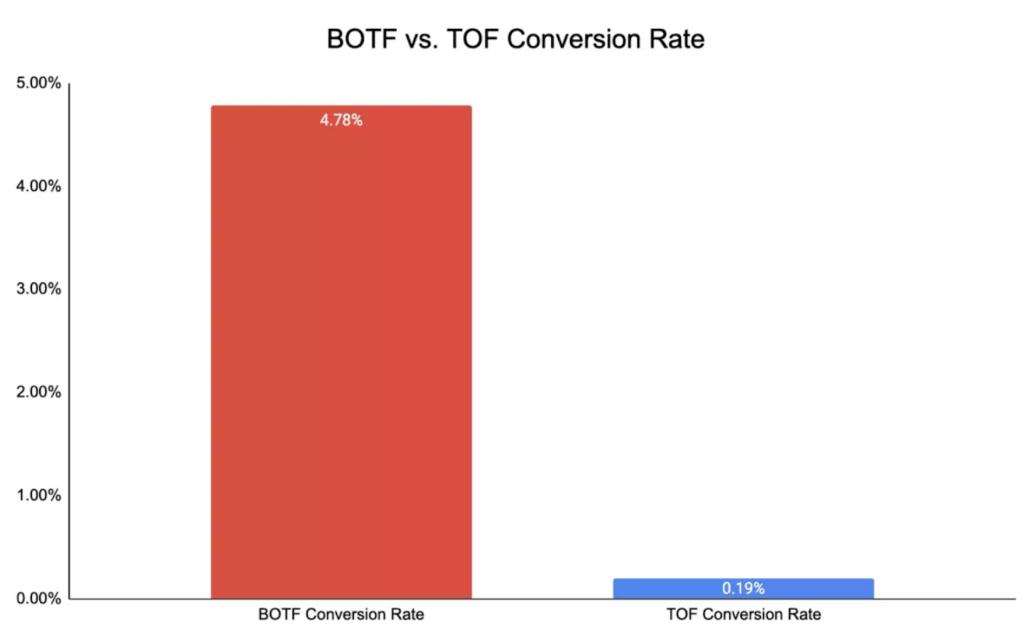
So even in traditional SEO, we’ve argued for years that companies should focus first on bottom of the funnel, pain-point-focused keywords, then work their way up. If an agency is still building content calendars filled with “What is X” and “Beginner’s Guide to Y” posts, they’re operating on an outdated playbook.
But now, in AI search, this becomes even more critical.
Top of the funnel content doesn’t just have low conversion rates in AI search. It drives almost no traffic. When you ask ChatGPT, “What is content marketing?”, it just gives you the answer. No links. No sources. No reason for the user to click through to your site. Google is heading in the same direction with Google AI overviews, answering the query and occupying most of the top fold in the search results page.

In contrast, for bottom of the funnel queries or prompts, LLMs do 2 things differently.
- They actually list brands. For example, when someone asks ChatGPT “What’s the best project management software for a small marketing team?” or “What are the best alternatives to HubSpot?”, ChatGPT, for example, literally lists tools in its outputs. That’s because it knows that the user is actively looking for product recommendations. Your goal is to be one of these recommended brands or products.
- They cite sources (and link to them) a lot more often than for TOF prompts. Note below how each tool has a link associated with it. We didn’t have to even click “web search” to do this, ChatGPT just does that automatically.

Factor 3: Is their content writing process expert-led or AI-led?
A lot of agencies have started using AI to write content for clients because it allows them to produce more content at a faster pace and lower cost. But 100% AI-generated content is too generic to stand out, and if done at scale, it can also be impacted by Google’s scaled content abuse policies.
LLMs are trained on what already exists online, and they’re programmed to produce responses that match the patterns in their training data. They find the most likely word that goes after the word they just wrote, over and over again. The result is content that sounds articulate on first read but says the same thing as everything else, with no original argument, no unique perspective, and no reason for an LLM to recommend it.
We wrote about this back in 2016 and called it Mirage Content. On the surface, it looks well-written. But when you actually dissect the arguments, it’s just stating generic points in different ways. AI content is essentially Mirage Content 2.0, making it easier to produce undifferentiated content at scale.
If an agency uses AI to generate your articles, they’re just regurgitating the average of what already exists. Generative engines have no incentive to recommend content that looks and sounds like everything else on the web.
The agencies doing this well use a human-led process. They interview subject matter experts inside your organization to understand your product, your differentiators, and your point of view. They create content that’s original, specific to your company, and worth citing. This is the kind of content that gets recommended by LLMs.
To be clear, we’re not against using AI in the writing process. It can be useful for research, creating briefs, fleshing out sentences, and other parts of the workflow. But if you want to produce content that actually stands out, you need to spend a lot of time providing the prompts and details that are specific to your business. That specificity is what makes content worth recommending. The agencies that just feed a topic into ChatGPT and publish whatever comes out are producing content that looks and sounds like everything else on the web.
When we asked ChatGPT for the best SaaS marketing agencies, it knew we specialize in content strategies that drive demos and signups, not just traffic. It pulled that information directly from the content we’ve published on our site.
If the content on your site has the same copy, benefits, and use cases as every competitor in your space, your SEO strategy will also be lost in the shuffle.
Factor 4: How do they measure AI visibility?
Traditional SEO tools can tell you where you rank on Google. They can show you traffic, impressions, and click-through rates, but they don’t know you if you’re being mentioned in ChatGPT, cited by Perplexity, or appearing in Google AI Overviews.
This is a real problem because these are different outcomes. You can rank on page one of Google and still not show up when someone asks ChatGPT for recommendations. You can appear in Perplexity but not in Google AI Overviews. Without a way to track this, you’re blind to whether an agency’s work is actually producing AI visibility.
Some agencies have started using AI visibility tools to track this. But there’s a problem with how most of them use these tools.
A lot of AI visibility tools work by generating a list of prompts and telling you which ones you’re “ranking” for. But these prompts are often random and made up by the tool. You have no idea if anyone is actually typing them into ChatGPT, or if they’re even relevant to your business.
For example, we’ve seen many AI visibility tracking tools generate prompts that have nothing to do with what a company actually sells or the topics their customers care about. That’s letting the tool lead the strategy instead of the other way around.
In contrast, a good AI SEO agency will decide which topic areas matter for your business first, then measure visibility for prompts related to those topics. They decide the prompts and topic, not some tool. You and the agency need to agree on what’s important, and then track visibility against that. Otherwise, you’re just looking at data on random AI generated prompts that your real customers may or may not ever be searching.
We start by identifying the bottom of the funnel topics that matter for each client, then track visibility across multiple prompts related to those topics in ChatGPT, Perplexity, and Google AI Overviews week over week. This lets us see what’s actually working and adjust accordingly.
When evaluating agencies, ask them how they measure AI visibility. If they don’t have a clear answer, or if they’re just pointing to traditional SEO metrics, they’re not set up to deliver on what they’re promising.And if they’re using a tool but can’t explain how they decide which prompts to track, they’re letting the tool lead them instead of leading the tool.
Now, let’s walk through how our agency addresses each of these factors, including our AI visibility strategy, content and promotion processes, and the research we’ve published on what actually drives results in AI search.
Then, since most companies like to evaluate multiple options, we’ll profile other agencies that are publishing real strategies and data around AI visibility.
Best AI SEO Agencies
Here are the best AI SEO agencies to consider, starting with our own. For each, we’ll explain their approach, what they specialize in, and how they address the factors above.
1. Grow and Convert

Grow and Convert is our SEO and GEO-focused content marketing agency, and we’ve spent over 10 years specializing in content strategies that drive leads and revenue for B2B companies, not just traffic. Unlike agencies that optimize for top of the funnel metrics, we focus on bottom of the funnel content that generates qualified leads and produces measurable ROI.
We’ve done this for years with traditional SEO and over the past year, we’ve extended this approach to AI search. We developed our Prioritized GEO framework, built Traqer.ai to track AI visibility the right way, and published the research we referenced throughout this article, including our study of 400+ keywords that showed a 77% correlation between Google rankings and AI mentions.
We work with companies at various stages, from startups looking to build their first scalable content strategy to growth-stage companies that are looking to expand their visibility in both traditional search and AI engines.
Our approach is built around the four factors we outlined above, and we’ve documented our entire process publicly through detailed case studies and research.
Here’s how we address each factor:
1. Our Strategy Is Built on Exposing Your Brand to LLMs (By Showing up in Web Searches Those LLMs Conduct)
Our Prioritized GEO framework prioritizes getting exposure to LLMs first, (Tiers 1 and 2) and only then testing on site tactics (Tier 3) which are only meant to help LLMs better undrstand your content (less important).
The foundation of our pyramid is Tier 1 – Owned Content that Ranks on Google. This is based on the fact that SEO is the #1 way to influence LLM outputs. LLMs search the web to supplement their responses, a process known as grounding. They do this very often, in particular, for bottom of funnel or product related prompts, which are the only prompts that really matter for GEO, as we established above. And the absolute most efficient way to get exposure to LLMs via traditional SEO is to have content on your site that is aimed at ranking for SEO keywrods that are related to the topics you want AI visibility for.
Related to this is Tier 2 – Off-Site Mentions. This is getting exposed to LLMs via other sites’ content that is ranking on Google. We do this for clients through citation outreach, where we see what sites are ranking for the prompts you care about and reach out to them to try to get placement in their articles.
Only after those have been exhausted do we test on-site tactics (Tier 3).
This has resulted in great AI visibility for our clients like the following for a client in the innovation management software space:

Or workflow management:

2. We Prioritize Bottom-of-Funnel Content That Gets Recommended by AI
We’ve been focused on bottom-of-funnel content since 2018, when we published the Pain Point SEO framework. We argued that companies should focus first on keywords with high buying intent, then work their way up the funnel.
In our experience over 10 years of working with 100+ clients and tracking conversion rates across thousands of keywords, we’ve seen bottom-of-funnel keywords convert 10x to 25x better than top of the funnel.
In AI search, this strategy is even more important. Top-of-funnel queries don’t drive any traffic because ChatGPT just answers them directly. Bottom-of-funnel queries are where LLMs actually recommend products and services.
When someone asks ChatGPT for the best software in your category or alternatives to a competitor, your goal is to be one of the brands it names. Our content strategy is built around making that happen.
3. We Use an Interview-Based, Human-Led Writing Process
We don’t produce articles by feeding topics into AI or having writers do Google research and regurgitate what’s already ranking. Instead, our writers start by interviewing people inside your organization who have the expertise to speak on the topic and explain how your product is differentiated.
We’re not talking about grabbing a few quotes to throw into an article. We’re talking about hour-long recorded interviews where we shape an entire article around the viewpoint and knowledge of an expert inside your company. This creates content that’s original, specific, and worth citing. Here’s a case study showing how this even lets us produce detailed technical content without prior domain expertise.
This matters for AI visibility because LLMs recommend brands based on how clearly their content articulates who they serve, what pain points they solve, and how they’re different. Generic content that sounds like everything else on the web doesn’t get recommended.
4. We Track AI Visibility with Traqer.ai
Traditional SEO tools can’t tell you if you’re being mentioned in ChatGPT or appearing in Google AI Overviews. And most AI visibility tools focus on prompts they randomly generate and hide the details in single visibility % numbers. This is not a proper AI search strategy, which is why we built our own tool, Traqer.ai.
Traqer is based on topics, not prompts. Since none of us know what users are actually typing into ChatGPT, Traqer flips the script and gets you, the brand, to first decide what topics matter to you and then it comes up with multiple prompts that get at that topic in different angles.
You can then see how often your brand gets mentioned across a variety of prompts on that topic. If you’re mentioned every time, you’re likely to be mentioned when a real user asks about that topic. If you’re hardly mentioned at all, you have work to do for visibility on that topic.
We also use Traqer to identify which domains are being cited most frequently for queries relevant to our clients’ industries. This informs our citation outreach, so we’re targeting the sites that AI tools are actually pulling from.
Our Content Promotion Process
To drive traffic to your articles as we wait for them to rank in organic search, we use a three-pronged promotion strategy:
- Paid Ads (short-term traffic): We use paid ads to promote content using cold audiences and lookalike audiences based on your existing customer list or website visitors. We test channels like Facebook, LinkedIn, and Google Ads based on where we’re most likely to reach your audience.
- Manual Link Building (long-term traffic): When certain pieces start ranking, we strategically build backlinks to boost them to page 1 or the top of page 1 in Google.
- Citation Outreach (AI visibility): We track which sources AI tools are citing when answering queries relevant to your industry, then work to get your content mentioned by those same sources. This ensures that when AI tools answer questions in your space, they’re more likely to cite content that mentions your brand.
We do all of the above from our own budget, with no extra spend for our clients.
Case Studies and Research
Here are some of the case studies and research we’ve published that demonstrate our approach:
- Does Google SEO Affect LLM Optimization? We Analyzed 400+ Keywords to Find Out
- Prioritized GEO: How Brands Should Focus Resources on AI Visibility
- AI Search: How Content Strategy Needs to Change
- How we scaled Leadfeeder’s signups to over 200/month
- Scaling SEO traffic from 920 to 14,577 sessions in 6 months (Circuit Case Study)
If you’re interested, you can learn more about our agency, pricing, and reach out about working with us here.
2. Siege Media
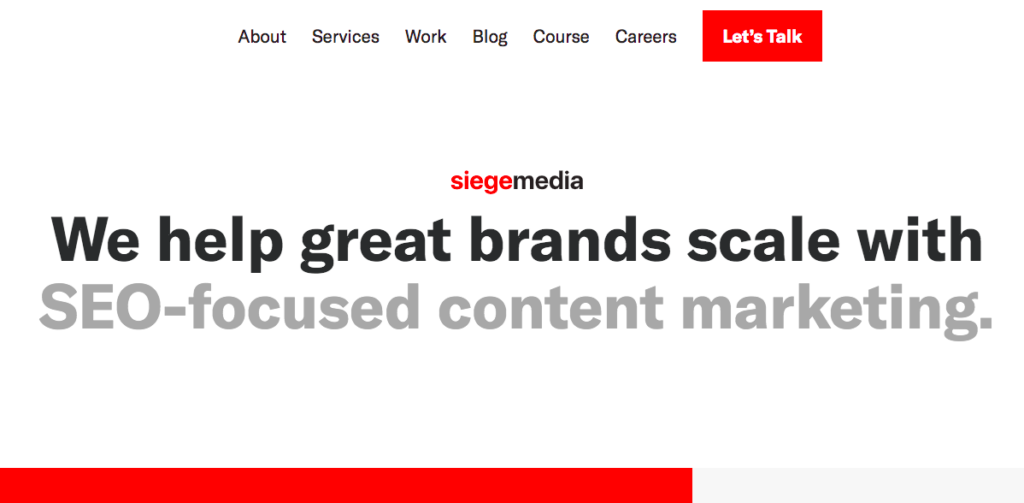
Siege Media is an SEO-focused content marketing agency founded in 2012 that has expanded into GEO and AEO services. They specialize in content creation, link building, and digital PR, with an emphasis on creating design-heavy, interactive content assets.
They offer comprehensive services, including content strategy, SEO, GEO (Generative Engine Optimization), link building, digital PR, technical SEO, and graphic design. They are mostly known for creating unique data studies and interactive content like quizzes, maps, and calculators that earn backlinks and citations from authoritative sources.
Just like our agency, their GEO methodology centers on creating owned assets. Their research found an 83% lift in traffic value when content includes unique data, and they report that companies publishing proprietary data gain 45% more AI citations than those using traditional content formats. They also have a proprietary tool, DataFlywheel, to automatically refresh existing content with new data and updated information on a quarterly basis.
For AI visibility tracking, they use third-party tools like Profound and Knowatoa to monitor brand mentions across ChatGPT, Perplexity, and Google AI Overviews.
They’ve worked with companies including Zapier, Figma, Zendesk, Shutterstock, and Zillow.
Visit their site for more information.
3. iPullRank

iPullRank is a New York-based enterprise SEO agency known for its technical SEO services and a data-driven approach to search. They offer Generative Engine Optimization services through their proprietary framework called Relevance Engineering.
They provide comprehensive services, including technical SEO, content strategy, audience research, digital PR, and GEO. Their work focuses on enterprise and mid-market clients with complex sites, particularly in finance, media, and e-commerce.
Their GEO methodology is centered around information retrieval, content strategy, UX, and AI to optimize content for visibility across traditional and AI-powered search platforms. The framework focuses on understanding how LLMs retrieve and synthesize content, including concepts like query fan-out, passage retrieval, and vector embeddings. They’ve published a comprehensive resource called The AI Search Manual that covers their entire approach to GEO, from strategy to measurement.
iPullRank emphasizes structuring content so it can be retrieved and cited by AI systems, not just ranked in traditional search. They focus on semantic chunking, entity optimization, and creating content that LLMs can easily parse and include in generated responses.
They’ve worked with companies including LG, DocSend, and Citi and report delivering $2B+ in results across their client base.
Visit their site for more information.
4. GrowSERP

GrowSERP is an organic growth marketing agency based in Canada that helps B2B and SaaS companies generate leads and revenue through editorial content, programmatic SEO, and product-led SEO strategies. The agency prioritizes bottom of the funnel keywords and topics and focuses on scaling traffic, authority and qualified leads.
Their content production model relies on expert writers who specialize in specific industries rather than generalist writers who research a topic before writing.
On the AI visibility side, GrowSERP offers AI search optimization services and tracks client visibility across AI platforms using their own proprietary internal tools. They combine their traditional SEO capabilities in content writing, technical SEO and link building, and position themselves as a full-service organic growth partner for companies looking to show up in both traditional and AI-driven search.
GrowSERP primarily works with B2B companies and SaaS platforms who want to scale their traffic and customer acquisition.
Visit their site for more information.
5. Spicy Margarita

Spicy Margarita is a UK-based SEO and content agency that works with B2B services and SaaS companies. They’ve built specialist services in generative engine optimization alongside their core SEO offering.
They offer SEO strategy, content production, digital PR, and GEO services. The agency is intentionally small, working with no more than 10 clients at a time, and positions itself as an extension of in-house marketing teams rather than a traditional agency.
Like our agency, Spicy Margarita focuses on bottom-of-funnel strategies designed to drive revenue rather than traffic. Their GEO approach centers on making brands visible when buyers are actively researching solutions in LLMs like ChatGPT, Claude, and Gemini. They run AI SEO audits and build playbooks for getting brands cited in AI-generated answers.
Founder Ben Goodey is active in the GEO space, sharing experiments and strategy breakdowns on LinkedIn and running How the F*ck, an SEO publication with case studies and interviews. The agency emphasizes ongoing experimentation in AI SEO as the field evolves.
They’ve worked with Series A and Series B tech startups, financial services companies, and other fast-growing B2B businesses.
Visit their site for more information.
6. Omniscient Digital

Omniscient Digital is an organic growth agency founded in 2019 that helps B2B software companies turn SEO and content into growth channels. Their leadership team includes former growth leaders from HubSpot, Shopify, and Workato.
They offer comprehensive services, including SEO strategy, content production, content optimization, technical SEO, programmatic SEO, link building, digital PR, and Generative Engine Optimization (GEO).
Their GEO approach focuses on making content that LLMs can retrieve, understand, and cite. They emphasize building authority signals through backlinks and PR placements and creating structured content that’s easy for AI systems to parse, and positioning brands as trusted sources across third-party sites that LLMs reference.
Omniscient publishes research on AI search trends, including studies on how SEO roles are changing with AI search and how retrieval-augmented generation (RAG) influences which content gets surfaced by LLMs.
They’ve worked with companies including Jasper, Loom, HotJar, Lokalise, and GatherContent.
Visit their site for more information.
7. Omnius

Omnius is a Europe-based B2B SEO and LLMO agency that works exclusively with SaaS, fintech, and AI companies. Their approach treats GEO as an added layer to SEO rather than a separate discipline.
On the technical side, their services include AI crawler optimization, schema markup, llms.txt file creation, and reducing JavaScript to improve crawlability. On the content side, they focus on structuring content for citation, embedding what they call “citation triggers” that prompt AI systems to treat information as authoritative. They also build authority across platforms that AI engines tend to favor, including Reddit, Quora, G2, and LinkedIn.
They frequently publish research on GEO topics, including a GEO Industry Report and case studies on AI visibility experiments.
They’ve worked with companies like AuthoredUp, TextCortex AI, Zencoder, and Anna Money.
Visit their site for more information.
8. Skale

Skale is a SaaS-focused organic growth agency that has expanded into GEO services alongside their core SEO, content, and link building offerings. They position themselves around revenue metrics like MRR, pipeline, and CAC payback rather than traffic and rankings alone.
They focus on making content citable by AI platforms through structured formatting, entity-rich language, and what they describe as “passage-level optimization” since LLMs pull from specific sections of content rather than evaluating entire pages.
The agency has published research analyzing citation drivers across AI platforms, including a study of six million LLM answer snapshots that identified factors like citation density and link breadth as predictors of AI visibility.
Skale works primarily with B2B SaaS and fintech companies and has worked with companies like Maze, Rezi, Holded, Pitch, TravelPerk, and HubSpot.
Visit their site for more information.
9. Digital Elevator

Digital Elevator is a B2B content marketing agency that specializes in technical verticals, particularly healthcare, biotech, and medtech. They provide SEO-driven content strategy, content marketing, product-led SEO, UX/UI, and PR services.
They offer Answer Engine Optimization (AEO) services built around owned content optimization through product-led SEO content. They focus most on bottom of the funnel content that appeals to both search engines and LLMs.
They also get their clients featured in high-authority articles and directories that LLMs cite and use strategic PR and media placements to build the authority signals that AI models use to determine credibility. They track visibility across ChatGPT, Perplexity, Google AI Overviews, and Microsoft Copilot.
They’ve worked with companies like McKesson BPS, Solvias, Champions Oncology, and Halo Labs.
Visit their site for more information.
10. First Page Sage

First Page Sage is a San Francisco-based SEO and thought leadership marketing agency that positions itself as an early mover in the GEO space.
Their methodology centers on what they call Thought Leadership SEO, which involves ghostwriting approximately 80 pieces of content per client over 12 months. They focus on ranking the content they produce in traditional search while also meeting the technical requirements for AI citation.
They position their clients as subject matter experts which they believe is what leads AI systems to recommend the brands they work with when users ask questions in their category. The agency combines content production with technical optimization, conversion funnel setup, and tracking. They also offer online reputation management and outreach to authoritative publications as part of their broader GEO service.
First Page Sage works primarily with B2B companies in technology, healthcare, medtech, manufacturing, and professional services. Some of their notable clients include Salesforce, Logitech, Microsoft, Verisign, LinkedIn, and US Bank.
Visit their site for more information.
Want to Work with Us or Learn How to Implement Our AI SEO Strategy?
- Conversion-Focused Content Marketing for SEO & GEO: You can learn more about working with us here.
- Our Content Marketing Course: Individuals looking to learn how to grow their SaaS business with content can join our private course, taught via case studies, here. We include a lot of information and examples not found on this blog. Our course is also built into a community, so people ask questions, start discussions, and share their work in the lesson pages themselves, and we and other members give feedback. We also get on live Zoom calls about once a month and dissect members’ actual content strategies and brainstorm ideas on how we’d form content strategies for their businesses.
- Join Our Content Marketing Team: Alternatively, if this style of B2B content marketing appeals to you, consider joining our content marketing team as a writer or content strategist. We have awesome clients. We’re a remote company. We pay well. And you won’t have to stress about getting your own clients or spend a bunch of time doing outreach to get them.
Join the Grow and Convert Newsletter
Get our marketing ideas emailed weekly.
Explore Articles By Categories


Explore our Videos