Over the last 10+ years running Grow and Convert, we’ve developed a content marketing framework focused on driving qualified leads and pipeline rather than just traffic, and we’ve applied it across hundreds of B2B companies.
Of all the verticals we’ve worked in, fintech companies deal with everything a typical B2B content program deals with, plus a set of challenges that are specific to financial services, which most marketers or agencies have never had to work through.
Fintech content has to satisfy YMYL (Your Money or Your Life) standards, which means Google holds it to the highest quality bar of any content category. Fintech companies also compete for rankings against publishers like NerdWallet, Bankrate, and the content teams at major banks, all of which have domain authority that’s nearly impossible to match head-on.
On top of that, at many fintech companies, content goes through a compliance review, which slows production and limits what you can say. And the audience, whether it’s a CFO evaluating a payments platform or a consumer comparing lending products, may be skeptical of vendor content about financial products.
We’ve seen most fintech companies respond to these challenges by doing exactly what doesn’t work:
- They publish high-volume, top of the funnel educational content because those keywords have the highest search demand and feel safe from a compliance standpoint
- They avoid mentioning their product in blog content because the compliance team is more comfortable with content that doesn’t make specific claims, and
- They measure success by traffic and publishing cadence because they don’t have attribution set up to connect content to funded accounts, demo requests, or applications
In this article, we’ll walk you through how our content marketing strategy applies specifically to fintech companies and addresses each of these challenges. We’ll cover how to:
- Prioritize high-buying-intent keywords that fintech companies can actually rank for
- Produce content through expert interviews, not just online research
- Sell your product in each piece of content without triggering compliance issues
- Optimize for AI search visibility in financial services
- Set up conversion tracking that connects content to revenue
Grow and Convert is a content-focused SEO and GEO agency that works with fintech and financial services companies. If you want to hire us to handle your fintech content marketing, you can learn more about working with us here.
Step 1: Prioritize High-Buying-Intent Keywords That Fintech Companies Can Actually Rank For
Most fintech companies and marketers we’ve spoken to build their content calendars by pulling a list of keywords from Ahrefs or Semrush and sorting them by search volume. The result is a blog full of glossary-style content that large finance publishers like NerdWallet, Bankrate, and Investopedia have been ranking for years and are not easy to replace.
The problem is that most people searching for these keywords are not really ready to apply to the service, schedule a demo, or open an account.
At Grow and Convert, we take a completely different approach. Instead of sorting keywords by search volume, we look for buying intent and target keywords where the searcher already knows they have a problem and is actively looking for a product or provider to solve it. We call this Pain Point SEO, and it’s the foundation of our approach to content marketing for the fintech companies we work with.
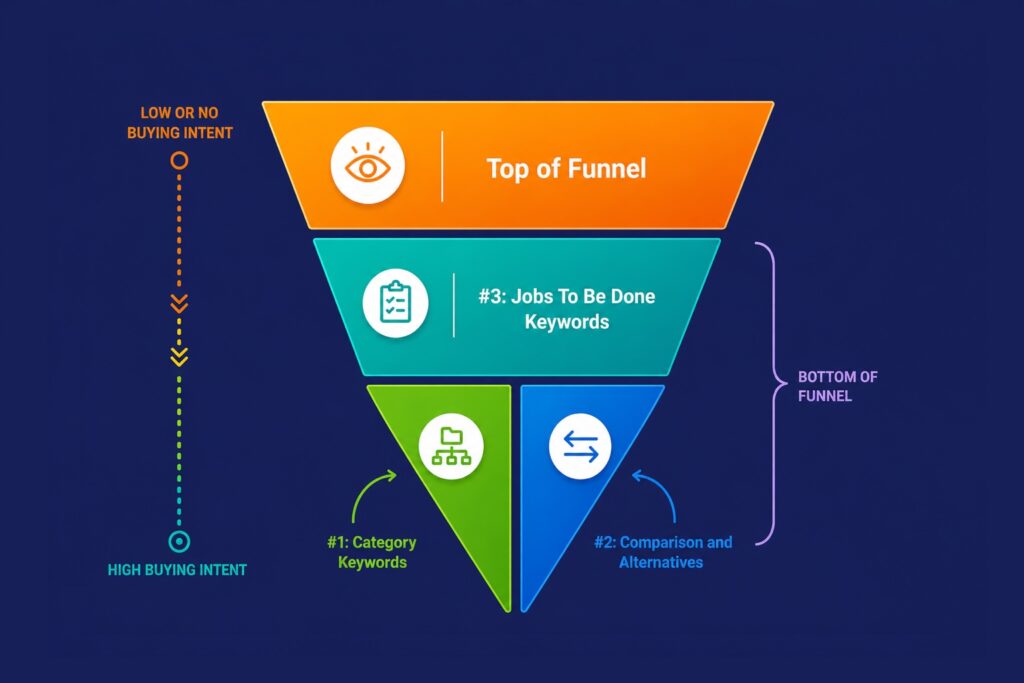
Here are the types of keywords we prioritize for fintech clients, roughly in the order we’d target them.
Category Keywords
These are some of the highest-intent keywords available because the searcher is explicitly looking for a type of product or provider. We start here because these keywords capture people who are ready to evaluate and choose a solution.
Across our clients, bottom of the funnel content targeting these types of keywords converts to qualified leads at roughly 25x the rate of top of the funnel content.
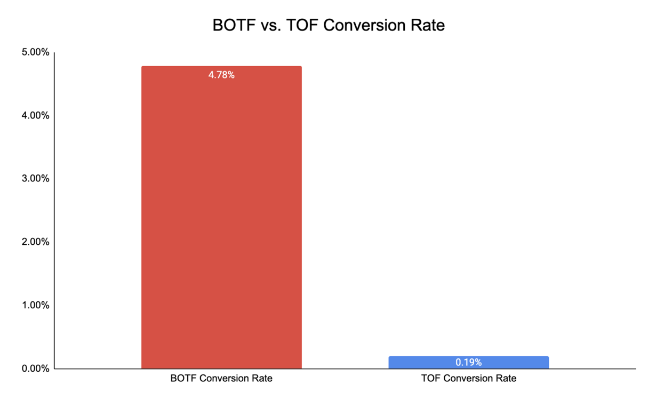
They follow patterns like “best [product type] for [audience or use case]” or “top [financial service] platforms.”
For a lending company, this means keywords like “best DSCR lenders for rental property investors” or “top hard money lenders for fix and flip.”
For a payments company, it’s “best payment processing platform for SaaS companies” or “top B2B payment automation software.” For a banking infrastructure company, it’s “best KYC compliance software” or “top banking-as-a-service platforms.”
Comparison Keywords
These are keywords where the searcher is evaluating your product against a specific competitor or looking for alternatives.
They follow patterns like “[competitor] alternatives,” “[brand] vs [brand],” or “companies like [competitor].”
According to our client data, these are some of the highest converting keywords anyone can publish.

Comparison research tends to be more thorough in fintech than in other industries because the switching costs are high.
A business choosing a payment processor or a borrower selecting a lender is making a decision they’ll live with for months or years, and the financial consequences of choosing wrong are real. That means people spend more time on comparison queries before making a decision, and content that answers those queries with genuine depth earns more trust than a surface-level feature table.
A payments company competing with Stripe might target “Stripe alternatives for high-risk merchants” or “Stripe vs [brand] for subscription billing.” A lending company might target “[competitor] alternatives for investment property loans” or compare specific rate structures and closing timelines that differentiate them from competitors.
Use Case Keywords
These keywords describe a specific scenario or application of your product. The searcher knows what they’re trying to do and is looking for the right tool or approach. They follow patterns like “how to [accomplish specific financial task]” or “[product type] for [specific situation].”
In fintech, use case keywords tend to be highly specific because financial products are applied in narrow contexts.
“How to finance a short-term rental property” is a use case keyword for a lender. “How to automate invoice reconciliation” is a use case keyword for a payments or accounting platform. “How to accept ACH payments for recurring billing” is a use case keyword for a payment processor.
What makes these different from educational keywords is that the searcher already has a specific situation in mind. They’re trying to figure out how to do something, and they’re open to a product that helps them do it.
Template and Checklist Keywords
These keywords indicate someone is looking for a practical resource to help them execute a specific task. They follow patterns like “[financial document] template,” “[process] checklist,” or “[calculation] calculator.”
A lending company might target “DSCR calculation spreadsheet” or “rental property cash flow template.” A compliance-focused fintech might target “KYC onboarding checklist” or “AML compliance audit template.” A payments company might target “payment reconciliation template” or “chargeback dispute letter template.”
These keywords work well in fintech because the audience is often looking for something they can use immediately, and the content gives you a natural opportunity to show how your product automates or simplifies the manual process the template addresses.
Pain Point Keywords
These are keywords where the searcher is expressing a specific frustration or problem. They tend to be phrased as questions or problem statements rather than product searches. They follow patterns like “why does [financial problem] happen,” “how to fix [financial issue],” or “how to reduce [cost or friction].”
A payments company might target “how to reduce payment processing fees” or “how to lower chargeback rates.” A lending company might target “why do hard money loans take so long to close” or “how to get approved for an investment property loan with no W2.”
These searchers have a real problem and are looking for a solution. Content that diagnoses the problem accurately and explains how your product addresses it converts well because the reader can see the direct connection between their pain and your product.
Jobs-to-be-Done Keywords
These keywords describe the outcome the searcher wants to achieve rather than the product category or problem. They follow patterns like “[desired outcome] for [audience]” or “how to [achieve result] as a [role].”
Jobs-to-be-done keywords capture searchers who are thinking about their goal rather than the tool they need to get there. “How to build a rental property portfolio with no money down” is a JTBD keyword for a lender. “How to get paid faster as a freelancer” is a JTBD keyword for a payments platform. “How to track expenses across multiple business entities” is a JTBD keyword for a financial management platform.
These keywords are valuable because they meet the searcher where they are in their thinking, before they’ve started evaluating products but after they’ve committed to achieving a specific result.
Step 2: Produce Content Through Expert Interviews, Not Desk Research
Most fintech content writing processes work like this: a content marketer or freelance writer is assigned a keyword, reads the articles already ranking for it, and produces a synthesized version of what they say.
The result is an article that covers the same ground as everything else on page one, adds nothing the reader couldn’t find elsewhere, and reads as if it were assembled by someone on the outside looking in.
This is what we call the “Google Research Paper” approach, and it’s a problem in every industry. But in fintech, it’s especially damaging because the audience knows more than the writer.
A CFO evaluating payment infrastructure has spent years dealing with interchange fees, PCI compliance, and failed payment recovery. A real estate investor comparing DSCR lenders understands debt service coverage ratios, prepayment penalties, and recourse structures at a level no generalist writer can fake. A compliance officer researching KYC automation tools can tell within two paragraphs whether the person who wrote the article has ever actually built a compliance workflow. When the content doesn’t reflect that level of knowledge, they don’t trust the company behind it, and they don’t convert.
The fix isn’t hiring writers with financial services backgrounds, because (1) even experienced writers are still working from secondhand knowledge when they research a topic on Google and (2) just because a writer has experience with an industry, it doesn’t mean they know your brand’s arguments or takes on that industry. You need the expertise, ideas, arguments, and strong opinions from within your company expressed in your content to ensure it’s high quality.
To accomplish this, at Grow and Convert, we build every article around interviews with people inside the company who actually do the work. For a lending company, that means talking to the head of originations about what borrowers get wrong in their applications, or talking to the underwriting team about why certain deal structures get declined. For a payments company, that means interviewing the solutions engineering team about the integration challenges their enterprise clients face, or talking to account managers about the specific pain points that come up on sales calls.
These interviews surface what we call “originality nuggets,” which are specific details, examples, and insights that only come from doing the work. An article about DSCR lending written from Google research will explain what a DSCR ratio is and list some general requirements. An article built from an interview with a loan officer will explain why a 1.25x DSCR requirement works differently for a short-term rental property than a long-term rental, what seasoning requirements actually mean for a borrower’s timeline, and which deal structures lenders are most likely to approve in the current rate environment.
That second article ranks better because Google rewards depth and expertise, converts better because the reader recognizes real knowledge, and can’t be replicated by competitors who are still writing from desk research.
This production process also solves a problem that’s specific to fintech content. In regulated industries, writers who research topics on their own often end up making claims that compliance teams have to flag and rewrite.
For example, an article about lending products might include rate comparisons that aren’t accurate, or an article about investment platforms might make performance claims that violate SEC guidelines.
When the content is built from interviews with internal experts, the information is accurate from the start because it comes from the people who understand the regulatory boundaries. This also makes compliance reviews faster and produces fewer rewrites because the source material is already grounded in what the company can and can’t say.
For category and comparison content, the best interview sources are account executives and sales engineers because they hear competitive objections every day and know exactly how the product stacks up.
For use case and pain point content, product managers and customer success leads are the strongest sources because they understand how the product solves specific problems in practice.
For compliance-related content, interviewing the compliance team directly gives the article a level of regulatory precision that no external writer could produce on their own.
Step 3: Sell Your Product in Each Piece of Content Without Triggering Compliance Issues
Most fintech content teams treat blog content as a brand awareness exercise. We’ve seen many top performing articles deliberately avoid mentioning the company’s product, explaining specific features, or making any claims about how the product compares to alternatives.
The reasoning is usually some version of “we don’t want to be too salesy” or “compliance won’t approve content that makes specific product claims.”
The result is an article that does all the hard work of ranking for a high-intent keyword, gets in front of a reader who has a real problem, and then fails to explain how the company’s product solves that problem. The reader finishes the article, learns something general about the topic, and leaves without any reason to take the next step. The content generated traffic but not pipeline, and the team points to pageviews in their monthly report instead of leads.
This is the opposite of what high-intent content should do. If someone searches “best payment processing platform for SaaS companies” and lands on your article, they are actively looking for a product like yours. Not mentioning your product in that article isn’t being helpful or objective but leaving the reader without the information they came for.
In fintech, every product claim has to be accurate and substantiated. You can’t say your lending platform offers “the lowest rates in the industry” unless you can prove it. You can’t claim your payment processor has “99.99% uptime” unless you have documentation to back it up. You can’t make forward-looking statements about returns if you’re in the investment space. These constraints are real, and they’re the reason most fintech content teams default to generic, claim-free content.
But compliance constraints don’t mean you can’t talk about your product at all. They mean you have to be specific and accurate instead of vague and aspirational. And that’s actually a better approach to selling in content anyway.
Instead of writing “our platform offers industry-leading rates,” you write about the specific rate structures you offer for specific deal types and explain how they compare to what borrowers typically see in the market. Instead of writing “our payment processing is faster than the competition,” you explain the specific technical architecture that reduces settlement times and walk the reader through what that means for their cash flow. Instead of writing “our compliance platform simplifies KYC,” you describe the specific workflow steps the platform automates and explain how that reduces onboarding time from weeks to days.
This kind of product selling actually makes compliance review easier, not harder. When product claims are specific and factual rather than superlative and vague, compliance teams have something concrete to verify. “We offer DSCR loans with a minimum ratio of 1.0 and no tax return requirement” is a verifiable claim that compliance can approve. “We offer the best DSCR loans on the market” is the kind of claim that gets flagged and rewritten.
The structure we recommend is to weave the product mention into the section of the article where it’s most relevant to the reader’s question. In a category article targeting “best DSCR lenders for rental properties,” the product appears as one entry in the list alongside competitors, with the same level of detail given to each. In a use case article targeting “how to finance a short-term rental property,” the product appears in the section where you explain the lending options available, because that’s where the reader expects to see specific solutions. In a pain point article targeting “why do hard money loans take so long to close,” the product appears when you explain what causes delays and how certain lenders have eliminated them.
In each case, the product mention isn’t an interruption but answer to the question the reader came with. When the content is built around a high-intent keyword and the product genuinely solves the problem that keyword represents, selling is just good content.
Step 4: Optimize for AI Search Visibility in Financial Services
There’s a growing conversation around how to optimize content for AI search engines like ChatGPT, Perplexity, and Google AI Overviews. Most of the advice in this space treats AI search optimization as if it requires an entirely new set of tactics, separate from traditional SEO. We’ve written about why we think most of that advice is wrong in our article on AI SEO strategy.
The short version is that AI search engines pull from traditional search results to generate their responses. When a user asks ChatGPT or Perplexity “what’s the best DSCR lender for investment properties,” the AI tool searches the web, finds the pages that rank for related queries, and synthesizes a response based on what those pages say. If your content ranks well for that query in Google, you’re likely to be cited and recommended in the AI response. If it doesn’t, you’re invisible.
This is why the keyword strategy we outlined in Step 1 is the foundation of AI search visibility, not a separate tactic. The same bottom of the funnel content that drives organic leads from Google also drives AI search recommendations, because both systems are evaluating the same content.
We’ve seen this play out directly with Constitution Lending, a financial services client we work with. Constitution Lending has a domain authority under 40, which means they can’t compete with major financial publishers on broad, educational queries. But because we focused their content strategy on bottom of the funnel keywords across their lending, investing, and real estate business lines, they now appear in the top AI search recommendations for over 50 bottom-of-funnel queries.
The reason this works is that AI search tools behave very differently depending on the type of query. For a top-of-funnel question like “what is a DSCR loan,” ChatGPT simply explains the concept in its own words. It doesn’t need to cite any source or recommend any brand, because the answer is factual and widely available. The user gets their answer and never visits a single website.
But for a bottom of the funnel query like “best DSCR lenders for multifamily properties,” the AI tool can’t just explain a concept. It has to recommend specific companies, and to do that, it needs sources. It looks for content that evaluates and compares lenders, and it pulls its recommendations from the pages it finds. If your content is one of those pages, you get recommended by name. If your content only covers educational topics, you never appear in these responses.
This is what makes the top of the funnel content strategy so damaging in the AI search era. It was already converting poorly in traditional search, but at least it drove traffic to your site. Now, AI tools are answering those broad questions directly, which means the traffic is disappearing too. A fintech company that built its entire content program around educational keywords is losing on both fronts: no conversions and declining traffic.
We call our approach to AI search optimization Prioritized GEO, and it’s built on this connection between traditional search rankings and AI search visibility. Rather than chasing unproven tactics like llms.txt files, key takeaway sections, or short-form blog posts optimized for AI crawlers, we focus on ranking for bottom of the funnel queries in traditional search across different core topics, which in turn drives AI search visibility.
For fintech companies, this connection between SEO and AI search is especially valuable because of the trust problem we described earlier. When ChatGPT or Perplexity recommends a financial product or service by name, it carries a level of implicit endorsement that traditional search results don’t. A user who sees your lending company recommended in a ChatGPT response alongside two or three competitors is starting from a different level of trust than someone who clicks a blue link on page one of Google.
And because AI search is still early enough that most fintech companies haven’t optimized for it at all, the competitive window is wide open for companies that move now.
Step 5: Set Up Conversion Tracking That Connects Content to Revenue
Most fintech content teams report on metrics that don’t connect to the business. They track pageviews, time on page, keyword rankings, and sometimes email signups or whitepaper downloads. When leadership asks whether content marketing is working, the team puts together a report showing traffic growth and a list of articles published that month.
The problem is that none of those metrics tell you whether content is generating funded accounts, demo requests, applications, or any other action that the sales or product team actually cares about. Traffic can grow every quarter while pipeline contribution from content stays flat, and without conversion tracking, nobody notices until the budget review.
This gap between content activity and business results is why content marketing gets treated as a cost center in most fintech companies. The team can show that they’re producing work, but they can’t prove that work is generating revenue.
The fix is setting up tracking that connects a blog visit to a product conversion. When someone reads an article targeting “best DSCR lenders for rental properties,” clicks through to your application page, and submits a loan application, you should be able to trace that application back to the article. When someone reads a comparison article about payment processors, clicks a CTA, and requests a demo, you should know which article drove that demo request.
This isn’t complicated to set up technically. It requires UTM parameters on internal links, goal tracking in Google Analytics or your analytics platform, and integration with your CRM so you can follow the lead from first touch to close. Most fintech companies already have the tools to do this. The reason they don’t is that their content strategy was never designed around conversions in the first place, so nobody thought to build the attribution layer.
When you combine this tracking with the keyword strategy from Step 1, the data becomes immediately actionable. You can see that your article targeting “best payment processing platform for SaaS” generated 14 demo requests last month at a cost per lead that’s a fraction of what paid search costs. You can see that your comparison article is converting at 8% while your educational article about payment processing basics is converting at 0.2%. You can see exactly which content types and keyword categories are producing pipeline and which are generating traffic that goes nowhere.
This data changes the conversation with leadership entirely. Instead of presenting a traffic report and hoping nobody asks about leads, you’re showing a direct line from content investment to revenue. Content stops being a cost center that has to justify its existence every quarter and becomes a channel with a measurable return that scales with investment.
For fintech companies specifically, this tracking also helps solve the compliance tension we described in Step 3. When you can show that articles mentioning specific product features and making concrete claims generate significantly more leads than articles that stay generic and claim-free, you have data to bring to the compliance team. The conversation shifts from “we need to be careful about what we say” to “here’s the business impact of being specific, and here’s how we can do it within the regulatory boundaries.”
Want to Work With Us or Learn More About How We Approach Fintech Content Marketing?
We’ve laid out our full content marketing strategy for fintech companies in this article, and we’ve seen it work across financial services clients like Constitution Lending, where bottom of the funnel content now drives AI search visibility for over 50 high-intent queries.
If you’re a fintech company and want us to apply this strategy for you, here’s how to get started:
- Hire us to do your content marketing and SEO. We handle keyword strategy, content production, link building, and conversion tracking for fintech and financial services companies. You can learn more about working with us on our services page.
- Hire us to optimize for AI search. If you want to focus specifically on AI search visibility, we offer GEO-focused services built around the Prioritized GEO framework we described in Step 4.
- Learn how to implement this yourself. We teach everything we do and give personalized feedback in our content marketing course and community.
Join the Grow and Convert Newsletter
Get our marketing ideas emailed weekly.
Explore Articles By Categories


Explore our Videos