We’ve more than doubled AI visibility for one of our clients this year. We put together this case study to show you exactly how we did it.
Here’s the client’s overall brand visibility in January 2026 vs. September 2026:
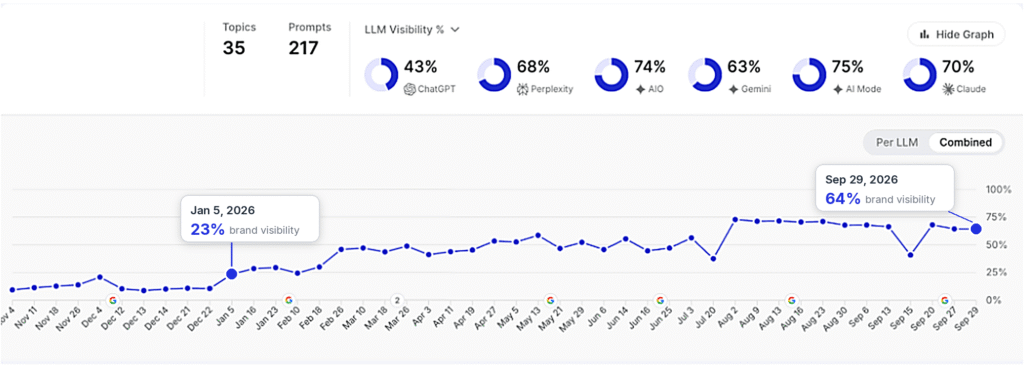
We can also zoom in to see visibility by topic. In January, they only had visibility for ~100 of our tracked topics. Now, they have visibility for nearly every topic we’re tracking.
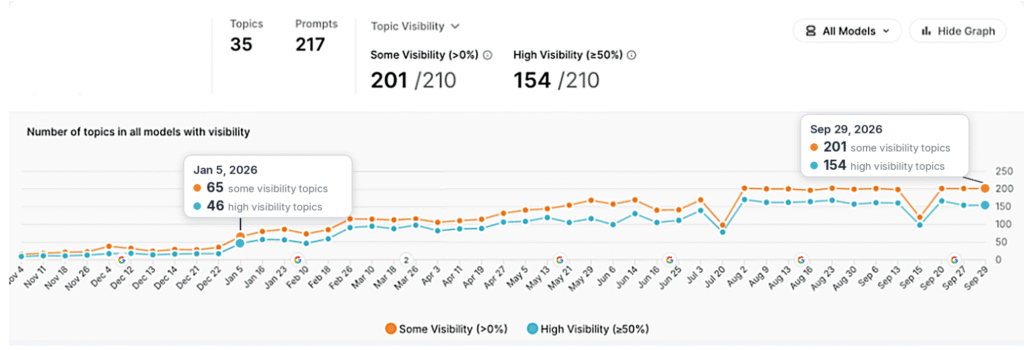
As we’ve discussed in our Invisible Prompts and Topic-Based Visibility articles, we track visibility by topic area, not single prompts, because that’s more accurate. We use our own tool, Traqer.ai, for this.
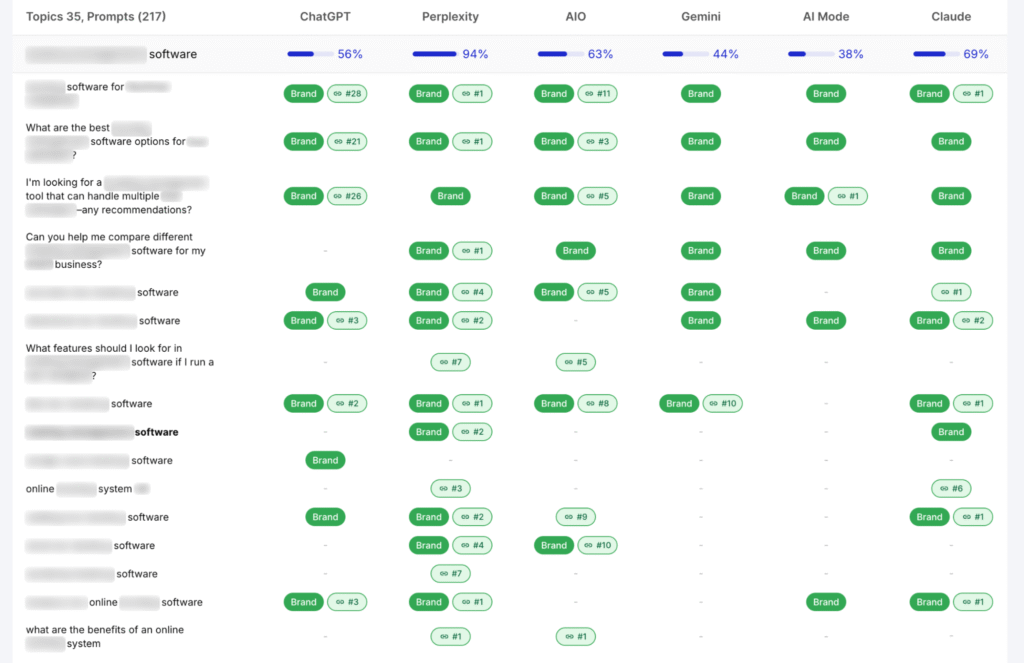
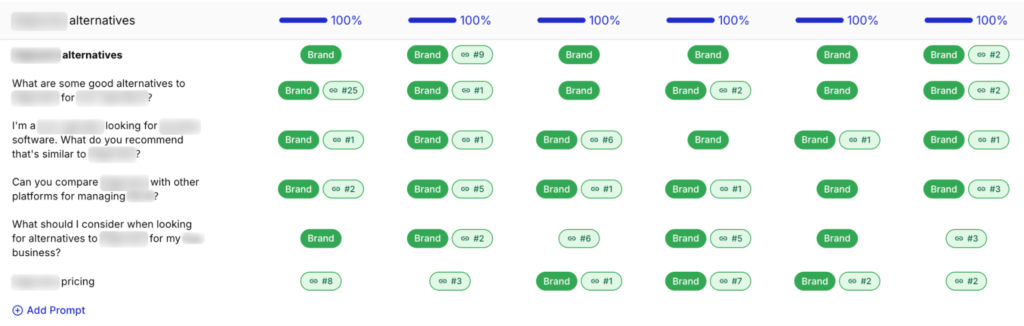
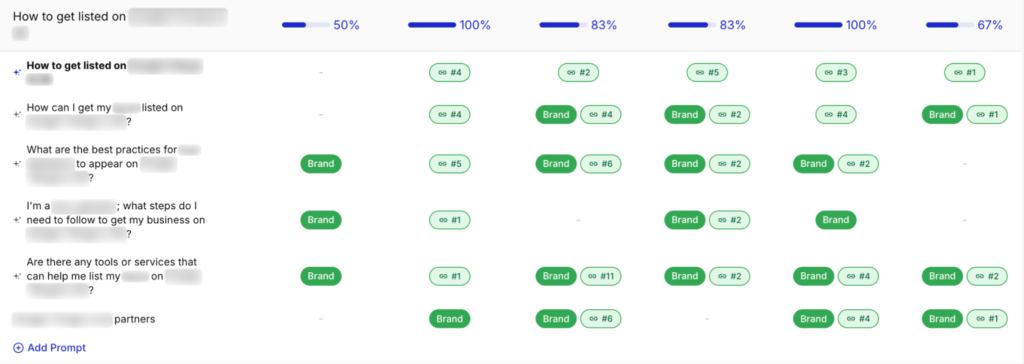
Here are examples of what this client’s brand and citation visibility look like for representative topics:
A product category (“X software”) topic:
A competitor alternatives topic:
A how-to (what we call “jobs to be done”) topic area:
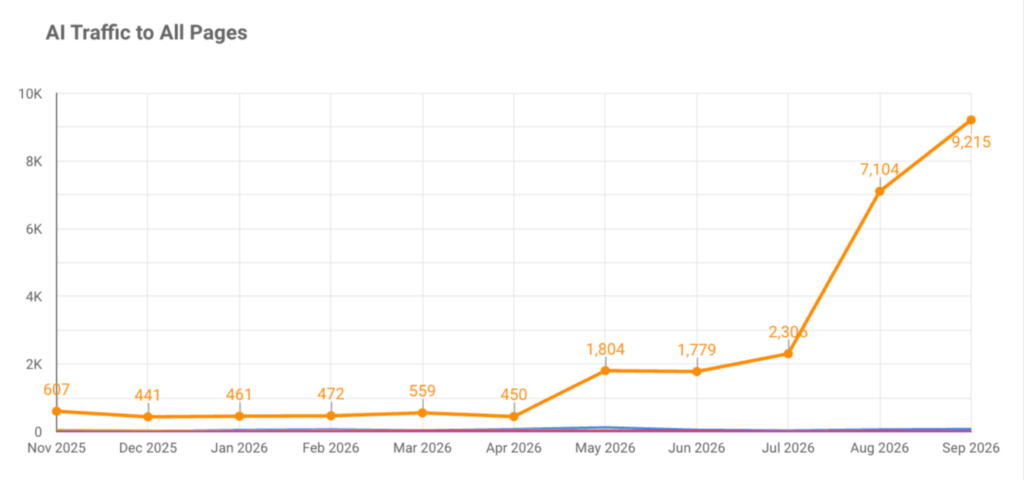
We’ve seen this visibility manifest in attributable traffic from AI sources (much of AI visibility does not result in traffic traceable from AI tools, as explained below).
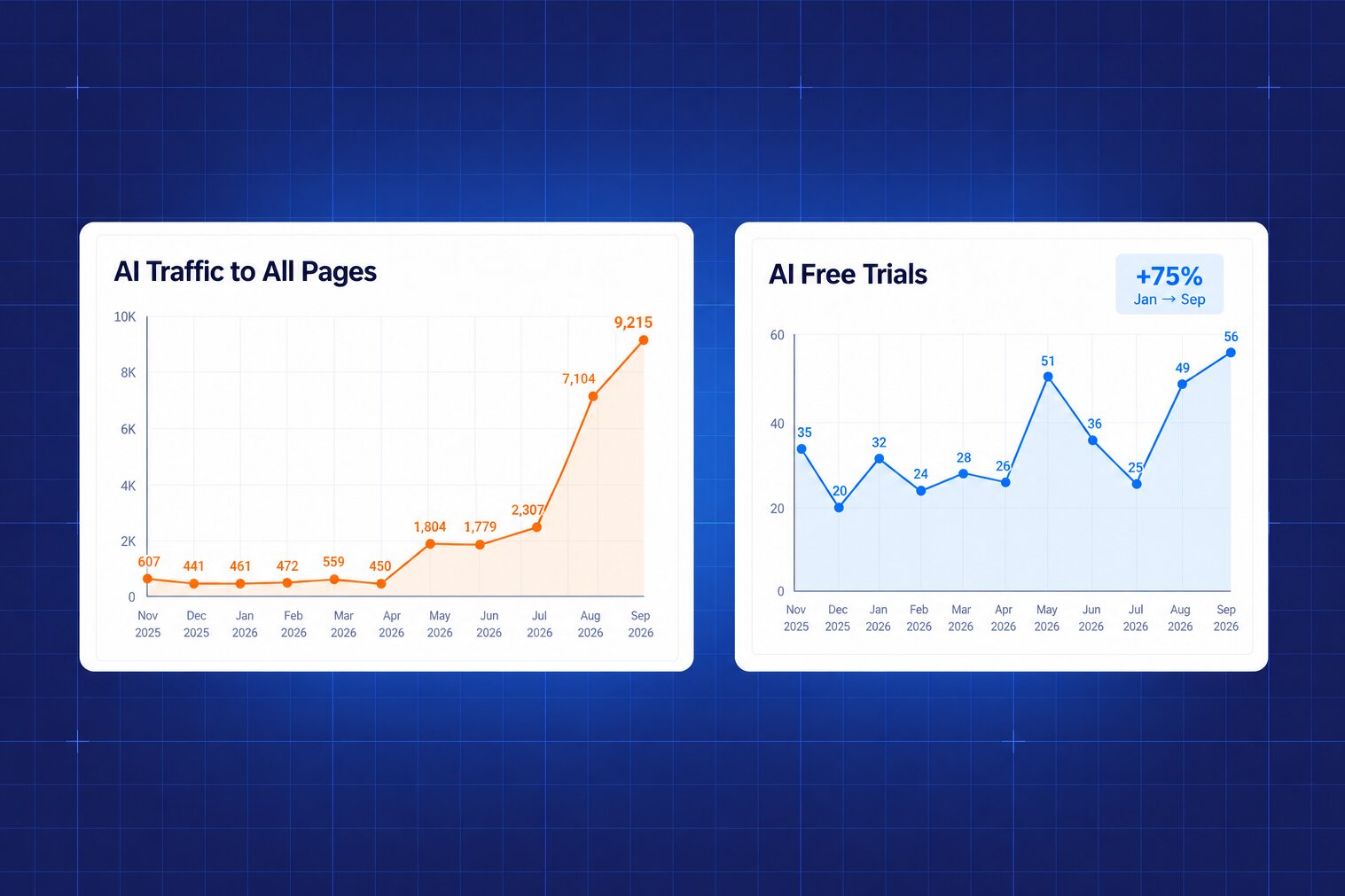
From January through September, overall AI traffic is up ~1,900% (~20x), and AI traffic to our articles is up ~750% (~8.5x). You can see it spike in May and again in August.
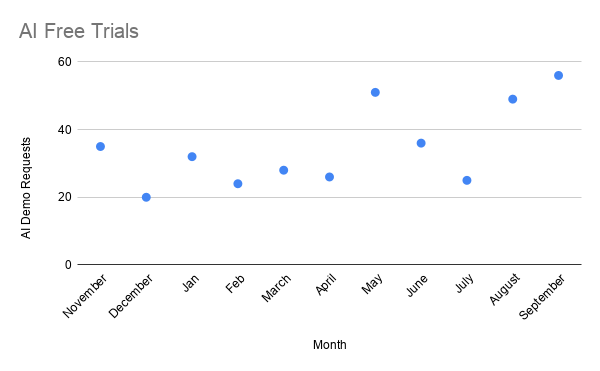
Finally, free trials directly attributable to traffic from AI tools are up ~75% since the start of the year (January through September).
Note that a lot of traffic from AI search is not directly attributable because users don’t often click into a brand’s site from a source link in ChatGPT or Claude, for example. Instead, they see a product recommended in the LLM’s output and open a new tab and Google that brand name.
So the above data is a lower-bound estimate. The real number of trials from AI tools is almost certainly higher.
Some context on this client: They’re a global B2B SaaS brand that works with a wide range of verticals, businesses big and small, and teams from all over the world.
We started working with them in 2023 (before AI search really took off), and following our Pain Point SEO framework, we built up a large collection of rankings for very specific, bottom-of-funnel keywords.
So the question was: What else could we do to extend that visibility to AI engines and show up in more of those conversations?
To answer that, we leaned on our core strategy and philosophy around AI search and how it differs from traditional Google search (SEO): personalization.
Specifically, LLMs can draw on context from past conversations and memory to understand a user’s needs in ways that go beyond traditional search. They use that information to research and recommend solutions tailored to each user’s specific situation. We’ll walk through that below.
Why AI search requires an ultra-specific & personalized content strategy
The way people search is becoming much more personalized
For decades, Google has dominated search, with users typically searching with short phrases like “online booking software.”
With AI engines, users can go beyond short keywords and have conversations. Conversations that are unique to them, where they share personal details about their specific situation.
Someone might type something like: “I’m a fitness coach with five employees and I need a better way to manage reservations across our books. I need to keep track of who’s booking with who, exactly what they’re booking, and how we can prep before clients come in.” And they may not even type that in a single prompt like this. In reality, these ideas are likely relayed to the LLM over the course of a conversation with multiple back-and-forths.
Plus, a lot of the context AI engines pull from is invisible. This is what we call Invisible Prompts.
Even if the user types something short (like “what is the best booking software?”), the LLM can factor in what it already knows about them from past chats and memory: their industry, team size, tools, and recurring problems.
So it may already know this person has five employees, can’t keep reservations straight, and doesn’t get enough detail on bookings to prep beforehand. It’s going to tailor its answer around all of that, even though none of it showed up in the prompt.
AI engines need the fine details to see how your product fits within these specific conversations
Finally, what LLMs do with all that context is also different. Traditional Google search simply gave the user a list of pages to read. It was on the user to judge which solutions were best for them.
In AI search, the LLM is the one doing that research, judging which solutions are best for that specific user, pitching the best ones to them, and explaining why they’re good fits.
LLMs have essentially become brands’ first-line salespeople.
So, in order to be one of the recommended solutions when your ideal customer shares their problems with an LLM, you need to have highly specific, detailed content that spells out all of the scenarios where you’re a good fit — meaning who your product works for, how it works for them, what pains it solves, and why it’s a better choice than the alternatives.
In our experience, the more specific and bottom-of-funnel the content, the more likely it gets pulled into the answer.
Readers can actually “see” themselves in the solution
Boilerplate content reads the same across every other product in the category and never speaks directly to the searcher or their situation.
Highly targeted, detailed content resonates with readers since they can relate to it and see how the product would help them. It feels like a natural solution instead of a sales pitch.
What we actually did
To illustrate how we applied this strategy to our B2B SaaS client while preserving their privacy, we’ll use online booking software as the example product.
Like our client’s product, online booking software is used globally, across industries (from fitness studios and hair salons to photographers, instructors, home service businesses, and event venues), and by businesses of every size (from solopreneurs to multi-location franchises).
Mapped every product angle
The first thing we did, following our Personalized GEO framework, was map every relevant product angle. This gives you a full picture of the conversations where an LLM could recommend you.
That means writing out:
- The specific verticals to target
- The use cases
- The features
- The jobs the product does
- The pains it solves
This comes from our own knowledge of the product and interviews with the client’s team, where we ask who their best customers are, what pains those customers come in with, and how the product solves them.
This tells us who we want to target and how we want to target them.
Found super-specific long-tail keywords around those angles
Then we found traditional SEO keywords around each of those angles:
- Vertical-specific keywords: best online booking system for fitness coaches, best online booking system for hair salons, best online booking systems for photographers…
- Feature-specific keywords: best online booking system with dynamic pricing, best online booking system with inventory management, best online booking system with mobile ticketing…
- Use-case or pain-point keywords: how to create an online booking site, how to get more website reservations, how to sell fitness memberships online, how to get more bookings from Groupon…
Why SEO keywords? Because LLMs can use search engines to help find solutions that best fit the specific situation of their users. So having content that ranks for SEO keywords related to finding specific products for specific situations, verticals, or personas is one of the most effective ways to teach LLMs that your product is a candidate solution for your ICP’s pain points. This is how SEO ties into GEO.
Also note that because AI search is so personalized, many of the keywords we found and went after for this client — and go after for all clients — have low or even no traditional SEO search volume. That’s OK. Our goal is not the same as traditional SEO, where you’re chasing high volumes and traffic. The goal is to get LLMs to associate your brand with the right prospects’ problems.
This gives you the opportunity to write highly targeted, detailed content for each specific audience: the fitness coach, the salon, the solo instructor, the team looking for dynamic pricing to optimize revenue, the team keeping track of physical equipment, the team looking for better mobile functionality, and so on.
This content is what gives LLMs the very specific detail they need on when and how to recommend your product, however the user phrases their question.
Wrote highly specific, detailed, personalized content for each keyword
Then comes the actual writing. For this strategy to work, each piece of content needs to be detailed enough to address that audience’s specific needs. Write like you’re speaking directly to the persona doing the search: their specific situation, their use case, what they’re trying to achieve, and how the product fits in.
To do that, you need background on:
- What the specific audience cares most about
- The pains they’re trying to solve
- What the software does, which specific features the audience cares about, and how those features solve their pains
It can help to map it all out side by side: cares about X and wants to solve Y, then note next to each point what the software does or offers that matches the need.
The whole article needs to revolve around those findings. For example, if you’re writing “best online booking systems for fitness coaches,” the intro could focus on the exact features this audience needs to solve their most common problems.
From there, that map informs:
- How you position the product
- Which features you highlight, and in what order
- The specific examples and how-to advice in each feature section
- The outcomes you mention
- The case studies you sprinkle in
- How you cover competitors (how they serve this audience, and which features they have for it)
Everything ties back to what you cover in the intro and what’s most important to the audience at hand.
This positioning is critical because of how LLMs use the content: how you position the product in these articles can shape how the LLM positions it in conversations with users.
We’ve seen this firsthand. In our Prioritized GEO post, we showed ChatGPT repeating the exact value props from an article we wrote for another client of ours.
Published case studies around these personas & pain points
We also wrote case studies about our client’s existing customers, since relatable stories attract more of those types of users. As we mentioned, readers can “see themselves” in these stories and see that the software works for what they’re looking for (real proof). So can the LLMs. They’re looking for solutions to their users’ specific scenarios, and case studies increase your chance of showing LLMs when, how, and for whom you’ve already been a good solution.
The key here is to dig into the details. A high-level “a fitness studio started with us and increased bookings by 5x!” isn’t enough.
You need an in-depth breakdown of the before and after:
What exactly were they doing before? What pains did they have with that? What were they considering to solve those pains before your product? Did those things work out? Why not?
What sold them on your product, and what were they most excited about? What exactly did they implement, and how did they set it up? Which features do they rely on most? And what do the results look like beyond the headline number? How has it improved their day-to-day workflows, their customer experience, and their profits?
Readers get the complete picture and can see how it relates to their own situation.
And AI engines can see all of this context, so they have the full story to tell in their conversations.
How we’re measuring the results of this strategy
We use Traqer, our AI visibility tool, to track AI visibility across LLMs — ChatGPT, Perplexity, AIO, Gemini, AI Mode, and Claude.
For this client, we set up topics around each of the angles from our topic map (a vertical, a feature, a use case or pain point, a core category keyword), with a set of related prompts per topic.
Some are short, keyword-style prompts, and some are longer, conversational ones closer to how people talk to LLMs.
This way, we’re measuring how visible the client is when the subject comes up, not whether they show up for one exact phrasing.
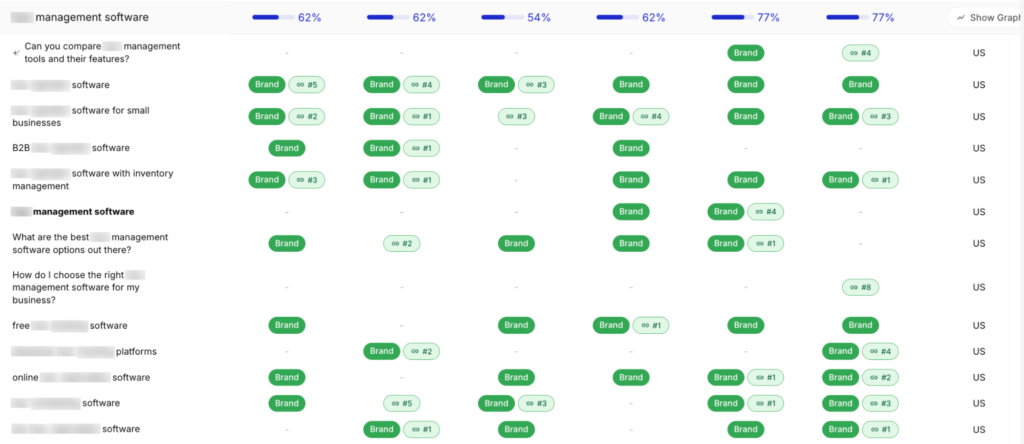
Within each topic, we look at two things:
- Brand mentions: how often LLMs name the client in their answers
- Citations: how often LLMs cite the client’s content as a source
And we track both of these per run, which is where the most useful data comes from.
LLMs can give different answers to the same prompt, so running a prompt once tells you very little. You might catch a good run or a bad one.
Traqer runs every prompt weekly and saves every result. This ensures we’re not judging off one lucky (or unlucky) answer. We can see how often the client actually shows up over weeks and months.
Here’s what that run history looks like when we drill into one of the client’s vertical-specific prompts on ChatGPT:
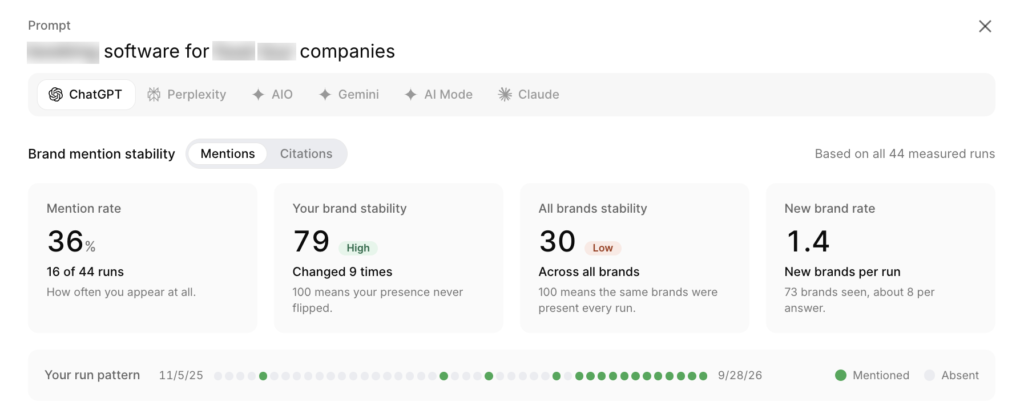
The run pattern at the bottom tells the story. Each dot is a weekly run, going back to when we started tracking in November 2025. The client showed up only occasionally in the early months, but it has been mentioned in every one of the last 12 runs.
That’s the kind of momentum a single visibility number can’t show. The overall mention rate (36%, or 16 of 44 runs) includes the early history, while the run pattern shows the client has been mentioned in every run for the last 12 weeks.
The stability scores back that up:
- Your brand stability (79, high): the client’s presence rarely flips between runs. Once it started showing up, it stayed.
- All brands’ stability (30, low) and new brands per run (1.4): the mix of brands changes a lot from run to run. ChatGPT has named 73 different brands across these runs (about 8 per answer), with 1 to 2 new brands appearing every week.
In other words, ChatGPT keeps reshuffling which brands it recommends for this prompt, but this client has held its spot anyway.
On that same vertical-specific prompt, the client is mentioned in 91% of Perplexity runs, 90% of AIO runs, 90% of Gemini runs, 91% of AI Mode runs, and 82% of Claude runs:
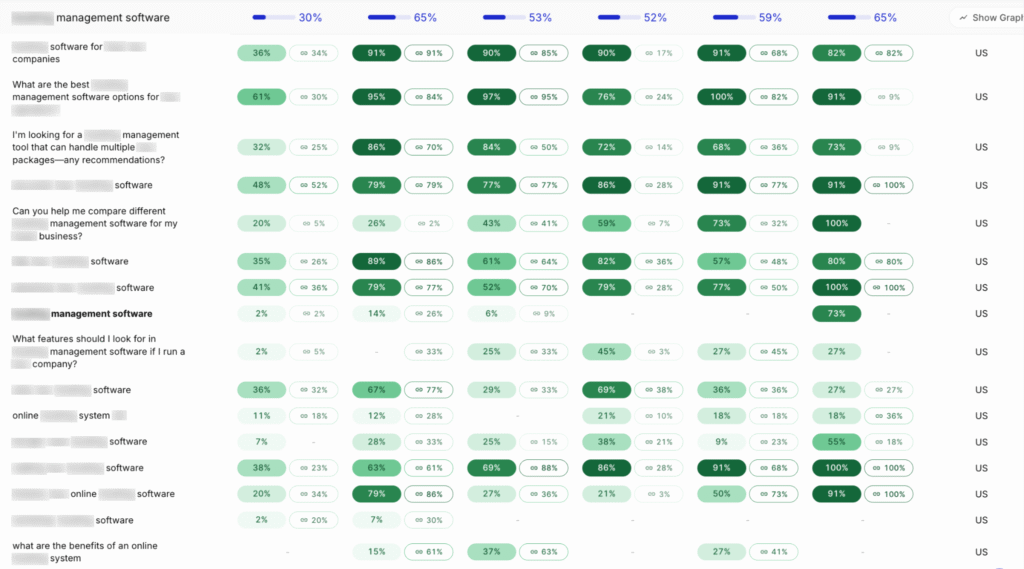
As the screenshot above shows, it’s not just that one vertical-specific prompt performing well. We’re seeing consistent visibility across the topic.
The client also shows up strongly when people are actively comparing options. On the main prompt in one competitor alternatives topic, the client is mentioned in 76% of ChatGPT runs, 88% on Perplexity, 97% on AIO, 82% on Gemini, 95% on AI Mode, and 100% on Claude:
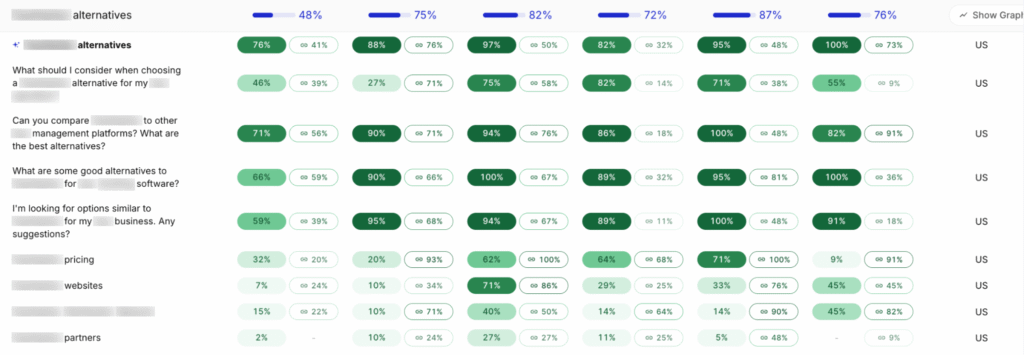
The citation data shows how much LLMs rely on the client’s content, too. In the “pricing” prompt above, LLMs cite the client’s content in 93% of Perplexity runs and 100% of AIO and AI Mode runs. So when someone asks what a competitor costs, the client’s article is a go-to source.
Jobs to Be Done topics are just as strong. On the main prompt in one JTBD topic (about becoming a supplier on a major third-party marketplace), the client is mentioned in 100% of AIO runs, 83% of Gemini runs, 89% of AI Mode runs, and 91% of Claude runs. Citation rates are also strong: 100% of AIO and Claude runs and 94% of AI Mode runs.
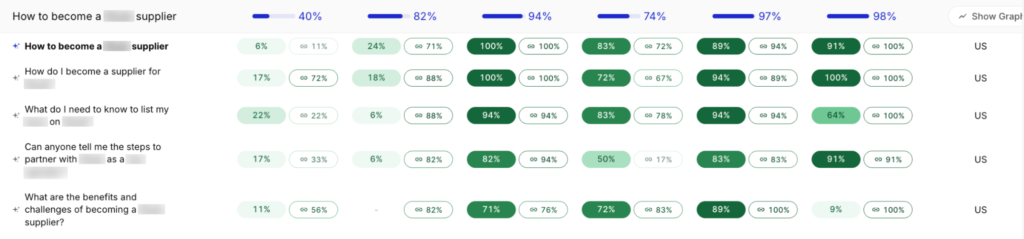
Across the client’s topics, we see the same strength, especially on the specific prompts this strategy was built around.
And that’s exactly what we set out to do with this content. When someone asks an LLM about a specific use case, competitor, or pain point, the client is one of the brands it recommends, and on several engines, it’s there nearly every time.
This is why we track at this level. Brand mentions and citations tell us the client is showing up. The visibility percentages and run data show us how reliably it shows up, prompt by prompt: which topics the client owns and where its content has become the source LLMs turn to. It’s also what we use to decide where to build next.
So when we say AI visibility has more than doubled, we’re not talking about one good week. It’s months of the client showing up, run after run, across its most important topics, and it’s still holding.
Want to grow your brand’s AI visibility?
To talk to us about building a Personalized GEO strategy for your brand, reach out here.
If you’d like more articles like this as we publish them, you can join our newsletter.
Join the Grow and Convert Newsletter
Get our marketing ideas emailed weekly.
Explore Articles By Categories


Explore our Videos