We’ve been running Grow and Convert for over 10 years now. In that time, we’ve worked with enterprise companies on scaling content programs, spoken with dozens more about what they need from an agency, and seen the patterns in what works and what doesn’t at this level.
One pattern we’ve seen consistently is that enterprise companies come to us after hiring an agency that technically did content marketing, published regularly, grew traffic, and hit their deliverable counts, but never generated pipeline. The content looks fine on the surface, ranks for keywords, and drives traffic, but rarely converts enterprise buyers into demos or sales opportunities.
In our experience, that failure comes down to a few recurring problems.
- Most agencies treat enterprise content marketing as a volume problem rather than a strategy problem rooted in how enterprise buyers actually make purchasing decisions.
- Most enterprise content marketing services target high-volume, top of the funnel keywords that attract early-stage researchers, not the active buyers who are already evaluating vendors. This has always been a flawed approach for pipeline generation, and it’s getting worse as AI tools absorb informational queries that used to drive organic search traffic.
- Most agencies don’t have a process for identifying genuine product expertise, so the content they produce is too generic and doesn’t really tell enterprise buyers how it could solve their pain points.
- Most enterprise content teams have no visibility into whether their brand appears in AI-generated responses when buyers are researching vendors on tools like ChatGPT or Perplexity, and most agencies they’ve hired don’t have a strategy for that either.
What’s behind all of this is a distinction we think matters a lot when evaluating agencies at the enterprise level. There are two fundamentally different things an enterprise business might need from a content marketing agency:
- Managing a content program at enterprise scale, with complex approval workflows, brand governance, compliance requirements, and global operations.
- Creating content that actually converts enterprise buyers who are making six or seven-figure purchasing decisions with long sales cycles and multiple decision-makers involved.
Most enterprise content marketing agencies are built for the first, but most enterprise marketing teams actually need the second, or some combination of both.
In this article, we’ll walk through the key factors enterprise marketing teams should use to evaluate content agencies, explain how we address each at Grow and Convert, and share profiles of the agencies whose names come up most often in this space.
Grow and Convert is an SEO and GEO-focused content marketing agency with experience working with several enterprise companies. If you want to hire an agency to handle your enterprise content marketing, you can learn more about working with us here. If you’d like to learn how to do this yourself, check out our content marketing course and community here.
Factors to consider when evaluating enterprise content marketing agencies
We’ve worked with enough enterprise companies to have a clear sense of what separates agencies that generate real pipeline from those that produce content without much to show for it.
Below are the four factors we’d focus on when evaluating enterprise content marketing agencies.
Factor 1: Is their strategy built to generate pipeline, not just traffic?
The number one factor to evaluate in any content marketing agency is whether their strategy is designed to drive their company’s bottom line, i.e., generate leads and pipeline, or to just grow traffic. Most agencies, including those that market themselves to enterprise companies, usually focus on traffic growth. They target keywords with high search volume, report on sessions and rankings, and treat pipeline contribution as something that’s hard to measure as a vendor in an enterprise setting, and therefore not their responsibility.
Enterprise content marketing has a specific version of this problem. Because enterprise deals are large and sales cycles are long, there’s a temptation to justify content investment through brand awareness and thought leadership metrics rather than direct pipeline influence. Most agencies are happy to operate that way because it removes measurement pressure from them.
The agencies that actually drive enterprise pipeline start with the keywords and topics that enterprise buyers search (in both Google and with LLMs) when they’re already evaluating solutions, not when they’re trying to understand a problem category for the first time.
In our research across dozens of B2B clients, bottom of the funnel content converts at 4.78% compared to 0.19% for top-of-funnel content. For enterprise companies where a single converted account can represent hundreds of thousands of dollars in revenue, that difference matters enormously.
When evaluating agencies on this factor, ask them to show you a client’s content strategy and explain how each piece connects to the pipeline. Ask what metrics they report on each month. If the answer centers on traffic, rankings, or domain authority rather than demos or sales opportunities sourced from content, that’s a meaningful signal about how they measure success.
Factor 2: Do they have a process for capturing genuine product expertise?
Enterprise buyers are sophisticated practitioners. A VP of Finance evaluating spend management software, or a CISO evaluating a security platform, can immediately tell whether a piece of content was written by someone who understands their problem at a practitioner level or by a writer who spent a few hours researching the topic online or used AI to produce generic copy.
Most agencies produce what we call “Google research paper” content, either on their own or with AI help. A writer is handed a keyword and assembles an article by just Googling what already ranks for that term. The output is generic, tells the reader nothing they couldn’t find on other websites, and gives enterprise buyers no reason to trust the vendor behind it. AI writing has only exacerbated this problem, with writers asking ChatGPT to just produce a piece on this topic, which, by definition, is AI just repeating what others have already said on that topic.
In contrast, at Grow and Convert, we have an interview-based writing process, where writers conduct detailed conversations with product managers, engineers, sales leaders, and customer success teams before writing anything. Those interviews help the writers surface the specific insights, differentiators, and customer pain points that competitors cannot replicate because they require insider knowledge. For enterprise companies with complex products and sophisticated buyers, this is the content writing process that has consistently produced results for our clients.
When evaluating agencies on this factor, ask them to walk you through exactly how their writers develop domain expertise on a client’s product. If the answer involves content briefs and keyword research but no direct interviews with subject matter experts, the content they produce will reflect that gap.
Factor 3: Do they have an AI search strategy for enterprise visibility?
Enterprise buyers increasingly use AI tools like ChatGPT, Perplexity, and Claude to research vendors and build shortlists before ever talking to a sales team. If your brand isn’t appearing in AI-generated responses when buyers search for solutions in your category, you’re being filtered out of consideration before the conversation starts.
Most content marketing agencies have not built a structured methodology for AI search visibility. They may list GEO or LLM optimization as a service, but what they’re actually doing is applying tactics, like optimizing a few pages, adding FAQ schema, or pursuing mentions on third-party sites like Reddit, without a coherent model for how AI systems retrieve and cite sources or how to systematically improve visibility across an entire content program.
Our research found a 72% correlation between ranking on the first page of Google and being cited by AI tools like ChatGPT and Perplexity, which increases to 77% for the top three positions. Owned content ranking in traditional search is still the foundation of AI visibility, but there are additional layers around off-site brand mentions, third-party citations, and on-site content structure that influence whether AI tools recommend your brand when enterprise buyers ask relevant questions.
What makes AI search meaningfully different from traditional SEO is that enterprise buyers aren’t typing short, repeatable keywords into Google. They’re having detailed, personalized conversations with AI tools that factor in their company size, existing tools, and specific pain points, and getting recommendations tailored to their exact situation. That means generic, high-volume informational content doesn’t give AI systems enough to work with when matching your product to a specific buyer’s situation.
When evaluating agencies on this factor, ask them to describe their specific framework for improving AI search visibility, not just whether they offer it as a service. Ask how they measure it, which platforms they track, and what their process looks like for improving a brand’s citation rate over time.
Factor 4: Do they understand enterprise buying dynamics, not just enterprise operations?
This is the distinction we raised in the introduction, and it’s worth going deeper on because it’s where many agency evaluations go wrong.
There’s a meaningful difference between an agency that knows how to operate inside a large organization and an agency that knows how to create content for the buyers that large organizations are trying to reach. The first type has experience managing complex approval workflows, navigating brand governance processes, coordinating content across multiple business units, and producing high volumes of content at scale. Those are real capabilities that some enterprise companies need.
The second type understands how enterprise deals actually happen. They know that a six-figure software purchase involves multiple stakeholders with different objections, that the buying timeline is measured in months, that the content a VP sees during the evaluation phase needs to speak to business outcomes rather than product features, and that category-level keywords with enterprise modifiers like “project management software for large teams” or “SOC 2 compliant data integration” convert at far higher rates than broad informational queries.
Most agencies that market to enterprise companies are strong at the first and weak at the second. They understand procurement and compliance. They don’t necessarily understand how to create content that generates inbound interest from the specific decision-makers their clients are trying to reach.
When evaluating agencies on this factor, ask them to show you examples of content they’ve produced specifically for enterprise buyers. Ask how their keyword strategy accounts for longer sales cycles and multi-stakeholder buying committees. The answers will quickly tell you which type of agency you’re looking at.
Best Enterprise Content Marketing Agencies
Below are content marketing agencies we’ve run into or names we’ve heard associated with enterprise content marketing. Before listing those, we start with a detailed overview of our own and how we built Grow and Convert to address each of the four factors above, and the results we’ve achieved for clients. For each, we’ll explain their approach, what they specialize in, and what types of companies they work best with.
1. Grow and Convert

Grow and Convert is our SEO and GEO-focused content marketing agency. We’ve spent over 10 years executing content marketing strategies that drive demo requests and pipeline for enterprise B2B companies, not just traffic.
Unlike agencies that optimize for top of the funnel metrics like traffic or rankings, we focus on bottom of the funnel content that generates qualified leads and measurable ROI through our Pain Point SEO and Prioritized GEO frameworks.
We work with enterprise B2B companies that sell complex products to sophisticated buyers, including large organizations with long sales cycles, multiple decision-makers involved in each deal, and significant revenue attached to each closed account.
Here’s how we address each of the factors we mentioned above:
Factor 1: We build content strategies around pipeline, not traffic
The core differentiator of our agency is that we measure performance on leads generated, not just traffic or rankings.
For every client, we create an ROI graph that tracks leads generated from our content each month against the number of leads they need to break even on their monthly investment with us. This gives enterprise marketing teams something concrete to show leadership: not sessions and impressions, but actual pipeline contribution from content.
For enterprise clients specifically, this means our SEO keyword strategy is built around the queries enterprise buyers search during an active evaluation, not during early-stage research. There are a few distinct keyword types we target for enterprise companies:
- Category keywords that reflect an active buying decision, such as “best [software category] for enterprise” or “enterprise [software category] software”
- Comparison keywords where buyers are already evaluating specific vendors, such as “[your product] vs. [competitor]”
- Jobs-to-be-done keywords that map to the specific outcomes enterprise buyers are trying to achieve, such as “how to manage compliance across multiple business units” or “how to consolidate HR software for large teams”
- Keywords with enterprise-specific modifiers that signal buying intent, such as “SOC 2 compliant,” “for teams of 500 or more,” or “with Salesforce integration”
Note, as we explain below, these keywords map really well to a company’s bottom of funnel topic map for AI search: the collection of topics users may ask AI tools about and where you want LLMs to mention your brand as a possible solution.
In our research across enterprise B2B clients, bottom of the funnel content converts at 4.78% compared to 0.19% for top of the funnel content. For enterprise companies where a single converted account can represent hundreds of thousands of dollars in revenue, that difference is the entire argument for doing content this way.
Factor 2: We have a structured process for capturing genuine product expertise
Enterprise buyers are practitioners and senior decision-makers. A CISO evaluating a security platform or a CFO evaluating financial software will immediately recognize whether a piece of content was written by someone with genuine domain expertise or assembled from generic research.
Most content produced by agencies falls into the latter category because writers are handed a keyword and asked to research the topic online, producing what we call Google research paper content that tells enterprise buyers nothing they couldn’t find elsewhere.
Our process is different. Before writing anything, we conduct in-depth interviews with product managers, engineers, sales leaders, and customer success teams at each client company. For enterprise clients, this often means interviewing the people closest to large-deal sales cycles, the account executives who understand enterprise objections, the customer success managers who know how large organizations actually implement and use the product, and the subject matter experts whose perspectives carry credibility with senior buyers.
The resulting content contains what we call originality nuggets, specific insights and perspectives that competitors cannot replicate because they require direct access to your team and customers.
Factor 3: We have a structured AI search strategy
Enterprise buyers increasingly use AI tools like ChatGPT, Perplexity, and Claude to build vendor shortlists before engaging sales teams. Procurement teams at large organizations use these tools to identify solutions, compare vendors, and understand the landscape before a formal RFP process begins. If an enterprise company’s brand isn’t appearing in those AI-generated responses, it’s being filtered out of consideration before a sales conversation ever starts.
Most content marketing agencies approach AI search visibility through isolated tactics rather than a coherent strategy. We built the Prioritized GEO framework specifically to address this problem.
The framework treats AI visibility as a layered strategy: owned content ranking in traditional search as the foundation, followed by off-site brand mentions and third-party citations that signal authority to AI systems, and finally, on-site content structure optimized for AI retrieval.
For enterprise clients specifically, our Tier 1 work goes beyond ranking for high-intent buying keywords. We build what we call a GEO topic map: a collection of content covering every product angle, use case, buyer persona, and competitive scenario in which an LLM could recommend you.
Our goal is to produce content that teaches LLMs to associate your brand as a possible solution when enterprise buyers describe their specific pain points in a conversation — content written at enough depth and specificity that when an AI tool searches the web while formulating a response, it finds clear, detailed signals about when and why your product is the right fit.
We track AI visibility at the topic level for every enterprise client using Traqer.ai (our own AI visibility tracking tool), which monitors brand citation rates across ChatGPT, Perplexity, and Google AI Overviews over time. We’ve also written about how we build topic-based GEO for clients in detail here.
Factor 4: We build content for enterprise buying dynamics, not just enterprise scale
Most agencies that serve enterprise companies understand enterprise operations. They know how to manage approval workflows, navigate brand governance, and produce content at scale inside a large organization. What they often don’t understand is how enterprise deals actually happen and what content moves enterprise buyers through the purchasing decision.
Our content strategies for enterprise clients are built around that buying process specifically. We map keyword strategies to the stages of an enterprise evaluation, from the initial queries a VP searches when they first recognize a problem, through the comparison and vendor evaluation searches that happen mid-cycle, to the compliance and implementation questions that come up before a deal closes.
We write for the business outcomes and risk considerations that senior decision-makers care about, not the feature-level details that would appeal to an individual contributor. And because enterprise deals involve multiple stakeholders, we think about the full buying committee when developing content, not just the primary user persona.
You can learn more about working with us here, or read our full guide to enterprise content marketing strategy here.
2. Tendo Communications

Tendo Communications is a B2B content and UX agency that works exclusively with large enterprise companies. Founded in 1999, they provide services including content strategy, content creation, UX design, content operations, and content performance. They are one of the oldest agencies in this space and one of the few that focuses entirely on the operational complexity of large B2B organizations rather than growth-stage or mid-market clients.
Unlike most agencies in this space, they integrate content strategy with user experience design. They acquired a UX design agency to bring both disciplines under one roof, making them well-suited for enterprise organizations managing large content ecosystems across multiple products, regions, and audiences.
Their production model centers on a Content Studio approach that provides dedicated editorial teams for sustained content production at scale. They use a proprietary audience-centric framework built around persona development and journey mapping, and work with clients on a long-term strategic basis across multiple regions, languages, and business units rather than as a project-based content vendor.
They have worked with companies like Cisco, Salesforce, HPE, Autodesk, VMware, Informatica, and Okta.
Visit their site for more information.
3. Animalz
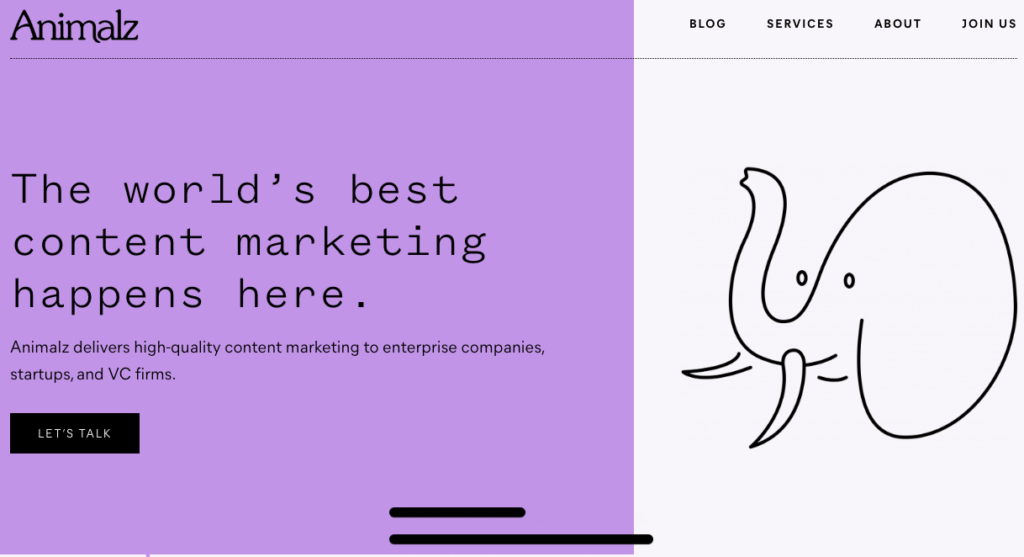
Animalz is a content marketing agency that works with B2B SaaS companies, enterprise software companies, and venture capital firms. They describe their programs as built to drive organic growth through content that reflects genuine domain expertise rather than research-assembled writing, and they have worked with enterprise technology companies alongside growth-stage SaaS clients.
Their production process starts with a deep onboarding phase where they study the client’s product, industry, and go-to-market strategy before developing a content strategy and moving into production through direct SME interviews. They emphasize building content that requires insider knowledge, which they believe is what separates effective B2B content from generic writing assembled from existing search results.
They also offer Answer Engine Optimization as a dedicated service, which includes brand visibility audits across Google AI Overviews, ChatGPT, Perplexity, and Gemini. They have published detailed frameworks on improving AI citation rates and employ a dedicated AI and marketing operations function internally.
They have worked with companies including Google, Amazon, Atlassian, GoDaddy, Airtable, Amplitude, Intercom, UiPath, and Ramp.
Visit their site for more information.
4. Siege Media
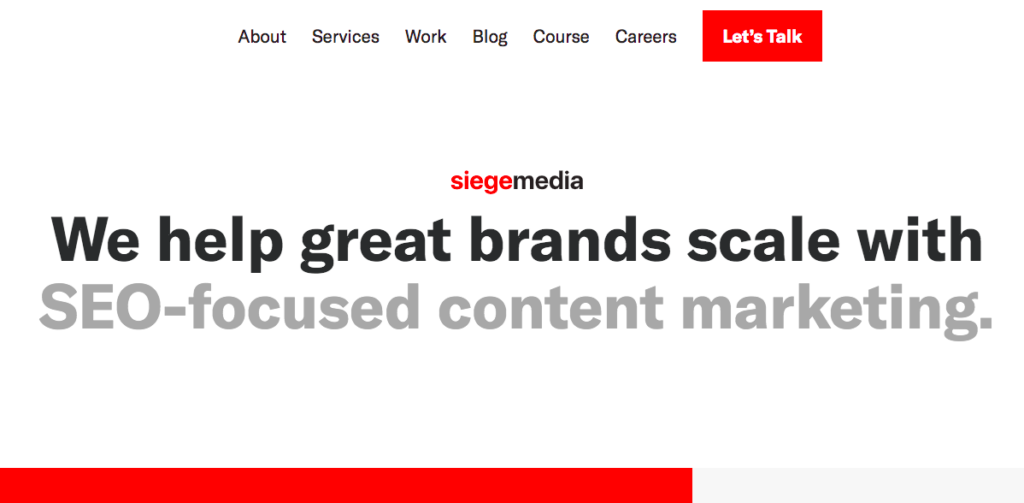
Siege Media is an organic growth agency specializing in SEO, GEO, content marketing, and digital PR. Their content strategy begins with a proprietary keyword prioritization framework, and they are explicit that their writers are senior specialists matched by vertical expertise rather than generalist freelancers.
Their production process emphasizes quality over volume, with approximately half of their content creation time dedicated to design alongside writing. They are also vocal about their selective use of AI in content production, stating that while they use it for certain tasks like brainstorming and outlines, writing is rarely one of them.
On the AI search side, they have built two proprietary tools. BlueprintIQ audits content against live AI search results across ChatGPT, Gemini, and Perplexity to identify gaps in topical coverage. DataFlywheel refreshes existing content assets on a rolling quarterly basis to maintain relevance for AI citation. These tools put them among the more technically developed agencies on this list when it comes to GEO execution.
They have worked with companies like Zapier, Figma, Instacart, Asana, and Intuit.
Visit their site for more information.
5. Brafton

Brafton is a full-service content marketing agency that has been operating since 2008. Their services cover blog writing, graphic design, video production, email marketing, social media management, PPC, web design, and SEO consulting. They work with a wide range of company sizes across industries including technology, healthcare, finance, and manufacturing, and have offices across the United States, United Kingdom, and Australia.
A distinguishing feature of their model is a proprietary content marketing platform they have built for workflow, project management, and content performance tracking. Each client is assigned a dedicated content marketing strategist who provides strategic direction alongside the production team. Their writers are described as full-time in-house staff rather than outsourced freelancers, matched with clients based on industry expertise.
They also offer generative engine optimization as a dedicated service, covering content optimization for AI retrieval, structured data, and citation tracking across AI platforms. Their engagement model is unit-based rather than per-piece pricing, which gives clients flexibility across different content types and volumes.
They have worked with companies like Webex, ViewSonic, Oxford University Press, and TruGreen.
Visit their site for more information.
6. Column Five

Column Five is a B2B content marketing agency that focuses on brand storytelling for enterprise SaaS and AI companies. Founded in 2009, they position themselves around helping companies develop a differentiated point of view and then expressing it across multiple content formats, including video, motion graphics, infographics, interactive content, and written content. Their tagline is “the best story wins,” which reflects their emphasis on narrative and brand identity alongside organic growth.
Their process begins with a proprietary Story Scan Program that audits a client’s brand messaging, competitive positioning, and content gaps before any production begins. They describe their approach as audit-first, strategy-second, and execution-third, and have published case studies showing multi-year engagements with enterprise clients where they work across multiple internal teams simultaneously.
They also offer Answer Engine Optimization consulting and AI-powered content services as part of their service line, and they explicitly position these services to help brands get found by both human audiences and LLMs. They also operate a proprietary AI content tool called Iris for clients that need content at scale.
They have worked with companies including Instacart, Databricks, Vercel, Salesforce, LinkedIn, GitHub, Microsoft, and SAP.
Visit their site for more information.
7. Omniscient Digital

Omniscient Digital is an organic growth agency that helps B2B software companies drive pipeline through SEO, GEO, and content. Founded in 2019 by alumni from HubSpot, Shopify, and People.ai, they position themselves around revenue as the end goal rather than traffic growth, and they publish detailed thinking about content strategy and organic growth through their own blog and podcast.
Their research methodology, which they call OmniscientX, includes competitive analysis, buyer research, content gap analysis, LLM visibility indexing, keyword exploration, product alignment, and SME interviews before strategy development begins. They emphasize hiring for business acumen alongside SEO skills and integrate closely with client product marketing, sales, and go-to-market teams rather than operating at arm’s length.
Their GEO work incorporates LLM visibility indexing and citation analysis from the research phase onward, and they apply RAG principles and semantic modeling to improve how AI systems retrieve and surface client content.
They have worked with companies like Jasper, SAP, Asana, Loom, Hotjar, Adobe, and Smartling.
Visit their site for more information.
8. Foundation Inc

Foundation Inc is a distribution-first content marketing agency for B2B companies, founded by Ross Simmonds. Their core premise is that most agencies invest heavily in content creation while underinvesting in distribution, and their entire process is built around that belief. They describe their methodology as research, create, distribute, and optimize, with distribution treated as equally important as production.
Before producing any content, their team studies client audience newsletters, online reviews, sales calls, Reddit communities, social platforms, and competitor content. They then build a 12-month content engine with specific distribution playbooks for each piece, covering newsletter placement, founder content, social media, YouTube, Reddit, and sales enablement channels.
Their content creation process includes formats built specifically for LLM visibility, and their optimization work targets ChatGPT, Claude, SGE, Gemini, and Perplexity. Their homepage explicitly positions them as an agency that increases LLM visibility alongside pipeline generation.
They have worked with companies including Webex, Mailchimp, Snowflake, Canva, Procore, and Paychex.
Visit their site for more information.
9. Power Digital

Power Digital is a full-service performance marketing agency that works with both B2B and consumer brands. Founded in 2012 and backed by private equity, they are one of the largest agencies on this list by headcount and operate across a wide range of services, including SEO, paid media, paid social, email, influencer marketing, PR, affiliate marketing, programmatic, and content.
Their core technology is a proprietary platform called Nova, which connects first-party client data to inform strategy and performance measurement across channels.
Content marketing sits within their broader owned media offering rather than as a standalone specialty. Their model is built around integrating content with paid and earned media channels rather than treating organic content as an independent growth driver. This makes them a strong fit for companies seeking a single agency to manage multiple marketing channels simultaneously.
They offer generative engine optimization as a dedicated service, covering LLM visibility audits, content structuring for AI responses, technical schema implementation, and citation engineering across ChatGPT, Perplexity, Gemini, Claude, and Microsoft Copilot. Their Nova platform also connects AI search performance data to broader marketing attribution.
They have worked with companies like ASICS, Crocs, Taylor Guitars, and Data.World.
Visit their site for more information.
10. iPullRank

iPullRank is an enterprise content marketing and SEO agency based in New York. They describe their focus as Relevance Engineering, a proprietary framework that integrates content strategy, technical SEO, information retrieval, digital PR, and user experience to optimize content for both traditional search and AI search platforms.
They work primarily with enterprise and mid-market companies and claim to have delivered over $4 billion in organic search results for their clients.
Their approach is built around the idea that enterprise brands need specialized partners rather than generalist agencies that treat content and SEO as interchangeable services. Their Relevance Engineering framework uses semantic content structures, passage scoring, and retrieval modeling to engineer brand visibility across AI search platforms alongside traditional Google rankings. They also offer AI search audits that surface a client’s current presence across both traditional and generative platforms.
On the content side, their team combines technical SEO expertise with content strategy and content engineering, and they are explicit that their writers and strategists are specialists rather than generalists. They publish detailed original research and thought leadership on natural language processing, machine learning applications in SEO, and how AI systems retrieve and rank content, which reflects how technically grounded their methodology is.
They have worked with enterprise companies like LG, American Express, Citi, and DocSend, as well as Fortune 500 companies across financial services, media, and retail.
Visit their site for more information.
Want to work with us or learn how to implement our enterprise content marketing strategy?
- Our Agency: You can learn more about working with us here.
- Our Content Marketing Course: Individuals looking to learn how to grow their enterprise business with content can join our private course, taught via case studies, here. We include a lot of information and examples not found on this blog. Our course is also built into a community, so people ask questions, start discussions, and share their work in the lesson pages themselves, and we and other members give feedback. We also get on live Zoom calls about once a month and dissect members’ actual content strategies and brainstorm ideas on how we’d form content strategies for their businesses.
- Join Our Content Marketing Team: Alternatively, if this style of enterprise content marketing appeals to you, consider joining our content marketing team as a writer or content strategist. We have awesome clients. We’re a remote company. We pay well. And you won’t have to stress about getting your own clients or spend a bunch of time doing outreach to get them.
Join the Grow and Convert Newsletter
Get our marketing ideas emailed weekly.
Explore Articles By Categories


Explore our Videos