Over the past 10+ years running Grow and Convert, we’ve developed a content marketing framework focused on driving qualified leads and pipeline rather than just hollow traffic that doesn’t convert. We call the traditional search version of this framework Pain Point SEO, and the AI search version Prioritized GEO.
Both are built on the principle that most content teams waste time on well-established but ineffective tactics that, at best, drive traffic with extremely low conversion rates to qualified leads.
Over the years, we’ve noticed that this problem is especially acute in enterprise companies. Enterprise organizations have all the content operations infrastructure you’d expect: content teams, agency retainers, editorial calendars, brand guidelines, content governance policies, multi-step content workflows, and they publish content consistently and in large volume. But where those resources are pointed to is at a strategy that’s fundamentally flawed: it’s focused on chasing search volume in SEO or citations in AEO/GEO (or frankly, in AEO/GEO, many organizations right now simply don’t have a coherent strategy and aren’t sure what to focus on).
So, when leadership asks what all that investment actually produced and how it connects to business goals, the content team can only point to traffic numbers or publishing volume, and they can’t really trace content to pipeline or revenue.
Specifically, here are the flaws in the typical enterprise content strategy:
- Traffic, not conversion-focused strategy: Their content strategy is built around high-volume, top of the funnel keywords that drive traffic but have extremely low conversion rates to sales-qualified leads (SQLs). Enterprise content marketing teams gravitate toward broad, educational terms mostly because they operate in a silo and are disconnected from sales data or product teams, and traffic is the metric that’s easiest to report on.
- Content just summarizes Google: Enterprise companies often have large content teams or multiple agency partners, but the actual writing process follows the same playbook: a writer or AI tool researches the keyword, reads what’s already ranking, and produces a synthesized version of the same information. At enterprise scale, this is a particular problem because the people reading this content are practitioners who already know the basics and can immediately tell when an article was written by someone who has never actually done the work.
- Too little product sales copy: They avoid selling their product in their content. Enterprise content teams often treat blog content as a brand awareness exercise, so articles deliberately avoid explaining how the product actually solves the problem being discussed. This exacerbates the low conversion problem.
The approach we’ve built at Grow and Convert addresses all three of these problems, and in this article, we’ll walk you through our entire enterprise content marketing process:
- Prioritize high-buying-intent keywords: Prioritize keywords based on buying intent rather than search volume, focusing on the terms enterprise buyers actually search when they’re evaluating solutions to specific problems. Traffic and brand awareness are fine goals, but if the brand isn’t consistently visible for bottom of funnel, high-intent searches, you’re leaving SQLs on the table for no reason. This is even more pressing in AI search because AI tools simply don’t link to or mention brands for top of funnel queries (more on this here).
- Produce content through internal employee interviews, not via genAI or humans regurgitating Google: Instead of having writers (or an AI tool) research topics on their own, which simply creates generic, me-too content, conduct interviews with internal subject matter experts to create content that contains genuine product and domain expertise. Enterprise buyers are not beginners, they’re advanced, and therefore your content also needs to be advanced.
- Sell your product in each piece of content: Because we emphasize producing high buying intent content, in this content, you need to talk about your product extensively, including specific features, differentiators, and use cases, rather than staying vague in the name of brand awareness.
- Build links and AI search citations: Generate backlinks and optimize for visibility in AI search tools like ChatGPT and Perplexity.
- Set up conversion tracking and attribution: Track actual pipeline metrics like demos, trials, and sales conversations sourced from content, not just traffic and rankings.
Grow and Convert is an enterprise content marketing and SEO agency. If you want to hire us to handle your enterprise content marketing, you can learn more about working with us here.
Our 5-Step Enterprise Content Marketing Process
We’ve written at length about each of these steps individually across our site. Here, we’re going to walk through how each step applies specifically to enterprise content marketing and link to further resources for each step:
Step 1: Identify High-Intent Keywords
The most fundamental part of an enterprise content marketing strategy is keyword selection. Keywords (or equivalently, prompts and topic areas in AI search) indicate the level of buying intent of the user.
If you’re only going after low-intent keywords, ones where the searcher isn’t in the market for your product at all, then nothing else in your enterprise content marketing strategy is going to matter. The volume of content you publish doesn’t matter. The quality of your editorial calendar doesn’t matter. Your brand guidelines and approval workflows don’t matter. You will simply generate low intent, low converting traffic over and over again.
Instead, to create an enterprise content marketing strategy that actually generates appreciable pipeline and revenue, you need to prioritize keywords based on buying intent, not search volume. We’ve written extensively about this concept in our article on Pain Point SEO, the strategy we coined that prioritizes content ideas around high-intent keywords over high-volume ones to drive conversions.
Most enterprise content teams do exactly the opposite. They build their content calendar around broad, high-search-volume keywords that attract the widest possible audience, because the logic is that more traffic means more potential customers, but that’s not really the case.
In practice, ranking for a keyword like “what is supply chain management” at 8,000 monthly searches will generate far fewer leads than ranking for “manufacturing supply chain management software” at 350 monthly searches, because the second keyword captures someone who already knows they need a solution and is actively looking for one.

This problem is especially pronounced in enterprise companies, where content teams don’t have visibility into which keywords actually drive the pipeline. If they operate in a silo, disconnected from sales data, they usually default to optimizing for the metric they can see: traffic.
We approach keyword selection differently. Instead of starting with search volume, we start with the customer journey and work backward to find the keywords that indicate someone is ready to evaluate or purchase a solution.
This means understanding your target audience and buyer personas deeply enough to know the language they use when actively looking for a product like yours, not just when researching a general topic.
These keywords are also where enterprise content marketing becomes a genuine lead generation channel rather than a brand awareness exercise. When someone searches for a specific problem your product solves, they’re further along in the buyer’s journey than someone searching for a general industry term, and content that meets them at that moment with real expertise and a clear product connection will convert at a fundamentally different rate.
We break these keywords into a few main categories and prioritize them roughly in this order.
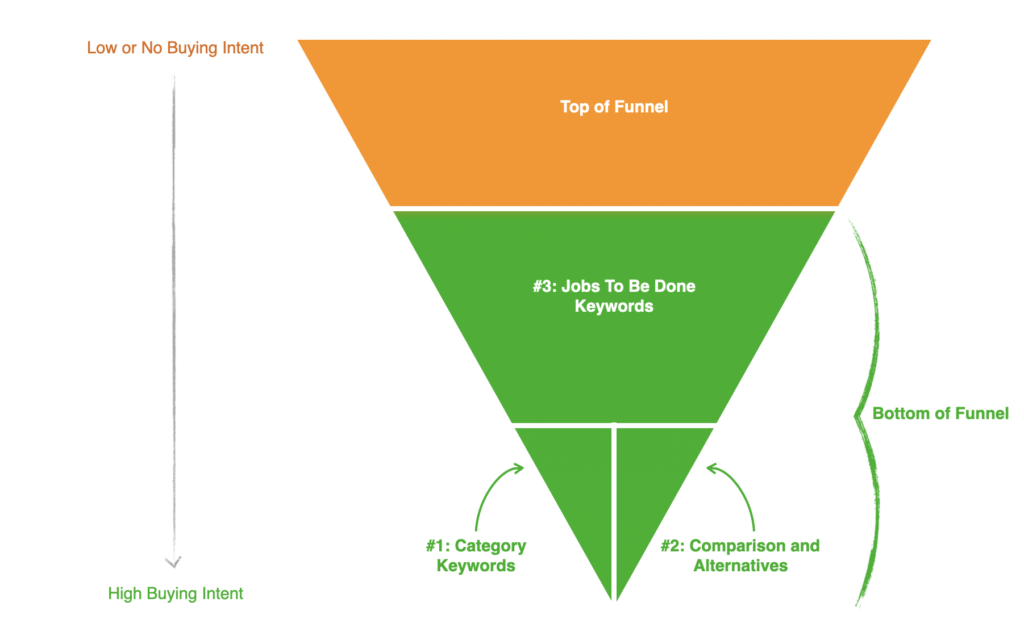
Category Keywords
Every enterprise content strategy should start here. These are the keywords that indicate someone is actively looking to buy or evaluate a product like yours right now. Software category keywords describe the type of product someone is searching for, and for enterprise companies, they tend to follow patterns like:
- “Best [use case] software for enterprise”
- “[Use case] platform for large teams”
- “Enterprise [use case] software”
- “[Use case] software for [industry]”
Enterprise keyword research also tends to surface modifiers that don’t appear in SMB or mid-market searches.
Enterprise buyers search for solutions that meet compliance requirements (“SOC 2 compliant [use case] software”), specific integrations (“marketing analytics platform with Salesforce integration”), and scale indicators (“project management software for 500+ users”). The more use cases your product serves and the more verticals you operate in, the more keyword opportunities you’ll find in this category alone.
These are the keywords that most enterprise companies are bidding on in paid ads, but, in our experience, aren’t pursuing organically through blog content. The search results for many of these terms are dominated by software review sites like G2 and Capterra, which means a well-written, expert-driven article from the company itself can compete effectively by going deeper into how the product actually works and what makes it different.
Comparison Keywords
The second category of high-intent keywords we prioritize is comparison keywords, including “[competitor] alternatives” and “[brand] vs [competitor]” searches. These are valuable because the searcher is already in evaluation mode. They know which product category they need and are now deciding between specific options.
For enterprise companies, comparison keywords often look like:
- “[Competitor] alternatives for enterprise”
- “[Brand] vs [competitor] for [industry]”
- “[Competitor] vs [competitor]” (where you insert your brand as a third option)
- “Best [competitor] alternatives for large teams”
The third variation is particularly useful for enterprise companies that are newer or less well-known in their space. If two established competitors have significant search volume for their head-to-head comparison, you can create content targeting that keyword and position your product alongside both of them. This puts your brand in front of buyers who are already deep in the evaluation process, even if they haven’t heard of you yet.
Enterprise comparison content also tends to be more nuanced than what works at the SMB level. Enterprise buyers are evaluating products across multiple dimensions (security certifications, integration depth, implementation timelines, support SLAs), so the comparison content needs to address these factors specifically rather than just listing features side by side.
Use Case, Pain Point, and Jobs-to-be-Done Keywords
After covering the core bottom of funnel category and comparison keywords, we move to use case, pain point, and jobs-to-be-done keywords. These are terms where the searcher has a specific problem or operational need but isn’t yet searching for a product category by name. They’re either describing a challenge they’re trying to solve, or a specific task they need to accomplish.
For enterprise companies, pain point and use case keywords often follow patterns like:
- “How to [solve specific operational problem] at scale”
- “[Specific pain point] for [industry] companies”
- “How to manage [process] across multiple teams”
- “[Operational challenge] for [enterprise role]”
Jobs-to-be-done keywords are closely related but the distinction matters. Pain point keywords describe a problem the searcher is experiencing, while JTBD keywords describe a specific task or outcome the searcher needs to accomplish. The searcher isn’t necessarily in pain — they just have a job to do and are looking for the best way to do it. These tend to follow patterns like:
- “How to [complete specific task] for [enterprise context]”
- “Best way to [achieve specific outcome] across [multiple departments]”
- “[Specific task] template for [industry]”
- “How to automate [process] at scale”
Both types convert well because the searcher is describing something that the enterprise product directly solves, even if they aren’t aware a product category exists for it. Someone searching for “how to standardize vendor onboarding across 12 offices” might not know that vendor management platforms exist, but that search describes exactly the job your product was built to do.
This is also where selling your product in the content (which we’ll discuss in Step 3) becomes especially important — if you write a thorough article about the problem but never explain how your product solves it, you’ve done all the hard work without capturing any of the value.
Enterprise pain points and JTBD keywords are where internal knowledge from sales and customer success teams becomes critical. The best keywords in this category often come from listening to the specific language enterprise buyers use during sales calls, reading through support tickets, and understanding the operational problems that drove your largest customers to seek out a solution in the first place. Asking your CS team “what are the top five things enterprise customers use the product to accomplish in their first 90 days?” will often generate keyword ideas that no research tool would surface on its own.
We recommend enterprise companies only move to top of the funnel content after they’ve exhausted their bottom of the funnel and middle of the funnel keyword opportunities. Top-of-the-funnel content can help build topical authority and support rankings for higher-intent pages, but it should never be the starting point for an enterprise content strategy.
This is even more important now that AI search engines like ChatGPT, Perplexity, and Google AI Overviews are answering broad, educational queries directly without sending users to your site. A top of the funnel strategy that used to drive significant traffic now drives very little, and that traffic still doesn’t convert well, making it the worst of both worlds.
In contrast, bottom of funnel queries where users are asking for product recommendations are exactly where AI tools list and cite brands, which makes BOFU content valuable for both traditional search and AI visibility.
One exception to the bottom-up prioritization is worth mentioning. In the first few months of an enterprise content marketing initiative, SEO content takes time to rank, which creates a gap between when you start investing and when you start seeing organic results.
To bridge that gap and show early traction to leadership, we produce what we call “Disruption Stories” alongside our SEO content. These are non-SEO narrative pieces that tell the story of why the company was founded, what specific problems the product was built to solve, and how it works differently from existing solutions.
We then promote these through paid channels, primarily LinkedIn, to drive traffic and conversions while the SEO content is ramping up. This gives leadership visibility into early results and buys the time needed for the organic content strategy to compound.
Step 2: Produce Content Through Expert Interviews That Deeply Satisfies Search Intent
Finding the right keywords is only half the problem. The other half is producing content that does two critical things simultaneously:
- Fulfill search intent enough to actually rank for those keywords
- Is written well enough to actually convert your ICP when they read it.
The “Google Research Paper” Problem
Most enterprise content programs get both of these parts wrong in a specific and consistent way. Whether the content is produced by in-house writers, freelancers, or agency partners, the content creation process is usually some variation of the same thing: the writer receives a keyword and a brief, researches the topic by reading what’s already ranking on the first page of Google, and writes a synthesized version of that information in the company’s brand voice.
We call this the “Google research paper” approach, and it produces content that is factually accurate but offers nothing the reader couldn’t find elsewhere. This is a problem for any company, but it’s a particular problem at enterprise scale for two reasons.
First, the people reading enterprise content are practitioners, decision-makers, and technical evaluators who are not beginners, they are advanced in their field. Their needs and questions are advanced. They don’t need a “beginners guide” to their own field or to know the “10 trends” in that field “to look out for” next year. They can immediately tell when an article was written by someone who doesn’t have hands-on experience with the subject matter.
Second, enterprise buying decisions involve multiple stakeholders, which means the content needs to be substantive enough that a champion inside the organization can share it with their team and it holds up to scrutiny.
AI-generated content has made this problem worse, not better. AI tools can produce content faster and cheaper, but the output is fundamentally the same as the Google research paper approach — it can only synthesize what already exists. It cannot produce original insights from someone who has actually built, sold, or implemented the product.
Our Solution: Internal Interview-Based Content Writing
At Grow and Convert, we solve this by building every article around a direct interview with a subject-matter expert within the client’s company. This is not a casual conversation or a quick fact-check. It’s a structured 30-45 minute recorded interview designed to extract the specific insights, examples, and perspectives that make the article genuinely different from everything else ranking for that keyword.
Before the interview, our content strategist researches the target keyword, analyzes search intent, reads top-ranking content, and identifies specific gaps and angles that existing content doesn’t cover. They then prepare a set of interview questions designed to pull out exactly those missing pieces from the expert.
During the interview, the goal is to get the expert talking about their actual experience: how the product works in practice, what specific problems enterprise customers face, how implementation typically plays out, what objections come up during the sales process, and what makes their approach different from competitors. These are the details that a freelance writer or AI tool could never produce on their own because they simply don’t have access to this information.
After the interview, the writer builds the article around these insights, weaving them into a piece that satisfies the search intent for the target keyword while containing perspectives and details that are genuinely original. We call these details “Originality Nuggets,” the specific pieces of information that make the content impossible to replicate by reading other articles or prompting an AI tool.
Writing With Specificity, Not Generalities
We also apply what we call the “Specificity Strategy” throughout the content creation process. This means replacing generic statements with concrete, specific details from the interview.
Instead of writing “our platform helps large companies streamline their onboarding process,” the writer uses the specific details the expert provided: “our platform reduced onboarding time from 6 weeks to 9 days for a manufacturing company with 12 regional offices, primarily by automating the document collection and compliance verification steps that previously required manual coordination across three different departments.”
That level of specificity is what makes enterprise content credible to practitioners, and it’s only possible when the content is built from expert interviews rather than desk research.
Enterprise content needs to demonstrate real product and domain expertise because the buyers are more sophisticated and the stakes of the purchase are higher. An SMB buyer might read a comparison article and sign up for a free trial within the same session. An enterprise buyer is going to share that article with their procurement team, their IT security team, and their VP, and every person in that chain needs to come away feeling like the company genuinely understands the problem and has a credible solution.
Interview-based content also creates a competitive moat that scales. Every article you produce through this process contains insights that exist nowhere else on the internet, which means competitors cannot replicate it and AI tools cannot synthesize it from existing sources. Over time, this builds a library of genuinely differentiated content, which becomes increasingly valuable as AI search engines begin to favor original, expert-driven content over recycled information.
Matching the Right Expert to Each Piece of Content
For enterprise companies with large teams, matching the right expert to each piece of content is also equally important. Not every article should feature the same person. The best approach is to match the expert to the keyword category:
- Product managers and engineers are the best sources for software category content, because they can explain how the product actually works, what architecture decisions were made and why, and how specific features solve specific problems at enterprise scale.
- Sales leaders and account executives are the best sources for comparison and alternatives content, because they hear directly from prospects why they’re evaluating competitors, what gaps they’ve found in other products, and what factors ultimately drive the buying decision.
- Customer success managers are the best sources for use case, pain point, and jobs-to-be-done content, because they see how enterprise customers are actually using the product day to day, which workflows they’ve built around it, and which outcomes they’re measuring.
This process ensures that every article draws from the most relevant firsthand experience available inside the company, which produces content that feels authoritative and specific rather than generic and surface-level.
It also solves a problem that enterprise content creators consistently struggle with: producing content that is both on-brand and genuinely expert-driven. When content workflows rely on writers working from briefs and existing materials alone, the output tends to be either on-brand but shallow or detailed but off-message.
The interview process bridges that gap because the writer gets the substance directly from the expert and shapes it within the company’s messaging and content management guidelines.
Step 3: Sell Your Product in Each Piece of Content
This is one of the most counterintuitive parts of our process for enterprise content teams, and it’s also one of the most impactful. Most enterprise content programs operate under an unspoken rule that blog content should educate, not sell. The assumption is that if you provide enough value upfront, the reader will eventually find their way to your product on their own. In practice, that rarely happens.
We see this play out in a very specific way across enterprise blogs. The article will do a thorough job of explaining a problem, walking through different approaches, and providing useful information. But it will never explain how the company’s own product solves that problem. It might mention the product once in a CTA at the bottom of the page, or it might not mention it at all. The content team considers this a feature — they believe that “selling” in content would undermine the reader’s trust.
We think this is a mistake, and a costly one. If someone is reading your article about vendor onboarding challenges for enterprise companies, and your product directly solves that problem, not telling the reader how it works is doing them a disservice. They came to your site looking for a solution. They’re reading your content because the keyword they searched indicated they have a real problem. The most helpful thing you can do is show them exactly how your product addresses it.
Selling your product in content doesn’t mean turning every article into a product landing page. It means weaving specific, relevant product details into the article at the points where they naturally answer the reader’s questions.
For a software category article targeting “enterprise project management software,” this means going beyond a generic feature list and explaining how your product handles the specific concerns enterprise buyers have: how permissions and access controls work across teams of 500+ people, how the platform integrates with the tools their teams are already using, how implementation and onboarding work for a company with multiple departments, and what the security and compliance posture looks like.
For a pain-point article targeting “how to reduce vendor onboarding time across multiple offices,” this means explaining the problem thoroughly, acknowledging the different ways companies try to solve it, and then walking through how your product automates the parts of the process that create the most friction. Show screenshots. Describe the actual workflow. Explain what changes for the user on day one versus day thirty.
For a comparison article targeting “[competitor] alternatives for enterprise,” this means being direct about where your product is stronger and where the competitor might be a better fit for certain use cases. Enterprise buyers are sophisticated enough to know that no product is perfect for everyone, and being transparent about tradeoffs actually builds more trust than claiming superiority across the board.
The underlying principle here is what we call “Customer-Content Fit,” which means matching the content format, depth, and messaging to where the reader is in their buying journey and what they need at that specific moment. Not every piece of enterprise content should look the same. A software category article needs detailed product walkthroughs and feature explanations. A pain point article needs problem diagnosis and workflow-level product demonstrations. A comparison article needs honest, side-by-side analysis.
This also applies to content formats beyond blog posts. Many enterprise organizations spread their marketing campaigns across case studies, white papers, webinars, podcasts, and video content without a clear strategy for how each format connects to the pipeline. The same Customer-Content Fit principle applies: case studies work best at the bottom of the funnel when a prospect needs social proof to share with their procurement team. White papers can work at the middle of the funnel when a prospect needs to understand a problem more deeply before evaluating solutions. But every format should tie back to a specific stage in the customer journey and include clear product messaging rather than treating content as a brand awareness exercise with no conversion path.
Enterprise content teams resist selling content for several reasons, all understandable but ultimately counterproductive.
The first is organizational. In many enterprise companies, the content team sits under brand or communications, not under demand generation. Their mandate is awareness and thought leadership, not pipeline, so they naturally produce content that prioritizes brand perception over conversion. Shifting this requires either changing the team’s mandate or building a content function that reports into a revenue-focused leader.
The second is the belief that buyers don’t want to be sold to. This is partially true because enterprise buyers don’t want to read a thinly disguised product pitch that provides no real value. But that’s not what we’re advocating. We’re advocating for content that provides genuine value through expert insights and thorough problem analysis, and then earns the right to explain how the product fits into the solution. When the content is good enough, talking about the product feels natural, not salesy.
The third is that many content teams simply don’t know their own product well enough to write about it in detail. This is where the interview-based process from Step 2 becomes essential. When the writer has conducted a 45-minute interview with a product manager or solutions architect, they have the specific details, language, and examples they need to talk about the product credibly. Without that interview, the writer defaults to vague descriptions pulled from the marketing site, which is exactly the kind of content that enterprise buyers ignore.
The difference between content that mentions the product and content that doesn’t is significant. Across the articles we’ve produced for clients, bottom of funnel content that includes detailed product positioning converts at rates that are dramatically higher than top of funnel content that doesn’t.
We published the data behind this in our article on what keywords convert the highest, where we analyzed conversion rates across 95 blog posts and found that bottom of the funnel posts converted at 4.78% on average, compared to 0.19% for top of funnel posts. That’s a 25x difference, and a large part of it comes down to whether the content actually sells the product or stays deliberately vague.

For enterprise companies, where each conversion can represent a six or seven-figure deal, that difference is even more consequential. A single well-positioned article that ranks for the right keyword and clearly demonstrates how the product solves the reader’s problem can generate more pipeline than an entire quarter’s worth of top of the funnel blog content.
Step 4: Build Backlinks and Brand Mentions
Even with the right keywords and expert-driven content, enterprise articles won’t rank if the site doesn’t have the backlink profile to compete. Link building is especially important for enterprise content marketing because the keywords worth targeting tend to be competitive, and the sites currently ranking for them, software review platforms like G2 and Capterra, established industry publications, and competitor blogs with years of domain authority, have strong link profiles.
Most enterprise companies approach link building in one of two ways, and neither is particularly effective.
The first is to do nothing and hope that good content attracts links on its own. This occasionally works for top of the funnel content that gets shared on social media, but it almost never works for bottom of the funnel content because articles about “best enterprise project management software” don’t tend to go viral.
The second is to run generic outreach campaigns that blast hundreds of sites with templated emails asking for links. This produces low-quality links from irrelevant sites that do little to move rankings.
We approach link building differently. We focus on building a smaller number of high-quality, relevant links from sites that actually have authority in the space. The specifics of how we do this are covered in depth in our articles on content distribution, but the core idea is that relevant links from sites in your industry or adjacent industries carry far more weight than a large volume of links from random directories and guest post farms.
For enterprise companies, there are a few link building advantages that large companies don’t typically leverage. Enterprise brands tend to have existing relationships with industry publications, analyst firms, partner companies, and professional organizations. These relationships can be leveraged for link building in ways that feel natural rather than forced, like co-authored research reports, contributed expert commentary, partner integration pages, and industry roundtable content all generate high-quality links while also serving a legitimate business purpose.
Repurposing existing content assets, such as webinar recordings, research data, or customer interviews, into linkable digital assets can also generate backlinks without requiring new content creation. LinkedIn, in particular, is a valuable distribution channel for enterprise content because it’s where enterprise buyers and decision-makers already spend time, and content that performs well there tends to attract organic links and mentions from industry peers.
Beyond traditional link building, brand mentions, and citations across authoritative third-party sites are becoming increasingly important for AI search visibility. AI tools like ChatGPT, Perplexity, and Google AI Overviews decide which brands to recommend based partly on what we call third-party consensus — how frequently and consistently your brand is mentioned, reviewed, and cited across independent sources on the web. When multiple authoritative sites mention your product in the context of solving a specific problem, AI tools interpret that as a signal that your brand is a credible option worth recommending.
This is why we actively build third-party citations as part of our link building process. Getting your brand mentioned in relevant industry publications, software review sites, partner directories, expert roundups, and contributed articles creates the kind of consensus that both Google and AI search tools reward.
For enterprise companies, this matters because when a buyer asks ChatGPT or Perplexity “what are the best vendor management platforms for enterprise companies,” the tools are pulling from that web-wide consensus to decide which brands to include in the response. Companies that only have their own website talking about their product will lose out to competitors who have built that third-party presence.
We’ve written extensively about how to approach this systematically in our article on Prioritized GEO, which lays out our three-tier framework for improving visibility across both traditional and AI search.
Step 5: Set Up Conversion Tracking and Attribution
This is the step that most enterprise content programs skip entirely, and it’s the reason content gets treated as a cost center. If you can’t show leadership that content generated 40 qualified leads last month, or that three enterprise deals currently in the pipeline originated from blog content, then content will always be the first budget line to get cut when the company needs to tighten spending.
The mistake most enterprise content teams make is treating measurement as something they’ll figure out later, after they’ve published enough content to have something worth measuring.
We take the opposite approach. We set up conversion tracking before we publish the first article because every piece of content we produce targets a high-intent keyword where the reader has a real problem and a real reason to take the next step. If we’re not tracking whether they take that step, we’re flying blind from day one.
Enterprise content teams tend to report on the metrics that are easiest to measure: pageviews, organic traffic, keyword rankings, time on page, and social shares. These metrics are fine for understanding content reach, but they tell you nothing about whether content is actually contributing to the business. A blog post that gets 10,000 monthly visits and zero demo requests is not a successful piece of content, no matter how impressive the traffic number looks in a slide deck.
The KPIs that matter for enterprise content marketing are conversion metrics: demo requests, trial signups, contact form submissions, and sales conversations that originated from or were influenced by content. These are the numbers leadership cares about because they directly connect to the pipeline and revenue.
This doesn’t mean you should ignore traffic and rankings entirely. They’re useful leading indicators, especially in the first few months of a new content marketing initiative when content is still building rankings and it’s too early to expect significant conversion volume. But they should never be the primary metric for evaluating content performance.
For our clients, the specific attribution setup depends on the enterprise company’s tech stack, including their content management system and CRM, but the core approach is consistent. Every article needs a clear call to action that matches the intent of the keyword it’s targeting.
For bottom of the funnel content, that’s typically a demo request or free trial signup. For middle of the funnel content, it might be a consultation request or a product walkthrough. The CTA needs to be tracked as a conversion event in your analytics platform so you can see exactly which articles are generating leads.
We use GA4 conversion tracking and BigQuery as the foundation. For each article, we track the number of users who arrive from organic search, the number who click through to a conversion page (demo request, trial signup, contact form), and the number who actually complete the conversion. This gives us a clear conversion rate for every piece of content, which we can then report on by keyword category, by funnel position, and by individual article.
For enterprise companies with longer sales cycles, we also recommend connecting content attribution to the CRM. When a lead comes in through a blog post and eventually closes as a six-figure deal, that information needs to flow back to the content team so they can demonstrate the revenue impact of their work. Most enterprise CRMs (Salesforce, HubSpot) support this kind of first-touch or multi-touch attribution, but it requires intentional setup and coordination between marketing and sales operations.
When you have conversion data, the conversation with leadership shifts fundamentally. Instead of presenting a content report that says “we published 12 articles and grew organic traffic by 15%,” you can present a report that says “our content generated 47 demo requests this month, 12 of which are now in active sales conversations, and three articles account for 70% of that volume.”
That second report is the one that gets content marketing treated as a revenue driver rather than a cost center. It’s also the report that justifies continued investment, because you can show exactly what the company is getting for its content spend and which types of content are producing the best returns.
We build these reports for every client engagement using what we call ROI graphs, which plot the cumulative number of conversions generated by content against the monthly investment over time. These graphs make it easy to see when content marketing becomes profitable and how the return compounds as more articles rank and generate leads.
For enterprise companies with larger budgets and higher deal values, the break-even point is often surprisingly fast, because a single enterprise deal closed through content can pay for months of content investment.
Conversion tracking is also not just a reporting function but a strategic advantage. When you know which keywords and articles are driving the most conversions, you can double down on what’s working, adjust what isn’t, and make every subsequent content decision with real data instead of gut instinct.
Want to Work With Us or Learn More About How We Approach Enterprise Content Marketing?
We hope this article gives enterprise content teams a clear framework for building a content program that drives pipeline, not just traffic. If you’d like to take the next step, there are a few ways to work with us:
- Hire our agency. Grow and Convert is an enterprise content marketing and SEO agency that handles strategy, keyword research, content production, link building, and conversion tracking. If you want us to execute enterprise content marketing for your company, you can learn more about working with us here.
- Join our content marketing course. If you’d like to learn how to do this yourself, we teach our full content marketing process in our course and community. Members get access to detailed lessons on every step covered in this article, plus live calls where we review real content strategies and give feedback. You can learn more and join here.
- Write for us. If you’re a content writer or strategist who wants to work with us, you can learn about open positions here.
Join the Grow and Convert Newsletter
Get our marketing ideas emailed weekly.
Explore Articles By Categories


Explore our Videos