High-intent keywords (or more specifically, high-buying-intent keywords) are search terms used by people who are actively looking to purchase a product or service.
Unlike top-of-funnel, low-intent keywords that attract researchers and browsers, high-buying-intent keywords attract buyers. That difference shows up directly in conversion rates.
In our analysis of 95 blog posts across a variety of clients in different industries, high-buying-intent keywords converted at rates of 4.85% to 7.5%+, compared to a fraction of a percent for informational intent.
Most advice on how to find these keywords covers the same ground, such as looking for long-tail keywords, checking which PPC keywords are converting, running customer surveys, etc. This is all reasonable guidance and things we recommend ourselves.
But in our experience working with dozens of clients, most marketers are leaving a lot of high-buying-intent keywords on the table.
Most guides on how to find high-intent keywords focus on trigger words that signal transactional intent like “buy,” “shop,” “pricing,” and “near me.” While that’s not wrong, it only represents a small fraction of the keywords where someone is actively looking to purchase. The reality is that most high-buying-intent keywords don’t include any of these trigger words.
In this guide, we walk through how to find dozens of the most valuable high-intent keywords for your brand and share tips on how to actually rank well for those keywords.
At the end, we’ll also briefly touch on how to show up for high-buying-intent prompts in AI search, which is increasingly where the buyer’s journey begins.
How to Find Dozens of High-Buying-Intent Keywords That Actually Matter for Your Brand
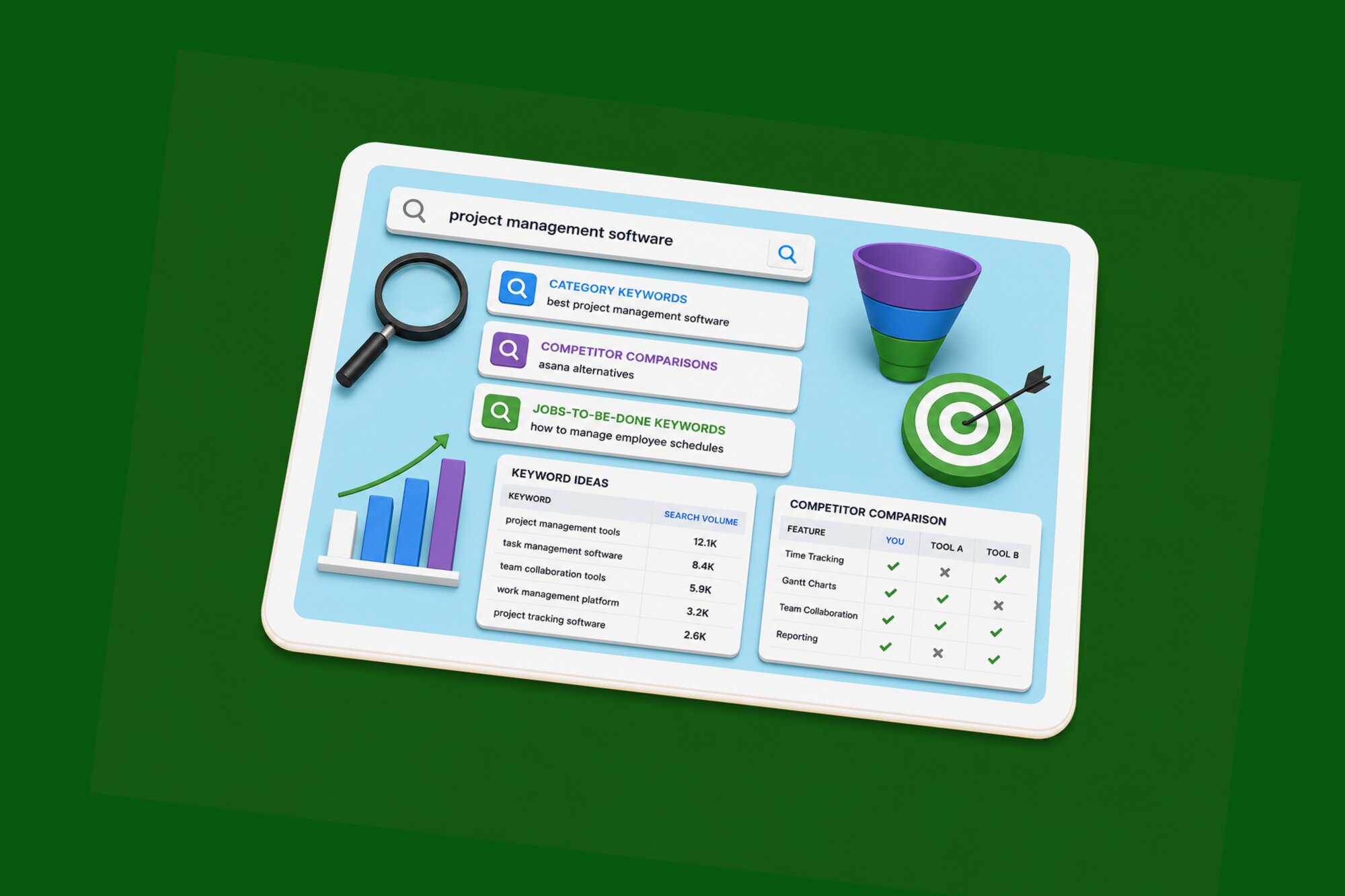
We group high-intent keywords into three buckets: category keywords, competitor comparison and alternatives, and jobs-to-be-done keywords. These three buckets sit at the bottom of the funnel, where buying intent is highest, which is exactly why they convert.
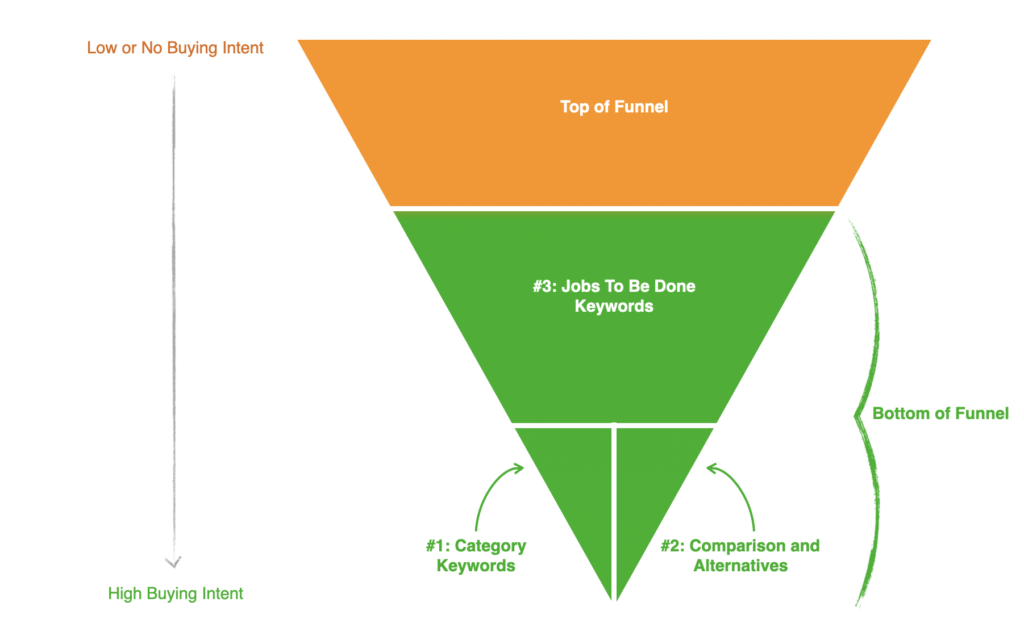
First, we’ll discuss each of these in detail including what they are and average conversion rates. Then, we’ll show how we uncover dozens of opportunities in each category by interviewing your customer-facing teams.
Category Keywords
These are searches like “best [tool type],” “[category] software,” or “[service type] for [use case].” The searcher knows they want a solution and they’re looking to compare their options.
In our analysis of 95 blog posts across clients, category keywords converted at an average of 4.85%.
Most teams can find their most obvious category keywords (the ones they want their homepage to rank for). For example, a project management software company will land on ‘project management software’ and ‘project management tools.’ But they’ll often miss adjacent category terms like ‘task management software,’ ‘team collaboration tools,’ or ‘work management platform’.
In our experience, there are way more than people think.
For example, in the first year of working with one all-in-one SaaS client, we uncovered over 200 high-intent keywords just from this bucket alone. That’s not unusual. We’ve seen this happen countless times across clients in healthcare, finance, logistics, project management, and more.
To find even more category keywords, you have to get specific. Every feature, use case, industry vertical, and niche variation can be its own keyword. For example, “medical project management software” or “work management platform for remote teams”.
As you’ll notice in the examples above, this is also the primary bucket where long-tail keywords come into play. Long-tail category keywords are often less competitive and therefore easier to rank for, while still converting at a high rate. We’ve written at length about long-tail keywords and how to think about them:
- Long-Tail Keyword Strategy: What It Is, Pros, Cons & More
- How to Rank for Long-Tail Keywords: Why Dedicated Content Is a Must
Competitor Comparison and Alternatives Keywords
These are searches like “[Competitor] alternatives” or “[Tool A] vs [Tool B].” The searcher is already deep in the buying process, meaning they know the category, they’ve identified at least one product, and they’re actively comparing. That proximity to a buying decision is why this bucket converts at 7.5%+ on average, the highest of the three.
Many people skip these keywords because search volume appears low, but we target them anyway. Near-zero-volume comparison keywords regularly drive real conversions because SEO tools chronically undercount these search queries. And, the high conversion rate is enough that even modest search traffic produces meaningful results.
Another tip is to not discount comparison keywords (tool A vs tool B) just because you aren’t one of the tools mentioned. We often target comparison keywords that name two competitors and then simply add our client’s name to the comparison. These posts still typically rank and convert quite well.
Jobs-to-be-Done Keywords
JTBD (jobs-to-be-done) keywords indicate that someone is trying to solve a problem your product helps with. They’re not searching for your product or a competitor by name, but they have an active pain point that can only be solved, or at least can best be solved, with your software or service.
The most common form is “how to” searches, but JTBD keywords can also include “ways to,” “can I,” and “should I” queries. There are also variants without a trigger word at all, such as “find therapist” or “hire movers”. These variations still surface how-to-style results because Google infers the search intent.
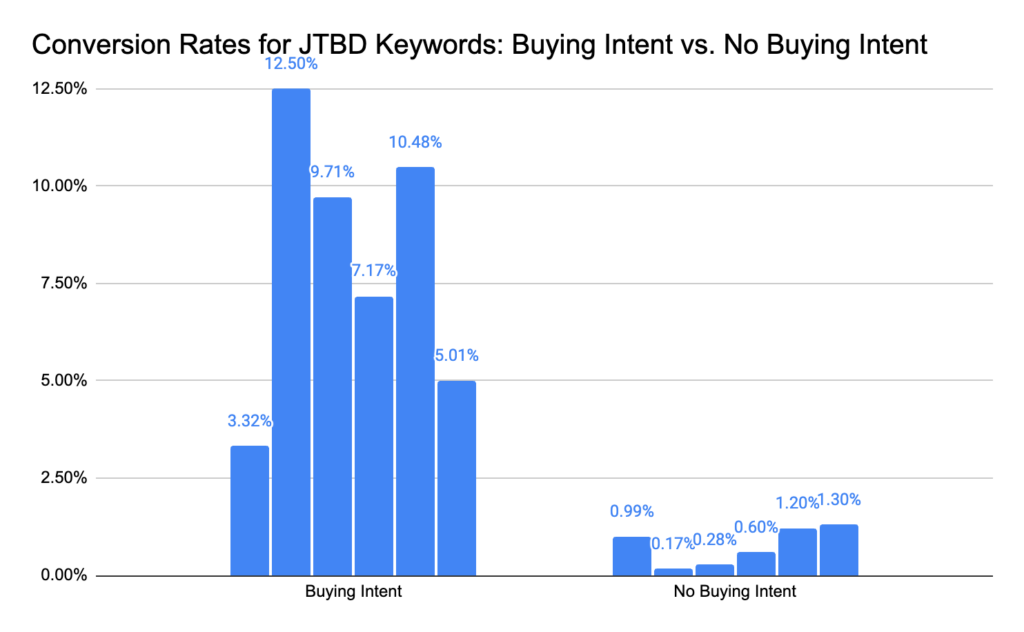
However, not all JTBD keywords carry equal buying intent. Someone searching “how to manage employee schedules” likely needs a tool to do it. Someone searching “how to prioritize your team’s tasks” could want a tool or could just be after a method they can apply on their own. The more mixed the intent could be, the lower the conversion rate.
We see this clearly in our own data. JTBD keywords with clear buying intent convert way higher than ones where the intent is more informational.
Why Most Keyword Research Falls Short (and How Interviews Fix That)
Some common recommendations for finding high-intent keywords are to look at your Google Ads and other PPC campaigns and see which ones are converting well, or use a keyword research tool. We think this is useful advice, and we often do this for clients who have solid paid search campaigns running. But in our experience, it usually only covers the most obvious keywords. There are almost always a lot more interesting or high-buying-intent keywords available for organic rankings that don’t show up in paid search campaigns.
SEOs will also often tell you to conduct customer surveys and/or look at your competitors’ keyword strategies. But surveys are expensive and can take a long time to return meaningful results. And while looking at competitor keyword strategies can be helpful, it’s not guaranteed to unearth keywords that will convert well for your brand.
Instead, what we find works much better than the strategies above is interviewing internal customer-facing teams.
The people who talk to your buyers every day, such as sales, customer success, and support, already know what problems bring your customers to you, the other tools they were using or considering before you, and the exact language customers use to describe the solutions you provide.
The goal of these interviews isn’t to have them tell you what keywords to target but rather to surface the jobs, pain points, and comparisons that are already happening in customer conversations. Then, you can take those and find related keywords with search volume.
Some questions we use are:
- “What problem did customers say they were trying to solve when they first reached out?”
- “What other tools were prospects already using or considering?”
- “What tasks do customers say they’re trying to accomplish with the product?”
- “What do customers ask about most in early calls or support tickets?”
The answers to these questions map almost directly onto the three buckets we covered earlier. From there, you run those phrases through a keyword tool like Ahrefs or Semrush to confirm search volume, find variations, and build out your full list.
How to Write So That You Consistently Rank Well for High-Intent Keywords
Once you have your keyword list, the decisions you make about how to structure and write the content will determine whether you actually rank and convert. Here’s what we focus on with every client to make sure they do both.
Let Google tell you whether similar keywords need separate pages. A common mistake is lumping related keywords together into one post. For example, “accounting software” and “accounting tools” sound similar enough that it feels redundant to write two articles. But if Google is ranking different pages for each, that’s a signal the intent is distinct enough to warrant its own piece of content. On the other hand, if Google is ranking the same pages for two keywords, you can target both with one post. If it’s a close call, start with one post and see if it ranks for both. If it doesn’t, create a second. We go deeper on this in another article.
Use blog posts, not just landing pages. You can rank a product or landing page for high-intent keywords, and sometimes that’s the right call. But landing pages typically don’t let you get specific enough or give you enough real estate to go deep into how you solve the given pain point. Blog posts frequently outrank them because you can create lots of them, each one designed for a specific intent, and they give you the real estate to go deep on the pain points and your solution. All of which is what the user is looking for and is what will convince them to try your product or service.
Sell your product in detail inside the content. This is where a lot of otherwise good content falls short. The reader landed on this page because they’re actively evaluating solutions. They want to know about your product in detail. That’s not a distraction from the useful content; it is the useful content. Soft product mentions don’t satisfy that intent. Going deep on what your product does, how it solves the specific problem, and why it’s the right choice is what the reader came for. You also don’t need to pretend to be unbiased. They can see who wrote the post, so they know you’ll be biased towards your own product. Admitting that builds trust.
Use your interview insights to write with specificity. The same internal interviews that surface your keywords also give you the exact language, pain points, and objections to write with. A post written using the company’s expertise reads completely differently than if you had just Googled the topic yourself. That’s what separates content that’s actually helpful and unique (and therefore converts) from content that just ranks.
Final Note: How to Show Up for High-Intent Prompts in AI Search
Creating high-buying-intent content is especially important for showing up in AI search responses. TOFU content is largely dead in AI search because AI models synthesize and answer informational queries themselves. So, for example, there’s little reason for them to cite your article explaining what project management is.
What actually brings you traffic and qualified leads is getting mentioned as a solution to a problem.
However, unlike traditional SEO where you’re targeting known, defined keywords, AI prompts are unique to each user. There’s no way to know exactly how someone will phrase their query. They aren’t entering a 2-7 string of words. They’re having long conversations about themselves, what the problem is, and what they’re looking for. There’s no way to replicate that.
The only way to show up when a logistics manager at a mid-size company asks AI to recommend route planning software that his team of old-school truckers will be willing to adapt for a fleet under 50 vehicles is to have content that actually speaks to that.
The good news is that the content strategy we’ve laid out in this article is the right foundation for AI search visibility too. For a deeper look at how to think about this, see our articles on BOFU Content in AI Search, why tracking AI visibility percentages doesn’t make sense, and what to prioritize first to show up in LLMs. And if you want to track how visible your brand actually is across ChatGPT, Perplexity, and Google AI Overviews, we built Traqer AI for exactly that.
Join the Grow and Convert Newsletter
Get our marketing ideas emailed weekly.
Explore Articles By Categories


Explore our Videos