We often talk to brands that tell us, “We’ve been doing SEO for a while, but it isn’t working.” What we’ve learned over time after digging into the details behind these comments is that when a founder tells us “our SEO isn’t working,” what they mean is: “We’ve been publishing content for months, maybe we’re getting some traffic, but we’re not getting leads.”
It’s not that search engine optimization doesn’t work. It’s that the way most companies do SEO doesn’t work. There’s a difference.
In our experience working with over 100 clients at Grow and Convert, the reasons fall into the same three categories almost every time:
- They’re targeting the wrong keywords
- The content itself doesn’t convert
- They’re measuring the wrong things
Let me break down each one. Then I’ll show you what it looks like when you fix all three, using real conversion data from one of our clients.
Problem 1: You’re Targeting the Wrong Keywords
This is the most common reason SEO “doesn’t work.” Most companies miss it because, on the surface, their keyword strategy looks fine.
Here’s what typically happens: a company hires an SEO agency or brings someone in-house. That person does keyword research in Ahrefs or Semrush, sorts by search volume, and picks keywords with the highest numbers. They target terms like “what is time tracking” or “best practices for employee scheduling” or “how to improve productivity.” These are real searches. They have volume. They look like opportunities.
The problem is that the person searching “what is time tracking” isn’t looking to buy time tracking software. They might be a student writing a paper, a manager doing preliminary research, or someone who just wants a definition. There’s no buying intent behind the search.
Yet SEO firm after SEO firm prioritizes keywords this way: by search volume over buying intent. So brands end up with a library of content that may drive traffic (sometimes a lot of traffic) but has extremely low conversion rates to leads, pipeline, or revenue.
Our approach is different. Instead of prioritizing keywords by search volume, we prioritize by buying intent. We ask:
Which keywords indicate that the searcher has a problem our product or service solves?
Those are the keywords that convert.
We call this Pain Point SEO.
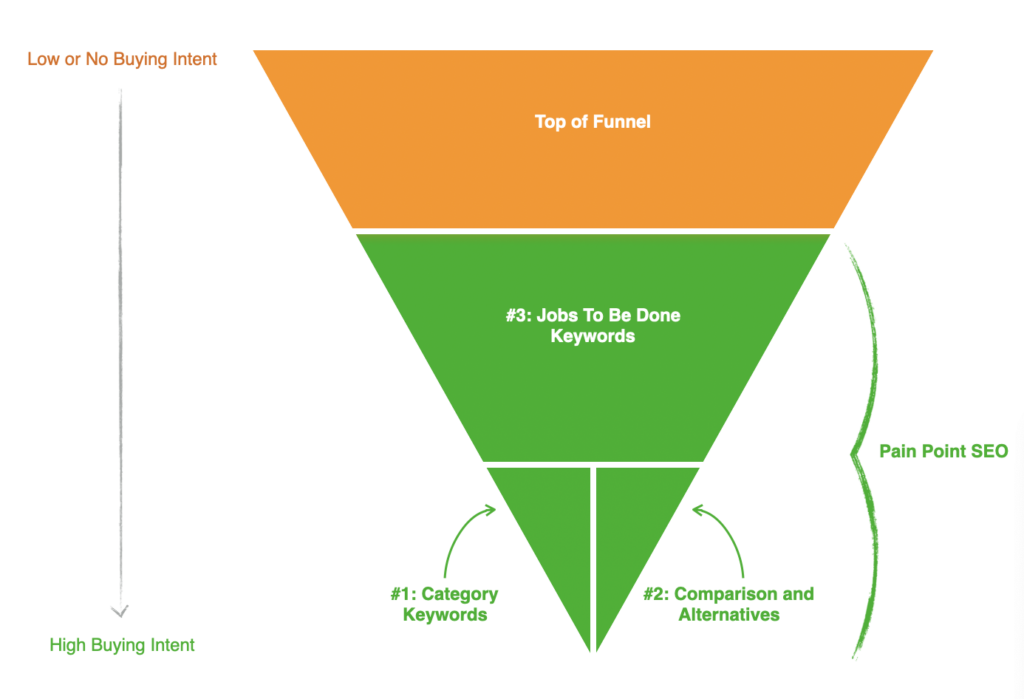
The difference in results isn’t small. Across our client base, high buying-intent keywords convert at 10x–20x the rate of top-of-funnel informational keywords.
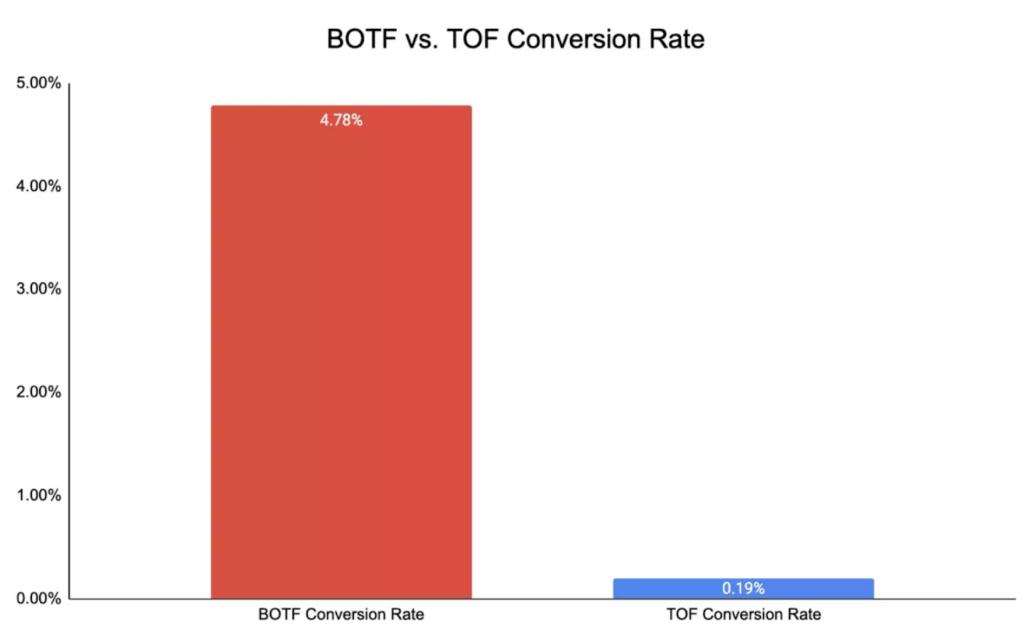
I’ll show you the data later in the piece — and the gap is striking.
The Other Keyword Mistake: Spreading Too Thin
There’s a second keyword problem I see constantly, especially from agencies. Instead of focusing each article around one keyword and writing the best possible piece for that specific search intent, they try to stuff multiple keywords into a single article. The logic is tempting: “If we target five keywords instead of one, we’ll rank for more things.”
But when you do this, the opposite happens. The article doesn’t rank well for any of them because it’s not focused enough to satisfy any single searcher’s intent. Search engines can tell when a piece is trying to be about five things at once. So can readers.
Each article should target one primary keyword. Build the entire piece around what that specific searcher needs to know — and how your product solves their problem. Search engines reward that kind of focus.
Do that one thing well.
Problem 2: Your Content Doesn’t Convert (Even If It Ranks for High-Intent Keywords)
You can do everything right on the keyword side — rank high for high buying-intent keywords, get real traffic — and still generate almost no leads from your blog. Why? Because the content itself isn’t written to convert.
Most blog content reads like Mirage Content. It looks good when you skim it, but when you actually read it, there’s nothing there that a competitor couldn’t say. Nothing that shows the reader why this company, specifically, is the one to solve their problem.
Here are the typical problems we see on the content side:
- The writer lacks subject matter expertise. Most content is written by freelancers or generalists who Google the topic for 30 minutes before writing (we call content like this “Google Research Papers”). The result is surface-level content because the writer doesn’t know enough to go deep. Your target customer, who has been in their industry for years, can tell immediately. They’ll read two paragraphs, realize the writer doesn’t actually understand the space, and leave.
- The content doesn’t sell the product. There’s a widespread belief in content marketing that blog posts shouldn’t be “salesy.” We disagree. Your blog posts should demonstrate how your product solves the reader’s problem. Not with a hard pitch, but with specificity. Show your product in action. Walk through real use cases. Include screenshots. The reader is searching for a solution. If your content doesn’t show them that you have one, you’re leaving conversions on the table.
- AI is making this worse. These content problems existed long before AI (we wrote about Mirage Content in 2017), but they’re now being amplified by it. As our survey of marketers about AI writing showed, the vast majority of in-house teams and agencies are using AI assistance to produce content. We do too. But most are using it the wrong way and just producing more low-quality Google Research Papers. AI isn’t the problem. It’s just speeding up how fast teams can produce mediocre content.
The fix is writing content that demonstrates real expertise. That means interviewing subject matter experts inside the company (founders, product leads, salespeople), outlining the piece around the specific searcher’s problem, and writing at the depth level of someone who actually works in the space.
Problem 3: You’re Measuring the Wrong Things
Many in-house content marketers and digital marketing teams focus on metrics like pageviews, number of pieces published per month, and keyword rankings. Why? Because if they were measured by leads, demos, or pipeline, the numbers wouldn’t look good. So they focus on metrics that prove “success” without actually moving the needle for the business.
Here’s a real example. One of our clients, a time and attendance software company, came to us after working with another agency for over a year. The business owners told us their SEO wasn’t working. But when they showed us the reports the previous agency had been sending, the agency’s metrics told a different story. Rankings were improving. Organic traffic was growing. Articles were being published on schedule.
The problem? The agency had never set up proper analytics to track conversions. They were reporting on rankings and traffic, sending polished monthly decks that showed upward-trending charts, and counting how many pieces they published each month. But they weren’t measuring how many trial signups or paid conversions the content was actually driving.
The founders couldn’t see business impact from SEO because no one was tracking business impact.
This pattern is more common than people think. A lot of agencies and in-house teams measure SEO performance by:
- How many articles we published this month
- How much organic traffic the blog is getting
- What keywords we’re ranking for
- The domain authority of the backlinks we built
- Bounce rate and page speed scores
None of these are business metrics. They’re activity metrics. They tell you whether your SEO efforts are happening, not whether they’re working.
The metrics that actually matter are:
- How many conversions (demo requests, trial signups, contact form submissions) did each blog post and landing page drive this month?
- What’s the conversion rate by article?
- Which pieces are generating real pipeline?
If you can’t answer those questions, you don’t actually know whether your SEO is working. You just know you’re publishing content. And publishing content doesn’t mean SEO is working.
What Happens When You Fix All Three: A Case Study
Here’s what happens when you get all three of these right. This is the same time and attendance software client mentioned above.
When we started working with them, we did three things differently from their previous agency.
First, we identified their highest-intent keywords. Instead of targeting broad terms or stuffing multiple keywords into each article, we focused each piece around one bottom-of-funnel keyword where the searcher had a real problem the software solves. Category keywords like “[product type] app,” category keywords with a specificity layer like “[product type] for [industry]” or “[product type] with [feature],” and use-case keywords like “apps to [job to be done].”
Second, we produced the content by interviewing their founders. We didn’t hand topics to freelancers. We interviewed the company’s founders and small business operators to capture their actual expertise about the time clock software space. The content reflected real industry knowledge, specific product details, and the kind of depth that only comes from people who’ve built the product and talked to thousands of customers.
Third, we invested in link building and set up analytics tracking to measure conversions by article. Every blog post was tracked individually for trial signups, paid conversions, and conversion rate. This allowed us to see exactly which pieces were driving business results and double down on what worked.
The Results
We worked with this client for about three years. Here’s how the numbers progressed:
- Organic traffic: 69 visitors/month → 11,555 visitors/month
- Free trial signups from the blog: 0/month → 295/month (at peak)
- Paid signups from the blog: 0/month → 55/month (at peak)
- Blog conversion rate: 1.7% → 3.9% (visitor-to-trial)

Over the full engagement, we published 111 blog posts that collectively drove 6,680 trial signups. But here’s where it gets interesting.
Not All Keywords Are Created Equal
When you look at the conversion data across all 111 articles, the distribution is extreme.
15% of the articles drove 80% of all conversions.

And those top-performing articles were almost exclusively targeting high buying-intent keywords: core category keywords and category keywords with a specificity layer.
Here’s the breakdown by keyword type:

Look at that last row: 16 informational articles. 40 total conversions. An average of 2 per article.

This is the data behind why your SEO isn’t working. If your content strategy is built around informational, top-of-funnel keywords, you could publish content for years and barely move the needle on leads. It’s not that SEO is broken. It’s that your keyword strategy doesn’t match your business goal.

What’s the value of going after more keywords if 15% of the articles drove 80% of conversions?
Fair question. If 15% of articles drove 80% of conversions, what’s the point of the other 85%?
Two things.
First, you can’t predict which articles will be top performers before you publish them. Some keywords you’d expect to perform well (like broad category terms) underperform, while narrower, long-tail terms you’d consider secondary end up driving hundreds of conversions. The only way to find your winners is to publish a portfolio of high-intent pieces and let the data tell you.
Second, the other 85% of articles aren’t worthless. They still drive incremental conversions that add up over time. They build topical authority, which helps the entire domain rank better in search engines. They support link building and earn quality backlinks. Internal linking strengthens the whole site. And they cover the full range of ways your prospects search for solutions.
You get to a total of 295 trial signups per month (our all-time high for this client) from dozens of articles working together, not from a single post.
The takeaway isn’t to publish fewer articles. It’s to make sure every article you publish targets the right keywords — ones with real buying intent.
How to Diagnose If Your SEO Isn’t Working
If you read this and thought “Ok, our SEO probably isn’t working,” and you want a specific checklist to figure out which of these problems is the cause, here it is.
Step 1: Look at your keyword list.
Pull up every keyword you’re targeting. For each one, ask: is the person searching this keyword looking to buy or evaluate a product like mine? If the majority of your keywords are informational (“what is X,” “how to Y,” “best practices for Z”), that’s likely your primary problem.
Step 2: Read your content as if you’re a buyer.
Pick your top five posts by traffic. Read them. Ask yourself: does this article show how a specific product solves a specific problem? Or does it read like a Google research paper that could appear on any competitor’s blog? If it’s the latter, your content isn’t converting because it isn’t written to convert.
Step 3: Check your analytics setup.
Can you tell me, right now, how many conversions each individual blog post drove last month? If you can’t, you don’t actually know whether SEO is working. Use Google Search Console to monitor search performance, and set up goal tracking in Google Analytics or HubSpot so you can measure conversions at the article level.
Step 4: Look at the results through the right lens.
Once you have conversion data by article, sort by conversions instead of traffic. The posts driving the most traffic and the posts driving the most conversions are almost certainly different lists. That gap tells you everything you need to know about your keyword strategy.
If you’re looking for SEO experts to fix your strategy, you can learn more about our process and inquire here.
Join the Grow and Convert Newsletter
Get our marketing ideas emailed weekly.
Explore Articles By Categories


Explore our Videos