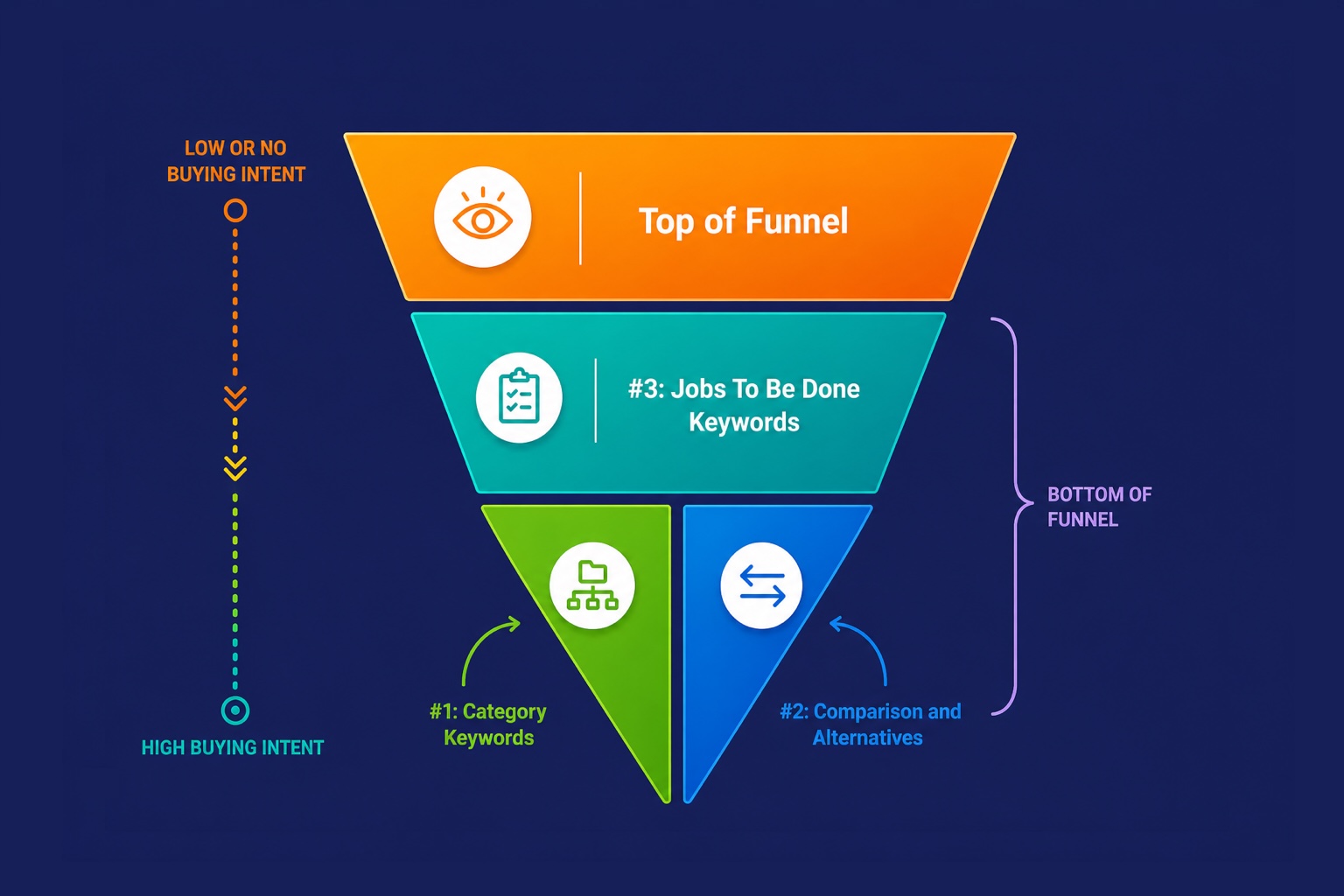
Unlike top of the funnel or middle of the funnel content, bottom of the funnel content is designed to target potential customers who are ready to make a buying decision.
For example, if you’re a software company that helps small business owners track employee time off, then a blog post or landing page written to rank for the keyword “best employee time off tracking software” is BOFU content. People searching for queries like that are ready to make a purchase.
That conversion potential is BOFU content’s primary selling point, and we’ve been preaching the benefits of bottom of the funnel content for years.
We think too many brands overfocus on top of the funnel content and would be better off prioritizing BOFU instead. We have plenty of data to back that up, including a conversion analysis of 95 articles we’ve written for clients.
We’ve noticed, however, that even when marketers publish BOFU content, they make several mistakes:
- Using the wrong criteria to pick topics. In our experience, marketers pick keywords using one of two frameworks: (a) researching what the competition is ranking for and (b) prioritizing keywords by search volume. Both criteria are worth considering as you develop your strategy, but neither is a strong enough indicator on their own when choosing which topics to write about.
- First, just because a competitor ranks for a keyword doesn’t mean that keyword is driving leads, or that it would drive leads for you. A competitor might be ranking for topics with no buying intent. They also might be ranking for BOFU topics where you cannot meaningfully differentiate yourself (i.e. topics where you’re not going to connect with your target audience).
- Second, higher keyword volume doesn’t translate to more conversions. In fact, we have seen organic leads grow for our clients when targeting mini-volume or even zero-volume keywords. (Keyword volume becomes even less meaningful when your goal is to show up in AI search. No one knows what queries are being typed into AI tools like ChatGPT and Gemini, but we do know that ultra-specific writing is showing up in AI search results.)
- First, just because a competitor ranks for a keyword doesn’t mean that keyword is driving leads, or that it would drive leads for you. A competitor might be ranking for topics with no buying intent. They also might be ranking for BOFU topics where you cannot meaningfully differentiate yourself (i.e. topics where you’re not going to connect with your target audience).
- Writing bad content. This can negate the benefits of publishing BOFU content. For example, the content may not match search intent and fail to show up in search engines, or it may not address specific customer pain points and struggle to convert.
At Grow and Convert, we’ve always championed the importance of addressing the exact pain points your customers have, not surface-level overviews, in our content. This approach has paid off for our clients in the past, and is continuing to pay off as more customers use AI search. This is because AI search results tend to be very specific to the user, based on chat history. We wrote about this aspect in our piece on Invisible Prompts. The more specific and precise your content, the more likely LLMs and Google are going to connect you with your target audience. - Not knowing how to make strategic choices based on what’s working. As you publish more content on your site, you’ll start tracking success through various metrics, such as page views, rankings, AI visibility, and new leads. But often companies focus on the wrong metrics or miss the full picture — like seeing declining Google traffic and concluding their BOFU content isn’t working, while not realizing that the same content is being recommended in AI search tools they aren’t tracking.
At Grow and Convert, we create organic channels that bring in qualified leads for brands. We do this by writing bottom of the funnel content that matches what your target customers are looking for.
We publish this content on a client’s blog so it can rank in search engines (both traditional and AI search). This creates an organic channel that drives conversions. We’ve been doing this for a decade, across a wide variety of clients, and have a lot of data on what bottom of the funnel content types convert the most.
In this article, we look at different types of BOFU content (with examples of content we’ve written for clients), how to find the best BOFU topics for your company, and how we write BOFU content.
Table of Contents
- 5 types of BOFU content. We cover five types of BOFU content and show actual data on how well they convert for our clients.
- How to come up with bottom of the funnel content ideas. We share how we ideate topics with new clients and why we don’t start with keywords, even though SEO is key to our process.
- How to write bottom of the funnel content. We discuss our research-based method, which lets us write high-quality, rankable content across various industries.
- Measuring your BOFU content and making data-informed decisions. We cover what metrics to track — including conversions, rankings, and AI visibility — and how to use that data to decide which content to double down on, re-optimize, or deprioritize.
5 Types of Bottom of the Funnel Content Shown to Drive the Most Leads
To help us find out what type of BOFU content converts the most, we analyzed 95 articles across clients, totaling over 123,000 organic pageviews and 4,687 conversions.
Across that dataset, we identified five types of content:
- Category keywords
- Side category keywords
- Category keywords with a layer of specificity
- Comparison and alternatives keywords
- Jobs to be done keywords
(Read more about the conversion rates across these keywords.)
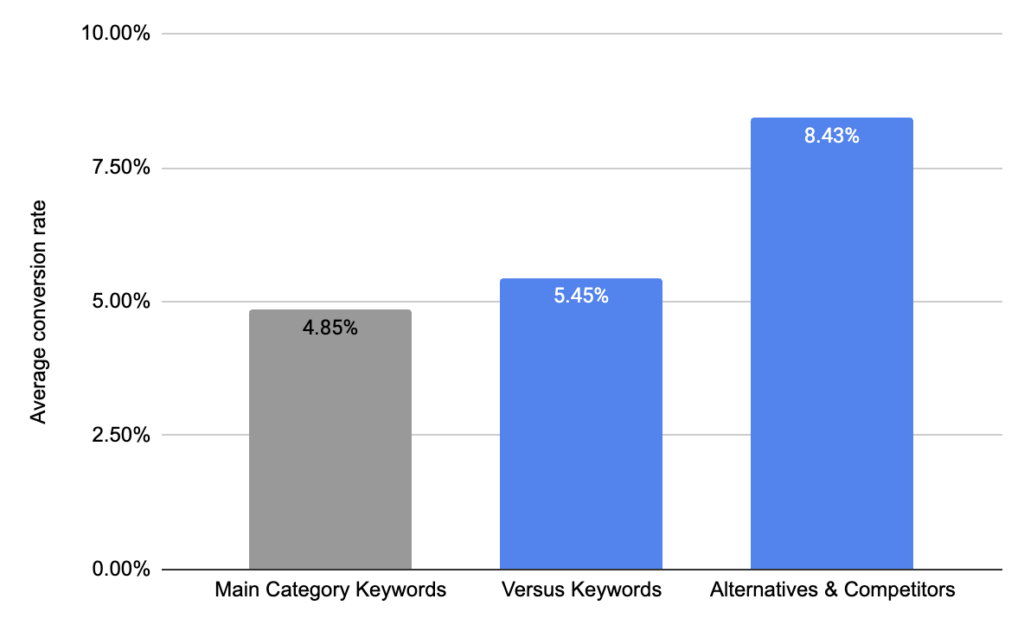
1. Category Keywords (4.85% Average Conversion Rate)
These are queries that describe exactly what you offer. Think of topics like “best accounting software” or “men’s running shoes.” For Grow and Convert, a category keyword would be “content marketing agency,” because that’s what we are.
Most people don’t expect blog posts to convert at multiple percentage points, but our data shows they can when they rank for the right keywords and are written to sell the product. For example, Geekbot, a past client and a solution for running online standup meetings, ranks #2 for “Slack standup bot” via a post we wrote for them, and that single blog post has a lifetime conversion rate of 8.36%.
To be clear, this is extremely high, and essentially unheard of for a typical blog content strategy (which heavily skews to top of funnel content). For example, in one of our clients we compared the conversion rate of BOTF vs. TOF content.
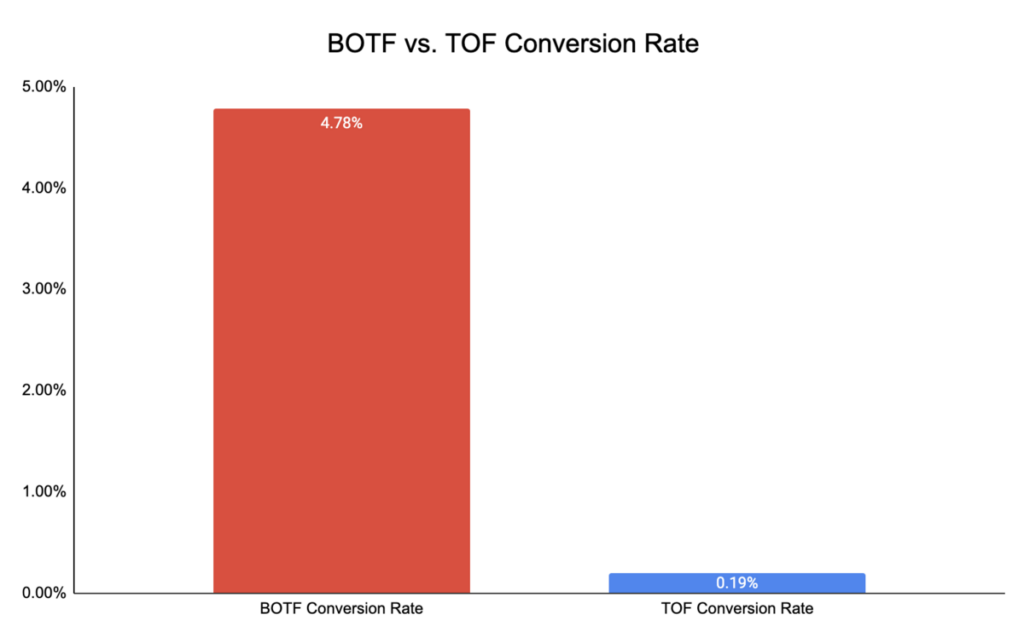
Their TOF content converted at just .19%, while their BOTF content had a 4.78% conversion rate.
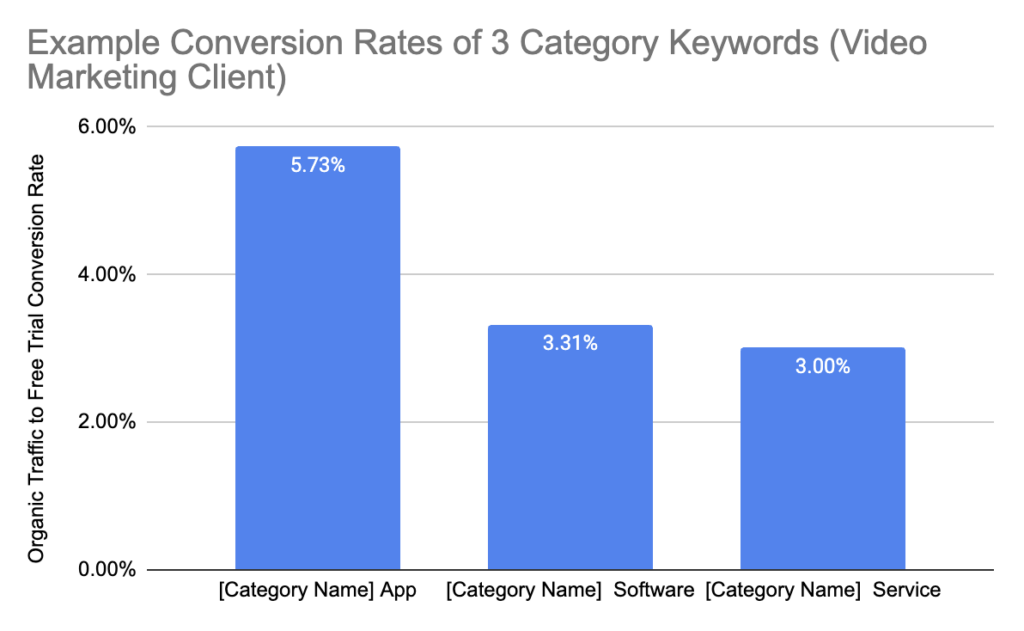
We’ve seen this pattern across clients: when you target variations of your core product keywords, most variations convert well. A video marketing client we ranked on page one for app, software, and service variations of their category saw conversion rates of 5.73%, 3.31%, and 3.00%, respectively. Not every variation will convert equally, but category keywords consistently convert at 3–5% or higher across our clients.
When you’re developing your BOFU content strategy, you want to identify your main category keywords.
2. Side Category Keywords (1.94% Average Conversion Rate)
These are queries that show buying intent for a secondary feature or use case — not your core offering. Many companies build content to promote these offerings, and while these keywords don’t usually convert as well as your main category keywords, they still can drive leads.
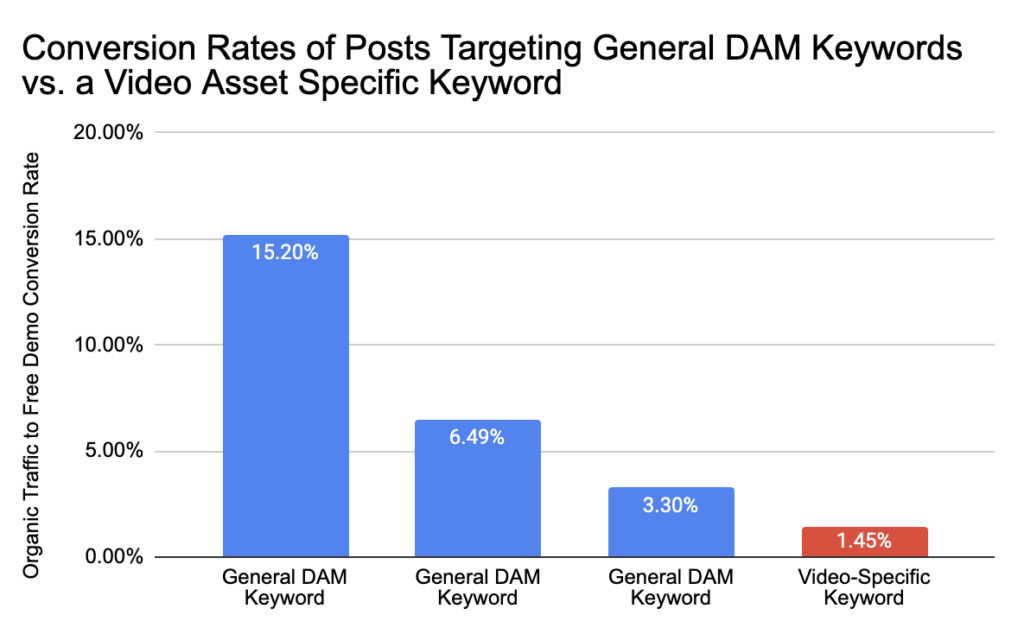
For example, one of our clients sells digital asset management (DAM) software. Based on our conversations with their sales team, we wrote a BOFU post on storing video assets, a specific use case within their broader product. That post converts at 1.45%. That’s still far higher than typical top of funnel content, but their posts targeting general DAM keywords convert at 3%, 6%, and even 15%. The difference comes down to fit: users who only need video storage could opt for something simpler, whereas users searching for general DAM software need exactly what this client offers.
3. Category Keywords + Layer of Specificity (2.96% Average Conversion Rate)
These are queries that add a word or two that make them more specific to a particular feature, use case, or customer type. For example, adding “for small business” to “best accounting tools,” or adding “for trail running” to “men’s running shoes.” You’re targeting searchers who already have some knowledge of the category and are searching for a very particular solution.
Here’s a recent example from our client that works in the private education space. Their main category keywords are topics like “best private schools in california” or “best private schools in the US.” But a key part of their offering is working with students that have learning differences, such as dyslexia, ADHD, and autism.
For this client, we targeted the topic “dyslexia private schools.” That’s a more specific query than “best private schools.” It has a smaller audience and smaller search volume, but it’s been a major driver of conversions for our client. It has an average conversion rate of 1.11%.
Taking this learning, we also targeted “private schools for autism,” which while bringing in less traffic, has brought in more conversions with a higher average conversion rate of 2.32%.
Note this kind of specificity has an additional benefit for AI search, where LLMs recommend products that are highly specific solutions to the users situation or problems. More on this below.
4. Comparison and Alternatives Keywords (8.43% Average Conversion Rate)
These are queries that mention competitor names, indicating the searcher is aware of other brands in your industry, is looking for alternatives, and could be a good candidate for your solution. This includes keywords like “salesforce alternative” or “Salesforce vs. Pipedrive.”
These were the highest converting keyword types in our analysis. This makes sense: these searchers already know about your industry, are familiar with competing products, and are actively evaluating options with a serious intent to buy.
But you want to be strategic about which competitor keywords you target. From our data, keywords mentioning direct competitors convert significantly better than those featuring loosely related competitors. Although the average conversion rate is 8.43%, the majority of the 23 competitor keywords we analyzed actually converted at less than 4%. The closer the competitor is to your product, the higher the conversion rate.
That said, even conversion rates between 1–4% are far higher than top of funnel content. And many comparison and alternative keywords have very low search volume — but as we’ve seen with our analysis of mini-volume keywords, the high conversion rates make them well worth targeting.
VS Keywords
These are a specific flavor of comparison keywords — queries comparing two solutions head-to-head, like [Brand #1] vs. [Brand #2]. The searcher is trying to decide between two specific options they’re already considering, which is why these converted at 5.45% in our analysis.
5. Jobs to Be Done Keywords (2.44% Average Conversion Rate)
These are queries that describe a job to be done (which is a problem to be solved) that your product offers the best solution for. These are mostly “how to” queries: how to organize design files, how to do a poll in Slack, how to get video testimonials from customers, etc. Although these users may not be aware of your brand or competitors, they still have the potential to buy because they have a job or problem that you solve.
While these types of keywords have a lower conversion rate than the above buckets, 2.44%, they still convert leagues higher than typical top of funnel blog content. Also these JTBD keywords often have higher search volume, which means more traffic.
And when the job in the query maps directly to what your product does, these keywords can convert incredibly well. For example, “collect video testimonials” — a keyword we targeted for a video marketing client — converts at 9.71%, because the searcher needs software to do that exact task and our client’s product is built for it.
The takeaway is that looking at the highest average conversion rate and focusing only on those keyword types is not a strategy. There is a large variety in what converts well, based on the client and the types of customers they serve.
How to Come Up with Bottom of the Funnel Content Ideas for Your Business
Often agencies approach content ideation in one of two ways: they open a keyword tool and target whatever keywords have the highest search volume, or they look at what competitors are ranking for and try to cover the same topics.
Neither approach is wrong on its own, but when your goal is to build an organic channel that generates qualified leads, they’re not the best starting points. High-volume keywords may not align with what your ideal customers are actually searching for when they’re ready to buy. And just because a topic works for a competitor doesn’t mean it’s the right fit for your business — their customers, positioning, and strengths may be completely different from yours.
Instead, the more effective approach is to start by asking: what problems do our customers have that our product solves?
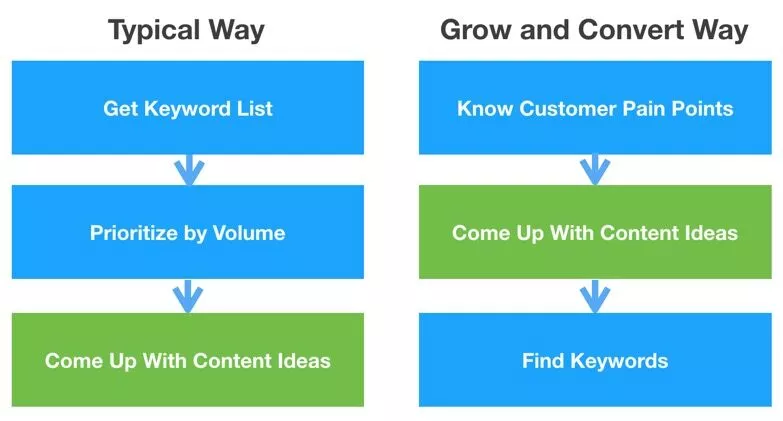
At Grow and Convert, we begin every new client engagement with a series of interviews with people from different departments, sales, customer success, founders, anyone who has direct interaction with customers. The goal is to understand the details of the product, the ideal customer personas, and most importantly, the specific pain points that the product solves.
Outside of speaking directly with customers, this is the fastest way to identify topics that resonate with potential buyers and naturally position your product as the solution.
These interviews are what allow us to choose topics based on how your customers actually search, rather than defaulting to whatever has the highest volume, mimicking what competitors are doing, or even relying on average conversion rates amongst types of BOFU content.
For example, one of our clients made a straightforward employee time off tracking tool for small business owners. Through our interviews with their team, we learned that most of their customers had been managing time off in spreadsheets and physical wall calendars. They weren’t coming from competing software. That insight changed the entire content strategy. Instead of prioritizing comparison and alternative keywords, which have the highest average conversion rate in our data, we focused on JTBD keywords like “how to track employee time off,” because that matched how their customers were actually searching. It worked: we grew a profitable organic channel for them by targeting keywords that matched their specific customers’ pain points.
Find Keywords That Correspond to Your Topics
Once you have topic ideas grounded in customer pain points, you can plug them into keyword research tools like Ahrefs or Semrush to check search volume and keyword difficulty. The role of keyword tools in our process is to confirm that people are actually searching for the topics you’ve identified, not to generate the topics in the first place.
The most important thing to resist here is letting search volume override buying intent. A keyword with 200 searches per month and high buying intent will almost always outperform a keyword with 10,000 searches per month that attracts people who are just learning about a topic. We’ve seen this repeatedly in client data: the posts that drive the most leads are rarely the ones with the highest traffic.
That said, not every topic you identify needs a Google keyword to be worth pursuing. With more customers using AI tools like ChatGPT and Gemini to find products and services, there’s demand happening in conversations that no keyword tool will ever show you.
As we mentioned above, LLMs recommend products based on the specificity and relevance of your content to a user’s situation, not based on whether you targeted a high-volume keyword (though we do see a positive correlation between ranking #1 for a keyword and showing up in AI results). So if your interviews surface a pain point that your product solves well but there’s no obvious keyword to match it to, it can still be worth producing content around that topic.
We’ve seen this with clients whose content is now showing up in AI search results for prompts we never could have predicted. We call this new type of search query answering Invisible Prompts, and it’s a big part of why we’ve developed a topic-based approach to GEO that doesn’t rely on keyword volume.
How to Write Bottom of the Funnel Content That Ranks and Converts
Choosing good high-intent keywords to target is the most important step but a close second in importance is how these pieces are written. If the content itself is generic or surface level (for example a very basic listicle of top software in a category) it risks you (a) not ranking and (b) not impressing or converting visitors that do land.
We’ve noticed this is actually extremely common, and we think it happens because most writers — and now most AI tools — don’t have deep enough knowledge of the product or customer to write anything original. Without that knowledge, they default to copying what’s already ranking in the SERP, which produces content that says the same thing everyone else is saying.
At Grow and Convert, we use a content writing process that helps us overcome these challenges.
- We interview subject matter experts. For every piece we write, we interview subject matter experts from within our client’s organization — sales leads, founders, product managers, whoever knows the product and customer best. This is the step most content teams skip. Without it, writers default to “Google research papers” — reading what competitors have published and repackaging it into a new article that says nothing original. The interview surfaces the specific details, positioning arguments, and customer insights that make a piece actually useful to a buyer. (Learn more about our content writing process here.)
- We conduct a SERP analysis. Before writing, we analyze what’s currently ranking on Google for the target keyword. We review the types of content on page one (listicles, how-to guides, landing pages), identify the subtopics and themes that come up repeatedly, and assess what existing results do well and where they fall short. This tells us what our piece needs to cover to compete, and where there’s an opportunity to differentiate. (Learn more about our SERP analysis process in our article on SEO Content Writing.)
- We use the Grow and Convert Questionnaire, not a formulaic template, to help us outline the piece. Most content briefs focus on logistics — word count, how many internal links to include, which heading tags to use, what Grammarly score to hit. But that kind of information doesn’t help a writer produce great content that will rank and convert.
Our questionnaire is fundamentally different. After the interview, writers answer a series of questions designed to help them synthesize what they learned from the interview and their SERP analysis. Our Questionnaire focuses on understanding the target audience at a level deeper than “our audience is a startup looking for accounting software” and understanding the SERP. - We draft the piece. The draft is written with the product woven throughout, not just mentioned in a CTA at the end. This means opening with the customer’s pain points, explaining the product’s positioning early to grab the right reader’s attention, and highlighting differentiating features as the foundation of the article. For example, when we wrote a piece for TapClicks targeting “paid search dashboard,” we structured the entire post as a walkthrough of how to create a dashboard using their product, which let us naturally showcase the features that made them different from competitors. (Learn more about our writing style in our post on How to Improve Your Content Writing.)
We’ve also built an AI writing tool, Wave Writer, that helps with this process. Unlike other AI writing tools that only learn your brand voice, Wave Writer ingests your business’s products, features, positioning, and customer pain points. It analyzes a SERP for any given keyword and suggests angles tailored to your business, produces outlines grounded in your actual arguments, and drafts content that says something substantive.
We used Wave Writer to do an SEO analysis for this very post, which you can view here, along with my comments on the output.
Measuring Your BOFU Content and Making Data-Informed Decisions
As discussed in this article, writing BOFU content is a good strategy to grow your organic channel. When done correctly — that’s writing about the right topics and writing content that ranks — your BOFU content can lead to new leads, free trial signups, demo requests, new customers.
But a key aspect of developing your BOFU content strategy is knowing what types of content to double down on, and what to deprioritize. At Grow and Convert, we track three things to create a full picture of your organic channel: conversions (our primary metric), keyword rankings and traffic, and AI visibility.
- Conversions. This is our primary metric. Traffic and rankings matter, but only because they lead to conversions — new leads, signups, demo requests. We track conversions from each piece of content so we can see which posts are actually driving business results, not just pageviews. (Learn how we track conversions in our article on measuring conversions in GA4.)
- Keyword rankings and traffic. Rankings and traffic tell you where you’re positioned, what’s growing, and where you’re slipping. For example, when one client saw a dip in conversions despite still ranking for their target keywords, we discovered they had lost rankings for secondary keywords — related keywords their posts had been ranking for that were quietly driving conversions. Re-optimizing 22 posts brought monthly conversions from 171 to 258. (Read the full process in our article on how to find and use secondary keywords to increase conversions.)
- AI visibility. Traditional search metrics don’t capture whether LLMs are recommending your brand. We track AI visibility at the topic level, not the individual prompt level. Our client Constitution Lending now appears in AI search results for 50+ bottom of the funnel prompts across ChatGPT, Perplexity, and Google AI Overviews — competing with lenders that have been in the market for decades. There’s still a gap in attribution here — it’s more difficult to track customers who found you through AI search — but visibility is the leading indicator. (Read more about our topic-based approach to GEO.)
Over the past eight years, we’ve built organic channels for clients across dozens of industries — from SaaS to healthcare to private education — using the process described in this article. Our BOFU content has driven thousands of conversions for clients, with conversion rates routinely hitting 3-10% on individual posts.
Our clients are now showing up in AI search results alongside competitors with decades of industry presence. If you want to build an organic channel that drives real leads, learn more about working with us.
Join the Grow and Convert Newsletter
Get our marketing ideas emailed weekly.
Explore Articles By Categories


Explore our Videos