Over the past 10+ years running our agency, we’ve helped to create and implement SEO strategies for dozens of B2B SaaS businesses and ranked for hundreds of valuable keywords on page one for our clients (as we’ve demonstrated in case studies like this).
During that time, particularly in the last two years, we’ve also seen the SEO landscape shift significantly. AI Overviews now appear for a large percentage of searches, zero-click searches continue to rise, and the top of the funnel content strategies that once drove traffic are producing diminishing returns for many companies.
These changes have made it even more critical to focus SEO efforts on the right keywords and the right content approach. And yet, through speaking with many different software companies who’ve done SEO previously (either in-house or through an agency), we’ve learned that companies and SaaS marketers often struggle to achieve the SEO results they’re seeking.
Specifically:
- They focus too heavily on top of the funnel, high-volume keywords that drive traffic but rarely convert (an approach that’s become even less effective as AI engines absorb informational queries).
- Their feature and solutions pages often don’t end up ranking for their intended keywords.
- They don’t see meaningful increases in trials, demos, and product signups as a result of their SEO efforts.
In our opinion, these are strategy problems, not issues at the tactical level (e.g. fixing broken links or doing on-page SEO). To fix these problems, you need to fix your SEO strategy.
In this article, we explain why these problems are so common among B2B SaaS businesses that try to do SEO. And then we walk through a 5-step process that you can follow to create a SaaS SEO strategy that solves these problems, based on the process we use at our agency.
The 5-step process we’ll cover includes:
- Identifying high-intent keywords: Prioritize finding keywords with high buying-intent, that is, those that indicate people searching are looking to buy or solve a problem your product solves — instead of only prioritizing search volume.
- Producing a unique piece of content to rank for each keyword: Create dedicated pages or blog posts for each keyword that deeply satisfies search intent instead of simply sprinkling SEO keywords throughout a bunch of blog posts.
- Selling your product through your content: Talk about your product extensively in these articles including outlining your unique product features and differentiators. Don’t worry about common content marketing myths about not selling your product.
- Technical SEO: Fix and monitor for technical SEO errors.
- External link building: Generate backlinks to boost domain authority and keyword rankings.
Curious about having us do SEO for your business? You can learn more here. Or, if you’d like to learn the SaaS SEO strategy that we share below, we also teach our content marketing strategy and process in our course and community.
How Most Businesses and Agencies Approach B2B SaaS SEO Strategy
As we mentioned above, we’ve spoken to many B2B SaaS companies about their past experiences doing SEO. And through those conversations, as well as what we see in our day-to-day work at the agency, we’ve observed that the typical SaaS SEO strategy consists of two key parts:
- Optimizing core website pages: Optimizing the core pages of their marketing website (i.e. home, feature, solutions, pages) for high-intent, software category keywords (e.g. “accounting software”).
- Producing blog content: Creating and publishing some form of blog content on an ongoing basis, and often prioritizing keywords based on search volume rather than buying intent.
There may also be some link building or technical SEO tactics that happen. But these are really the two key parts to the strategy.
Let’s take a closer look at each, and then below we’ll discuss the flaws of how this approach is typically executed in practice.
1. Optimize Home, Feature, and Solutions Pages for High-Intent Keywords
Most SEO agencies and SaaS businesses focus the majority of their SEO efforts on optimizing their core web pages — homepage, feature pages, and solutions pages — for a handful of target keywords.
The standard process for this involves:
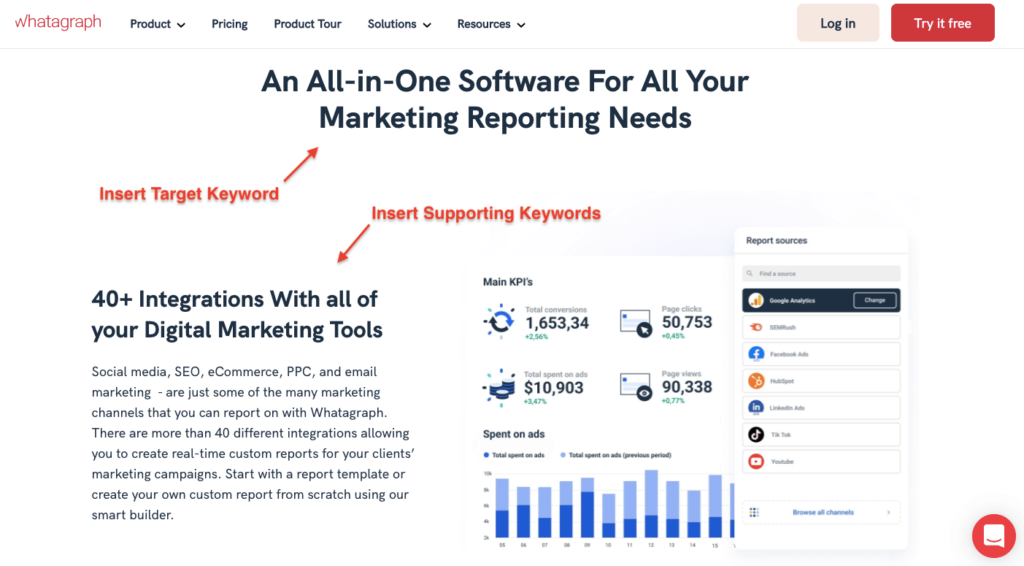
- Selecting primary target keywords for each page. These are generally the most obvious, high-value keywords that describe exactly what your product is (or what we call “software category keywords”) like “accounting software” or “enterprise CRM”.
- Selecting supporting keywords for each page. These are generally pulled from a list of keywords that keyword research tools suggest including in your page in order to rank for the primary target keyword.
- Optimizing each page for their target keyword. Adding the target keyword or keywords into the title tag, page headings, and page subheadings throughout each page. And then using on-page SEO tools and sprinkling the supporting keywords throughout the body copy, or creating FAQs at the end of the page to include those keywords.
For feature pages, they’ll often optimize for software category keywords (e.g. lead generation software, social media management software, etc.).
For solutions pages, they’ll often optimize for a particular industry or vertical they serve (e.g. marketing agency operations software, enterprise CRM software, etc.).
Homepages will often be optimized for either a brand keyword, a software category keyword, or a mix of both (e.g. QuickBooks accounting software).
This is the base-level strategy that B2B SaaS companies and SEO agencies implement. Once these pages are optimized, they build links to them in an effort to boost their rankings. But often they don’t end up ranking, for reasons we’ll explain below.
2. Create and Publish Some Form of SEO Blog Content
The second core part of the typical SaaS SEO strategy is to publish some regular cadence of blog content. And there are a few common ways that companies approach this:
- Outsource to freelance writers
- Outsource to content agencies
- Using AI writing tools to create content at scale
- Hire an in-house writer or content marketer
We’ve written extensively about the pitfalls involved with each of these, which you can read about here and here.
Outsourcing content is more common for SaaS startups, while larger and more established SaaS companies often opt to hire in-house. More recently, many companies have turned to AI writing tools to produce content faster and cheaper. But regardless of which option you choose, we usually see one of the following two problems:
- The keyword strategy prioritizes traffic over conversion. The predominant approach we see is what we call the “Top of the Funnel” volume-driven method:intentionally choose and prioritize keywords based on those that have the highest search volume, and write articles to rank for those keywords. These keywords are typically loosely related to the business’s target audience, but have no buying intent (and do not indicate people searching are looking to buy).
- The content lacks depth and differentiation. Whether it’s written by freelancers who don’t deeply understand your product, generated by AI tools, or produced by agencies doing surface-level research, the result is often the same. Most B2B SaaS content reads too generic with very little to no differentiation from the competitors. It might be factually accurate but it usually doesn’t offer unique insights, speak to specific pain points your product solves, and doesn’t give readers a compelling reason to choose you over competitors. We call content like this “Google Research Papers” because they resemble students writing a paper by Googling a topic and regurgitating what’s already been written without adding genuine expertise.
In our experience, neither of these methods are effective at generating trial or demo signups.
To be fair, many agencies have improved their practices in recent years, and many B2B SaaS SEO agencies now talk about “high buying intent keywords” and “conversion-focused content.” But in our experience, even when the language has evolved, the execution often prioritizes traffic over conversions.
Let’s look at why.
3 Flaws with the Typical Approach to B2B SaaS SEO Strategy
Flaw #1: It’s Difficult to Rank Home, Feature, and Solutions Pages for High-Value Software Category Keywords
As we mentioned above, SEO agencies and SaaS companies tend to focus the majority of their SEO efforts into optimizing the core pages of their marketing website for high-intent, software category keywords.
But there are fundamental attributes of these pages that make it difficult for them to rank for highly competitive, purchase-intent software keywords.
Namely:
- Core website pages have limited space to include relevant SEO keywords. It often takes including 50+ supporting keywords (worked in naturally — not “stuffed” in) to rank for a given target keyword. And typical home, feature, and solutions pages don’t offer enough space in the headings and body copy to naturally include this volume of keywords.
- Core website pages are first and foremost meant to explain your features and solutions (not meet the search intent of specific keywords). The purpose of feature and solutions pages are to explain your features and solutions! There’s only so much you can modify them to address search intent. And yet, satisfying search intent is the key ranking factor used by Google and other search engine algorithms. Therefore, these pages have difficulty competing with other page types, such as dedicated landing pages or in-depth blog posts, which can leverage longer form content to deeply address topics and better satisfy search intent.
- Core website pages do not typically mention competitors, but ranking for software category keywords often requires including lists of software options. The intent of people searching for SaaS category keywords is often to see lists of SaaS solutions. And most SaaS businesses aren’t going to include lists of their competitors on their core website pages (that would make no sense!). So their pages aren’t going to outrank the SaaS review sites and list-style blog posts (often from direct competitors) that better meet search intent.
This is why, despite their efforts, many companies never see their core website pages rank for their intended keywords.
Note: We’ve talked to (or are actively working with) multiple SaaS companies who have had such bad experiences working with SEO agencies that they’ve concluded they simply “can’t rank” for their top keywords. They’ve concluded that “Google just won’t rank us” on the first page. This is obviously not true and a shame.
By all means, companies should be strategic about optimizing these marketing site pages. But they should be aware that, as we’ve explained, they can be difficult to rank. And if these are the pages you put the majority of your SEO efforts into, you’re unlikely to see great results from SEO.
In addition, as we’ll demonstrate next, you’ll leave a ton of high-value keyword opportunities on the table — even if you get those pages ranking for their intended target keywords.
Flaw #2: There Are Way More High-Intent Keyword Opportunities Than You Can Reasonably Rank for with Feature and Solutions Pages
How many feature and solutions pages does a B2B SaaS marketing site typically have? In our experience, with the exception of “all-in-one” platforms that offer extremely large feature sets, it’s less than ten.
Of those, maybe 2–5 of them have enough relevant content to be morphable into something that could rank for a valuable, competitive target keyword (per the issues we discussed above).
So, at best, most SaaS websites can only rank for a handful of “Bottom of the Funnel” SaaS category keywords with their feature and solutions pages. And yet, as our work has shown, there are often dozens upon dozens of keywords with good conversion potential in your space!
Many of our SaaS clients have 50+ keywords that indicate people searching are potential customers looking to buy. And if you only use your feature and solutions pages to target high-intent keywords, you’ll leave all of those remaining opportunities on the table.
This is where companies can leverage blog content to go after these additional high-intent opportunities (as we do at our agency), but most do not.
Flaw #3: Blog Content Isn’t Used Strategically to Rank for Valuable Keywords and Drive SaaS Product Signups
As we discussed above, the predominant approach to SaaS blog content, whether produced by freelancers, agencies, AI tools, or in-house teams, tends to prioritize traffic over conversions. Companies choose keywords based on search volume rather than buying intent, and the content itself often lacks the depth and product expertise needed to actually convert readers.
As we’ve explained in our post on SEO content writing, ranking for keywords with blog content requires a much more strategic approach than simply “sprinkling” in keywords. So the “Sprinkle” method is wholly insufficient when it comes to ranking for keywords that have actual business value.
The “Top of Funnel” (TOF) method — which is the predominant method used by agencies and companies that are genuinely trying to be strategic about content — can work great for driving organic traffic. But as we’ve argued in many articles such as those linked below, it often doesn’t end up producing many leads.
Companies and agencies using the TOF method don’t choose keywords based on searchers’ intent to buy. They choose keywords based on how much traffic a given search query can drive to their site. And as a result, the majority of traffic they receive isn’t from people who are in the market looking to buy the type of software they sell, and conversion rates from their content tend to be very low. We’ve had countless conversations with companies who say “We have all this blog traffic but it barely converts” — this is why.
You might think, “Well, even if the conversion rates are lower, doesn’t the increased search traffic make up for that?” It’s a good question, but in our experience, the theory that TOF traffic eventually leads to conversions down the line (through email marketing, PPC remarketing ads, etc.) isn’t always true.
And this problem has gotten worse. With the rise of AI Overviews and zero-click searches, top of funnel informational content is increasingly being summarized directly in search results. The traffic that TOF content used to generate is shrinking, while bottom of the funnel, high-intent content remains largely unaffected because searchers with buying intent still need to click through and land on your website to sign up and use the service.
In fact, as we’ve explained and demonstrated in numerous articles and B2B SaaS case studies — such as our foundational article on SaaS content marketing, our article on Pain Point SEO, and our Geekbot case study — not only do BOF, high-intent keywords produce significantly higher conversion rates, they also tend to produce a higher volume of overall conversions.
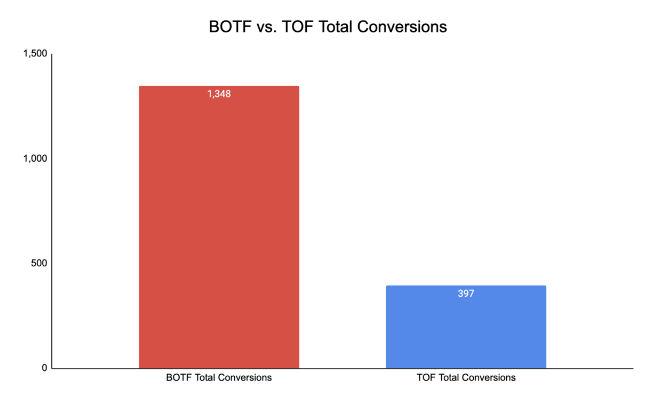
By choosing and prioritizing keywords based on purchase intent instead of search volume, companies can:
- Strategically go after all of the remaining high-intent keyword opportunities that their core website pages don’t rank for.
- See significantly higher conversion rates and conversions from their blog content.
- Drive meaningful increases in trial, demo, and product signups as a result of their SEO efforts.
- Build an SEO strategy that’s more resilient to AI-driven changes in search.
In the next section, we’re going to walk through how you can execute this for your business and how we approach this at our agency.
Our 5-Step B2B SaaS SEO Strategy
We have written at length about every step of our SaaS SEO strategy. So here we’re going to list and describe each step in our process, and link out to the individual articles that dive deeper into each step.
At Grow & Convert, our B2B SaaS SEO strategy consists of the following:
- Step 1: Do keyword research to identify high-intent keywords.
- Step 2: Create a dedicated blog post for each keyword that deeply satisfies search intent.
- Step 3: Sell your product in each piece of content.
- Step 4: Fix and monitor for technical SEO errors.
- Step 5: External link building and citation outreach.
Let’s look at each.
Step 1: Do Keyword Research to Identify High-Intent Keywords
The most fundamental part of a SaaS SEO strategy is keyword selection. If you don’t pick the right keywords (ones that, if ranked for, will drive demos and trials), then nothing else in your SEO strategy matters:
- Your technical SEO doesn’t matter. (It doesn’t matter how well your site is optimized if it’s not ranking for keywords that bring in customers.)
- Your link building doesn’t matter (same reason).
- The number of blog articles you write doesn’t matter.
Thus, keyword selection is the most important thing to get right.
We’ve written about how you can approach this step effectively in our article on SaaS content strategy where we . classify high buying-intent keywords into three categories. Any SaaS company can use this framework to identify the keywords most likely to drive conversions.
Software Category Keywords
These are keywords where someone is literally searching for your product or service, which means they’re in the market right now.
The obvious ones are easy to think of: “project management software,” “help desk software,” “CRM for small business.” But there are usually far more variations than you’d initially expect, and exploring all of them is where you find opportunities your competitors have missed.
- Use case variations: “[Use case] software,” “[Use case] tools,” “[Use case] apps”
- Industry variations: “[Industry] software,” “[Use case] software for [industry]”
- Business size variations: “[Use case] software for small business,” “enterprise [use case] tools”
- Integration variations: “[Use case] software for QuickBooks,” “[Use case] tools with Slack integration”
- Feature variations: “time clock app with GPS,” “[use case] software with [specific feature]”
The more use cases you have or verticals you serve, the more keyword opportunities exist in this category alone. A company with four use cases serving three verticals could have 12+ variations just from combining those dimensions.
Competitor Comparison Keywords
These keywords indicate someone is actively evaluating solutions, which means they’re in buying mode and close to making a decision.
- “[Competitor] alternatives”: Searchers who are either using a competitor and want to switch, or who are aware of that brand and exploring what else is out there.
- “[Brand] vs. [Competitor]”: Direct comparison searches where you can make your case head-to-head against a specific competitor.
- “[Competitor 1] vs. [Competitor 2]”: Even when your brand isn’t mentioned, you can create content comparing all three options and insert yourself into the conversation.
These keywords often have lower search volume but extremely high conversion rates because the searcher has unmistakable purchase intent.
Jobs-to-be-Done Keywords
These keywords describe problems your product solves, even if the searcher isn’t explicitly looking for software yet. The reason they still indicate buying intent is that the searcher needs a solution to a current problem, and your product is one of the best ways to solve it.
- “How to” keywords: “how to track employee time off,” “how to automate customer follow-ups,” “how to plan delivery routes”
- Template and checklist keywords: “[use case] template,” “free [use case] spreadsheet”
- Process keywords: “best way to manage multiple projects,” “ways to automate invoicing”
JTBD keywords are different from pure top of the funnel content because the searcher has a specific problem requiring a solution, not just idle curiosity about a topic.
For example, “What is project management” has no buying intent because the searcher is just learning about a concept. But “how to manage a team inbox” suggests someone actively trying to solve a problem, and that person may be ready to buy software that solves it better than their current approach.
We don’t prioritize high-volume, top of the funnel keywords like “what is CRM,” “customer service tips,” or “project management best practices.” We also avoid keywords where the SERP indicates purely informational intent. If all the top results are Wikipedia, encyclopedias, and scholarly articles, the searcher isn’t looking to buy anything.
That said, these keywords aren’t useless. They can be valuable for building topical authority with search engines, increase overall traffic, and create internal linking opportunities to your core pages that target bottom of the funnel keywords. We just don’t recommend starting here because the conversion rates are so much lower, and in an environment where AI tools increasingly answer these informational queries directly, the traffic payoff is shrinking as well.
Once you’ve exhausted the high-intent opportunities, top of the funnel content makes more sense as a way to strengthen your overall SEO foundation.
Step 2: Create a Single, Dedicated Blog Post for Each Keyword That Deeply Satisfies Search Intent
As we mentioned earlier, ranking on the first page for a high-intent keyword requires a very strategic approach to content creation. You can’t just sprinkle in keywords and hope that your post will rank, especially for high-intent terms which are valuable and highly competitive.
When it comes to Step 2 of creating your content, there are two key factors to be successful:
- Create a dedicated page for each keyword.
- Deeply match search intent with each piece of content.
Create a Dedicated Page for Each Keyword
One of our key learnings (and a differentiator of our agency’s strategy) is that the best way to get top positions for high-intent keywords is to create a dedicated page for each one — even when keywords are nearly identical and have similar meanings.
As we discussed in our conversation with Bernard Huang of Clearscope, you only get one SEO title, one H1 heading, one meta description, etc. — and these are key ranking factors for getting top positions.
If you try to rank for multiple target keywords with one piece of content, it will often only end up ranking for one of them (or worse, you won’t match the intent of any individual keyword, and you won’t rank for any of them).
This is especially important for high buying intent keywords where competition is usually fierce. Your competitors are likely creating dedicated pages for these terms, and if you’re trying to cover multiple keywords with one piece of content, you’re putting yourself at a disadvantage from the start.
Deeply Satisfy Search Intent with Each Piece of Content
Satisfying search intent begins with analyzing the search engine results page (SERP) for your target keyword to understand a) which topics need to be covered in your article for it to rank and b) how you can differentiate or improve on existing results to get a top ranking position.
The problem is that most marketers stop at high-level intent categories like “commercial” or “informational,” and in our experience, that’s nowhere near enough. You need to understand the specific layers of intent for each keyword, which requires analyzing what’s already ranking and figuring out why Google chose those particular results.
We’ve documented the exact process we use when analyzing search engine rankings for target keywords in our post on SEO content writing. Before writing any piece of content, we spend time analyzing the SERP for the target keyword to understand what Google thinks searchers want. While the keyword research stage involves a quick SERP scan (a minute or two per keyword just to verify buying intent), the content creation stage requires a much deeper analysis. Here’s what that process looks like in practice.
1. Review the titles, page types, and sources of existing page one results
The titles and page types of currently ranking content reveal what format Google expects for your target keyword. You’re looking to understand whether the top results are mostly list posts (“10 Best…”), step-by-step guides, comparison articles, landing pages, or something else entirely.
For example, if you’re targeting “project management software for agencies” and the top results are all listicles comparing different tools, that tells you searchers want options to evaluate rather than a landing page pitching a single product.
If you create a landing page when Google is ranking listicles, you’re unlikely to break onto page one because you’re not matching what searchers (and therefore Google) expect to see.
2. Identify the subtopics and sections covered in top-ranking articles
After you understand the format, click into the top 3-5 results and examine what topics they actually cover. What questions do they answer? What sections do they include? What information do they provide that seems essential to the topic?
If every top result includes a section on pricing, that’s a strong signal that searchers expect pricing information and you should include it. If they all feature comparison tables, you probably need one to stay competitive.
This doesn’t mean you should copy your competitors’ structure exactly (in fact, doing so would make it hard to differentiate), but you do need to cover the topics that searchers expect. In our experience, missing a key subtopic that all the top results include can signal to Google that your content is incomplete, which makes it much harder to rank.
3. Look for gaps and opportunities to differentiate
While you need to cover the expected topics, you also need to give Google (and searchers) a reason to rank your content over what already exists. This is where you look for gaps in the current results.
Are there questions that aren’t being answered thoroughly? Are the existing articles generic and surface-level, full of advice that could apply to any industry? Are they missing specific examples, real data, or expert insights that would make the content more useful?
The goal should be to create something that’s genuinely better and more useful than what currently ranks on page one. If you can’t articulate a clear reason why your piece would be more valuable than what’s already there, you probably need to rethink your approach before you start writing.
4. Analyze the sources that are ranking
Understanding who is currently ranking gives you a sense of how difficult it will be to compete for that keyword. If the top results are dominated by high-authority sites like G2, Capterra, and major industry publications, you’ll likely need to invest more heavily in content quality, promotion, and link building to have a shot at page one. If smaller blogs and direct competitors are ranking, the barrier to entry is lower.
You should also pay attention to whether any of your direct competitors are ranking for the keyword. If they are, study what they’re doing well and where they’re falling short so you can create something better.
If none of your direct competitors are ranking, that might signal an opportunity where you can establish a presence in the SERP before they do.
This SERP analysis process is essential because when you nail search intent, two important things happen. First, readers spend more time on your post, click into different sections, and display on-page behavior signals that tell Google your piece is fulfilling their search intent, which leads to higher rankings over time. Second, the searcher feels like your brand actually understands their problem, which makes them significantly more likely to trust you, explore your product, and eventually convert.
The companies that skip this step and just start writing based on their assumptions about what the keyword means almost always underperform compared to those who take the time to understand what’s already working.
Step 3: Sell Your Product in Each Piece of Content
In search engine optimization and content marketing, there tends to be an aversion to selling products and services through blog content. Blogs are considered to be primarily for generating traffic and brand awareness, and most marketers think that you shouldn’t be too salesy.
But when you design your content strategy to go after high-intent keywords, where people are at the purchase stage of the buyer’s journey, a key part of meeting search intent is discussing your product! This is what people are literally searching for. They want to know about what your product does, how it solves their problems, and how it’s different from other products and services on the market.
Therefore, an additional key step to writing your content is that you need to discuss the details of your product features and differentiators. And this has implications on how your content is produced — the person writing the content needs to know these things.
If you want to see actual ROI from your content marketing, you need to adopt the perspective that it’s okay to sell your product through your content, especially when you’re targeting bottom of the funnel keywords where selling is exactly what the searcher expects.
The key is that selling through content looks different than selling on a landing page. In content, you’re selling through demonstration and education. You’re showing how your product solves specific problems, walking through features in the context of real use cases, and explaining why your approach is different or better than alternatives. When done well, this doesn’t feel “salesy” at all because it’s genuinely useful information that the reader came looking for.
This is why we urge companies not to fully outsource their content to freelance writers or agencies, unless those freelance writers or agencies have a process for developing deep expertise in your product or service and its differentiators (most do not).
Think about what it takes to write a truly compelling piece of content that sells your product. The writer needs to understand the nuances of how your product is positioned in the market, why it’s better than competitors for certain use cases, and what specific features solve which customer pain points. A freelance writer does not know these things if they’ve never worked at your company, talked to your customers, or deeply used your product.
Some companies try to solve this by hiring writers with industry expertise, but that doesn’t fix the problem either. Outside experts may have general industry knowledge, but that doesn’t mean they think about the nuances of your space in the way you do. If you rely on their perspective, you’ll end up with a blog full of their ideas, not yours, and your company won’t have a distinctive voice or point of view.
At Grow & Convert, we solve this by interviewing the experts at our clients’ companies for each piece of content we create. This allows us to express the company’s expertise on each topic to create truly high-quality content.
Before we write anything, we get on a call with someone at the client’s company who has deep knowledge of the topic (a founder, product manager, sales lead, or customer success manager depending on the subject matter) and we ask them detailed questions about the problem, how the product solves it, what makes their approach different, and what specific features or capabilities matter most.
This is in contrast to doing what we call “Google Research Papers” — learning about topics in Google and regurgitating what everyone else is saying (what many digital marketing agencies and freelancers do).
With our interview-based approach, we’re not making things up or relying on surface-level research but capturing the actual expertise and perspective of people who know the product inside and out, and then expressing that in clear, well-structured content.
For example, in a piece targeting “help desk software for small business,” we wouldn’t just list generic features that all help desk software has. We’d explain what makes our client’s specific product better suited for small businesses, whether that’s pricing structure, ease of setup, specific integrations, or a particular approach to ticket management. This level of specificity is what converts readers, and it’s only possible when the person writing the content has access to real product expertise.
If you’re targeting high-intent keywords where people are actively looking for solutions, you need to actually present your product as a solution. Generic advice that avoids mentioning your product will not convert, no matter how well-written it is or how much traffic it gets.
To better understand how you can approach selling your product through your content, check out our post on SaaS content writing which walks through an example.
Also, check out the SaaS content strategy post we shared above, which has links to a bunch of articles we’ve written for our clients. (We discuss our clients’ products in every article we produce.)
Step 4: Fix and Monitor for Technical SEO Errors
Technical SEO — the process of resolving any technical website issues that might hurt your organic search performance — is a necessary part of SaaS SEO.
However, while we occasionally run into larger site architecture issues with our SaaS clients, the need for ongoing technical SEO support is more common in eCommerce where sites can have hundreds of product pages that target tons of long-tail keywords (very specific product queries).
For SaaS companies with largely static marketing sites, technical SEO is less about ongoing optimization and more about getting the fundamentals right from the start, then monitoring to make sure nothing breaks. If you notice sudden drops in rankings (which can be monitored in tools like Ahrefs or Semrush, along with other SEO metrics), then it’s worth looking into whether technical SEO might be present. But otherwise, technical SEO for SaaS websites can usually be taken care of with a one-time SEO audit and occasional follow-up.
That said, there are several technical SEO fundamentals that we see SaaS companies get wrong, and these mistakes can significantly limit the ability to rank even if the content is excellent.
Here are the key areas to get right:
Host Your Blog on a Subfolder, Not a Subdomain
One of the most common technical SEO mistakes we see SaaS companies make is hosting their blog on a subdomain (blog.yourcompany.com) rather than a subfolder (yourcompany.com/blog).
This matters because search engines treat subdomains as separate websites, which means the authority you build through your blog content doesn’t fully transfer to your main domain, and vice versa.
When your blog lives on a subfolder, every backlink you earn to a blog post strengthens the authority of your entire domain, including your homepage and product pages. When it’s on a subdomain, that link equity is siloed.
We’ve seen companies make significant ranking improvements simply by migrating their blog from a subdomain to a subfolder (though the migration itself needs to be handled carefully with proper redirects to avoid losing existing rankings).
Set Up Proper Canonical Tags
Canonical tags tell search engines which version of a page is the “official” version when duplicate or very similar content exists across multiple URLs. This is important for SaaS sites because the same content can often be accessible through different URL variations (with or without trailing slashes, with different query parameters, through HTTP and HTTPS, etc.).
Without proper canonical tags, search engines might split the ranking signals between multiple versions of the same page, or worse, choose the wrong version to index.
Most modern CMS platforms handle basic canonicalization automatically, but it’s worth auditing your site to make sure canonical tags are implemented correctly, especially if you have pagination, filtered views, or content that appears in multiple places on your site.
Submit and Maintain Your XML Sitemap
An XML sitemap is essentially a roadmap of your website that helps search engines discover and understand the structure of your content. For SaaS blogs, this means making sure your sitemap includes all your blog posts, is updated automatically when new content is published, and is submitted to Google Search Console.
While Google will eventually find most of your content through crawling, a properly configured sitemap helps new content get indexed faster and ensures that nothing important is missed.
If you’re publishing content regularly, check periodically to confirm that your sitemap is updating correctly and that there are no errors showing in Google Search Console.
Check for JavaScript Rendering Issues
This is particularly important for SaaS companies because many SaaS marketing sites are built on custom platforms, React-based frameworks, or other JavaScript-heavy technologies that can cause rendering issues for search engines. If your content is loaded dynamically through JavaScript, Google may not be able to see or index it properly.
You can check for rendering issues by using Google Search Console’s URL Inspection tool, which shows you how Google sees your pages.
If the rendered HTML is missing content that you expect to be there, you have a rendering problem that needs to be fixed, either by implementing server-side rendering, using dynamic rendering for search engine bots, or restructuring how your content is loaded.
Configure Your Robots.txt Correctly
The robots.txt file tells search engines which pages or sections of your site they should and shouldn’t crawl. For most SaaS sites, the main concern is making sure you’re not accidentally blocking important pages from being crawled.
We’ve seen cases where a robots.txt file left over from a staging environment was blocking the entire blog, or where overly aggressive rules were preventing search engines from accessing key content.
Review your robots.txt file to make sure it’s not blocking anything that should be indexed (your blog, landing pages, etc.), and that it is blocking things that shouldn’t be indexed (admin pages, internal search results, duplicate filtered views, etc.).
Ensure Your Site Loads Quickly
Slow-loading pages hurt both your search rankings and your conversion rates because users will leave before the page finishes loading. For SaaS sites, the biggest opportunities are usually unoptimized images, too many third-party scripts (analytics, chat widgets, marketing tools), and render-blocking JavaScript.
Use Google’s PageSpeed Insights tool to identify specific issues on your site and prioritize fixes based on impact. You don’t need a perfect score, but you should aim to pass Core Web Vitals thresholds and ensure your pages load quickly on mobile.
Implement Proper Internal Linking
Internal linking is one of the most overlooked aspects of technical SEO, but it’s also one of the easiest to fix. When you link from one page on your site to another, you’re passing authority and helping search engines understand the relationship between your content.
For SaaS blogs, this means linking from newer blog posts to your most important pages (product pages, pillar content, high-converting articles) and making sure no valuable pages are orphaned without any internal links pointing to them.
As you build out your content library, develop a habit of going back to older posts and adding links to newer relevant content. This helps distribute authority throughout your site and can give newer posts a ranking boost.
For most SaaS companies, technical SEO is not something you need to obsess over or hire a dedicated specialist for. Get the fundamentals right, monitor for issues using Google Search Console and your SEO tools, and then focus the majority of your energy on creating great content and building links and citations which we’ll discuss next.
Step 5: Link Building
Link building — the process of generating backlinks to pages on your site — is helpful for supporting your website’s domain authority and keyword rankings.
However, it’s key to understand that link building is a supporting element of a good SaaS SEO strategy. Sometimes agencies or companies think that link building is the thing that gets content ranking. But in our experience, it’s not.
If you don’t get the key steps of creating your content right (i.e. creating dedicated pages for each keyword, and deeply matching search intent), no amount of outreach, link building, or internal links will get your content up to the first page. So, link building is something to do and pay attention to, but don’t expect it to be a magic bullet for your SEO campaign.
We’ve found that building links to individual articles can often give them a boost in rankings and help support content in getting up to the first page. Each month, we build links to different articles we’ve published as an ongoing effort.
There are several ways to build links, and the right approach depends on your resources and goals. Here are the primary methods we use and recommend for SaaS companies.
Guest Posting
Guest posting involves writing articles for other websites in your industry (or adjacent industries) that include links back to your content. This is one of the most reliable and scalable ways to build high-quality backlinks because you control the context in which your link appears and can ensure it points to the specific pages you want to rank.
To make your guest posting campaign effective, make sure that you are targeting sites that are relevant to your industry and have real audiences, not just sites that exist solely for link building purposes. Links from sites with genuine readerships carry more weight with search engines and can also drive referral traffic directly.
Digital PR and Media Mentions
As search is getting more competitive, you should also try to get your company, product, or expertise mentioned in news articles, industry publications, and other media outlets. This can include contributing expert quotes to journalists, publishing original research that gets picked up by other sites, or simply being newsworthy enough that publications want to write about you.
The advantage of PR-driven links is that they often come from high-authority domains like major publications and industry news sites, which can have a significant impact on your domain authority. The challenge is that PR is less predictable than guest posting, and you have less control over where links point.
Resource and Listicle Inclusion
Many high-ranking articles in your space are listicles or resource pages that mention multiple tools, products, or solutions. Getting your product included in these existing articles can be an effective way to build links and also drive referral traffic from readers who are actively evaluating options.
This approach involves identifying articles that rank for keywords relevant to your product (like “best project management software” or “top CRM tools”), then reaching out to the authors or site owners to request inclusion.
The success rate depends heavily on the quality and relevance of your product, but when it works, you get a link from a page that’s already ranking and driving traffic. Having an affiliate marketing program significantly increases your success rate with this approach, since many of these listicle sites are monetized through affiliate commissions. If you can offer the site owner a way to earn revenue when their readers click through and convert, they have a much stronger incentive to include your product and keep the listing updated.
We prioritize link building based on which articles have already shown they can convert. When we run paid promotion to articles and see that certain pieces are generating conversions through ads, we prioritize those articles for link building because they’ve already demonstrated business value. If we can get them ranking organically for their target keywords, we’re confident they’ll continue to convert.
This approach ensures we’re not just building links to random articles, but rather investing our link building resources in content that we know will drive results once it ranks.
Citation Outreach for AI Visibility
Beyond traditional link building, there’s an additional tactic we offer clients who want to accelerate their AI visibility: citation outreach. This involves identifying which articles and sources are appearing most frequently in AI-generated answers for topics relevant to your product, then reaching out to those sources to get your product mentioned or included.
For example, if ChatGPT and Perplexity are consistently citing a particular “best project management software” article when answering product recommendation queries, getting your product added to that article (with accurate information about features and use cases) can directly improve your visibility in AI answers.
This is essentially the same concept as getting included in listicles for SEO purposes, but with the added benefit of directly influencing AI-generated recommendations.
For most SaaS companies, we recommend treating GEO as an extension of your SEO strategy rather than a separate initiative. If you’re doing Pain Point SEO well, you’re already building the foundation for AI visibility. The additional tactics (citation outreach, content structure optimization) can amplify those results, but they’re not a replacement for ranking in traditional search.
To learn more about our approach to link building, check out our content distribution strategy article.
Measuring Traffic, Keyword Rankings, and Conversions
To measure B2B SaaS SEO performance, see what’s working and not working, and spot additional keyword opportunities, we track and report on a variety of metrics for our clients with the following tools:
- Conversions: We track and report on conversions using the Model Comparison Tool in Google Analytics.
- Keyword Rankings: We use Ahrefs rank tracker to monitor rankings progress for each article’s target keyword. (You could also use Semrush, Google Search Console, etc.)
- Overall Pageviews and Organic Traffic: We set up traffic dashboards in Looker Studio (formerly Google Data Studio) that measure overall pageviews and organic traffic to our articles.
The most notable of these three KPIs is conversion tracking. Most SEO teams (in-house or agencies) don’t hold themselves accountable to leads generated from content. In fact, most don’t even report on this. But without conversion data, you are essentially conceding that your SEO strategy is traffic focused (because everyone tracks traffic).
Check out our article on tracking conversions in Google Analytics 4 to learn more about how to measure conversions from SEO content.
Want to Work with Us or Learn More About How We Approach Content Marketing?
- Our Agency: If you want to hire us to execute content marketing in this way, you can learn more about our service and pricing here.
- Join Our Team: If you’re a content marketer or writer and would love to do content marketing in this way, we’d love to have you apply to join our team.
- Our Content Marketing Course: Individuals looking to learn our agency’s content strategy and become better marketers, consultants, or business owners can join our private course, taught via case studies, and presented in both written and video content formats. We include several details and examples not found on this blog. Our course is also built into a community, so people ask questions, start discussions, and share their work in the lesson pages themselves, and we, along with other members, give feedback. Learn more here or watch our video walkthrough here.
Join the Grow and Convert Newsletter
Get our marketing ideas emailed weekly.
Explore Articles By Categories


Explore our Videos