Over the last 10+ years running our SEO and content marketing agency, working with dozens of SaaS companies and having countless conversations with them about their past experiences doing SEO, we’ve found that most SaaS SEO strategies, whether in-house or through an agency, focus heavily on traffic and rankings for keywords with high search volume, which doesn’t necessarily drive trials, demos, and product signups.
We’ve seen this play out in a few different ways:
- They focus most of their SEO efforts on optimizing core site pages (homepage, features, solutions) for obvious category keywords, but these keywords are dominated by large businesses with very high domain authority, making it difficult for most SaaS companies to rank.
- They ignore other high-intent keywords in their space (comparison keywords, jobs-to-be-done keywords, long-tail category variations) because the search volume looks too low, not realizing that these keywords convert at much higher rates than the high-volume informational terms they’re chasing.
- Their blog is primarily used for company updates or top of the funnel, how-to content that has little buying intent, converts poorly, and is increasingly vulnerable to AI tools that answer informational queries directly, without sending traffic to your site.
- Then, in terms of actual content quality, the blog posts that do get written often read like what we call “Google research papers” — articles that simply regurgitate what’s already ranking without genuine expertise or explaining how their product actually solves the problem.
These are strategy problems, and no amount of technical SEO fixes, on-page optimization, or link building will help if you’re targeting keywords you can’t rank for or creating content that doesn’t convert. To fix these problems, you need to fix your SEO strategy.
In this post, we’re going to walk through everything you need to know to create a SaaS SEO strategy that drives rankings, leads, and product signups. We’ll share the biggest lessons we’ve learned and the exact strategy that we’ve used to get page one rankings for hundreds of valuable buying intent keywords for our clients.
Curious about having us do SEO for your business? Learn more about how we can improve your SEO results here. Or, if you’d like to learn the SaaS SEO strategy that we share below, we also teach our strategy and process in our course and community.
Our 5 Step SaaS SEO Strategy That’s Designed to Grow Leads and Signups
We define SaaS SEO as the process of selecting keywords that indicate people are looking for (or need) your product, creating content to rank for those keywords, and supporting that content with link building and technical SEO. When this is done well, organic search becomes a valuable marketing channel that drives meaningful increases in trials, demos, and product signups.
At Grow & Convert, our SaaS SEO strategy consists of the following 5 steps:
- Step 1: Do keyword research to create a list of keywords with high buying intent.
- Step 2: Create a dedicated blog post for each keyword that deeply satisfies search intent.
- Step 3: Sell your product in each piece of content.
- Step 4: Fix and monitor for technical SEO errors.
- Step 5: External link building.
Step 1: Do Keyword Research to Identify High-Intent Keywords
The most fundamental part of a SaaS SEO strategy is keyword selection. If you don’t pick the right keywords (ones that, if ranked for, will drive demos and trials), then nothing else in your SEO strategy matters. It doesn’t matter how well your site is technically optimized, how many backlinks you build, or how many blog articles you publish if none of that effort is pointed at search queries that bring in customers.
Thus, keyword selection is the most important thing to get right. And the key is to prioritize based on intent, not search volume.
Most SaaS keyword research advice tells you to prioritize keywords by volume, discard keywords with high difficulty, and go after the same keywords as your competitors. The problem is that none of this considers whether the keyword actually has buying intent. And, as we’ve written about for many years, the buying intent behind your target keywords is the #1 factor behind whether your content and SEO efforts will generate qualified leads and pipeline or just hollow traffic.
Consider a keyword like “human resource management”. On the surface, it seems valuable for an HR software company. It even has a lot of search volume.
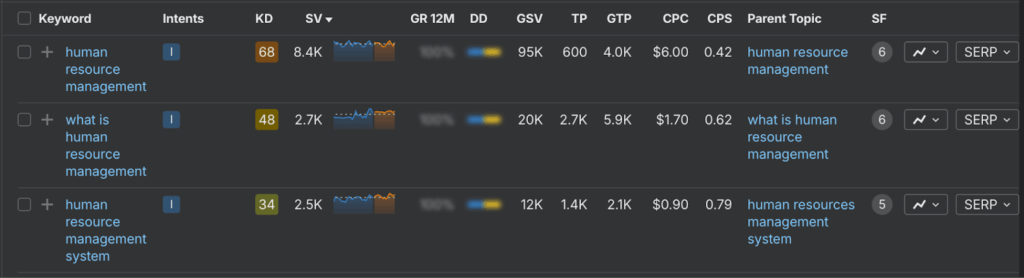
But the pages that actually rank for this term are general explainers, and the people searching it can be students writing papers, job seekers exploring career paths, or founders learning what HRM even means. There is little to guarantee that someone searching for this is actively looking to purchase HR management software.
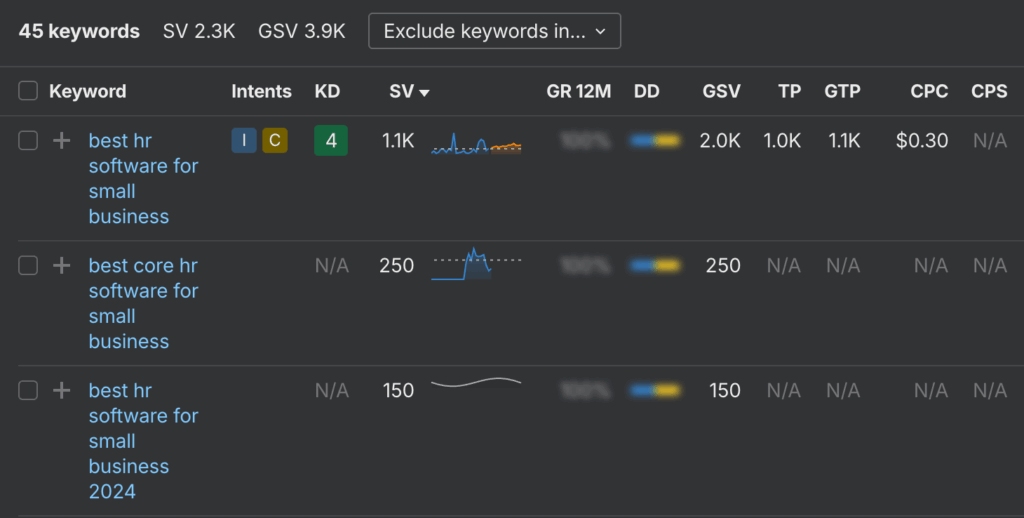
Meanwhile, a keyword like “best HR software for small businesses” has a fraction of the above search volume, but the person typing it is literally shopping for HR software right now.
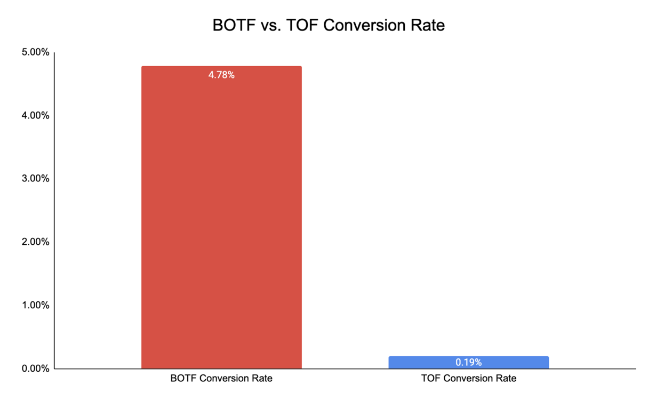
In our analysis of 60+ articles for a single SaaS client, we found that bottom-of-funnel keywords converted at 4.78% compared to just 0.19% for top-of-funnel keywords. That’s a 2,400% difference. And despite having nearly twice as many top-of-funnel articles that generated 10x the traffic, the bottom-of-funnel articles still brought in 3x more conversions.
We typically start at the bottom of the funnel and work up when we are executing SEO strategy for our SaaS clients. We organize buying-intent keywords into three categories: category keywords, comparison and alternative keywords, and jobs-to-be-done keywords.
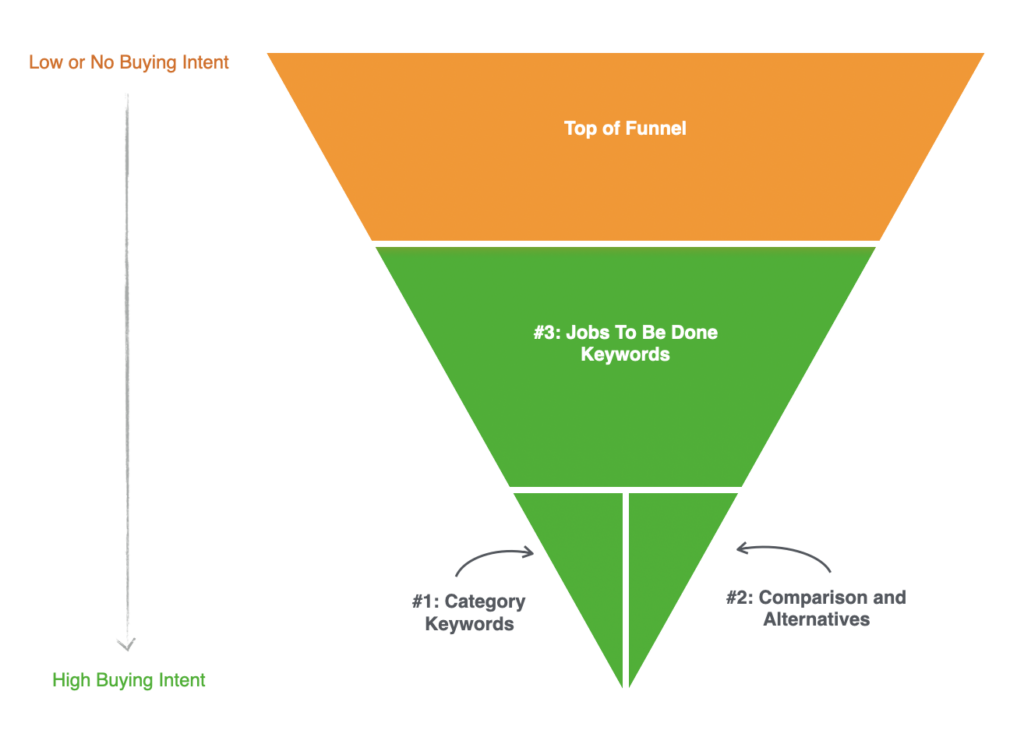
In the first couple of months of our engagement, we focus heavily on category keywords and comparison keywords because these have the clearest buying intent and often the highest conversion rates. After we’ve covered the most obvious bottom-of-funnel terms, we add jobs-to-be-done keywords, and then we consider moving up the funnel to broader awareness topics.
Category Keywords
These are queries where the searcher is literally looking for products in your category. Think of all the ways your customers describe what you sell: “CRM software,” “marketing analytics tools,” “employee scheduling app.”
The challenge with obvious category keywords is that they’re highly competitive. But there are usually more variations than companies realize. You can expand your list by considering feature variations (invoicing software, time-tracking software, payroll software), industry variations (CRM for real estate, accounting software for nonprofits, HR tools for startups), and format variations (scheduling app, scheduling tool, scheduling platform, scheduling system).
When you are targeting category keywords, don’t skip low-volume variations. A keyword like “CRM software for law firms” might show 50 monthly searches, but if you sell CRM software specifically for lawyers, every one of those searchers can be a potential customer.
Comparison and Alternative Keywords
These indicate the searcher is comparing options before buying. Alternative keywords include queries like “Salesforce alternatives” or “HubSpot competitors.” Versus keywords are direct comparisons like “Salesforce vs. Pipedrive” or “HubSpot vs. Marketo.”
In our data, comparison and alternative keywords convert at the highest rate of any keyword type (8.43% average). This makes sense because someone searching “Salesforce alternatives” knows exactly what they want and is ready to switch if they find a better alternative.
Even if your brand isn’t well-known enough to appear in these searches naturally, you can create content targeting “[Competitor A] vs. [Competitor B] vs. [Your Brand]” to insert yourself into the comparison.
Jobs-to-Be-Done Keywords
JTBD keywords are queries that describe a problem your product solves, without explicitly mentioning software: “how to automate time-off requests,” “how to track employee hours remotely,” “how to get video testimonials from customers.”
These searchers may not know your brand or even that a software solution exists for their problem. But they have a job to do that your product can help with, and that makes them potential buyers.
We’ve seen jobs-to-be-done keywords convert at very high rates because the content directly solves what the reader is searching for in the context of our client’s product. Someone searching “how to organize design files” and landing on a post that shows them exactly how to do it with your design tool is a warm lead.
Step 2: Create a Single, Dedicated Blog Post for Each Keyword That Deeply Satisfies Search Intent
Ranking on the first page for a high-intent keyword requires a very strategic approach to content creation. You can’t just sprinkle in keywords to a bunch of blog posts and hope that they’ll rank. You also can’t rely entirely on on-page SEO tools, because getting the right words on the page — while necessary — isn’t sufficient to rank for buying intent terms which are valuable and highly competitive.
Instead, from years of experience, we’ve learned that you need to satisfy these two criteria to be successful:
- Create a dedicated page for each keyword.
- Deeply match search intent with each piece of content.
Ranking Criteria #1: Create a Dedicated Page for Each Keyword
One of our key learnings (and a differentiator of our agency’s strategy) is that the best way to get top positions for high-intent keywords is to create a dedicated web page for each one — even when keywords are nearly identical and have similar meanings.
Consider “sick leave tracking” and “sick leave app.” The intent behind these search terms is almost the same: people want a tool to track employee sick leave. But Google treats them as distinct queries, and the pages that rank for each are often different. If you try to target both with a single page, you’ll likely rank well for neither.
As we discussed in our conversation with Bernard Huang of Clearscope, you only get one SEO title, one H1 heading, one meta description, etc. — and these are key ranking factors of Google’s algorithm.
If you try to rank for multiple target keywords with one piece of content, it will often only end up ranking for one of them (or worse, you won’t match the intent of any individual keyword, and you won’t rank for any of them).
Ranking Criteria #2: Deeply Satisfy Search Intent with Each Piece of Content
Satisfying search intent begins with analyzing the search engine results page (SERP) for your target keyword to understand a) which topics need to be covered in your article for it to rank and b) how you can differentiate or improve on existing results to get a top ranking position.
Before writing anything, look at what already ranks and pay attention to the format of the top results and how they structure their content. This helps you understand two things: which topics need to be covered in your article for it to rank, and how you can differentiate or improve on existing results to get a top ranking position.
The second part is critical. Your goal shouldn’t be to copy the format of pages that are already ranking, but to create something better by bringing genuine expertise to the topic. This is why we interview product experts at our clients’ companies for every piece of content we create, rather than doing what we call “Google Research Papers” — Googling a topic and regurgitating what everyone else is saying.
If you’re targeting “project management software for agencies,” for example, you might find that the top results list a bunch of tools but don’t explain the specific workflows agencies need or why certain features matter more than others for agency use cases. By interviewing your product team and customers, you can create content that actually explains the nuances of agency project management in a way that generic listicles can’t.
This approach to keyword selection and search intent has become even more important as AI changes how people find information. AI Overviews now appear for a large percentage of searches, and tools like ChatGPT and Perplexity increasingly answer informational queries directly. The traffic that top of the funnel content used to generate is shrinking because users get their answers without ever clicking through to a website.
Bottom of the funnel content is more resilient to these changes. When someone searches for “project management software for agencies” or “HubSpot alternatives,” AI tools may summarize options or make recommendations, but the searcher still needs to visit your site to evaluate your product, request a demo, or start a trial. And even when AI answers the query directly, being mentioned or recommended in that output still influences the customer’s decision — which is far more likely to happen when you have high-quality content ranking for that keyword than when you have nothing at all.
This is one more reason we prioritize high-intent keywords and invest heavily in making each piece of content genuinely useful. Not only do these keywords convert at significantly higher rates, but they’re also more resilient to AI-driven changes in search behavior. And when you create content that demonstrates real product expertise rather than regurgitating what’s already ranking, you’re building the kind of depth that both search engines and AI tools recognize as authoritative.
We’ve explained in-depth the exact process we use when analyzing search engine rankings for target keywords in our post on SEO content writing. Check that out to view examples and learn how you can approach this.
Step 3: Sell Your SaaS Product in Each Piece of Content
In search engine optimization and content marketing, there tends to be an aversion to selling products and services through blog content. As we mentioned earlier, blogs are considered to be primarily for generating traffic and brand awareness, and most marketers think that you shouldn’t be too salesy.
But when you design your SEO content strategy to go after high-intent keywords, where people are at the purchase stage of the buyer’s journey, a key part of meeting search intent is discussing your product! This is what searchers are literally looking for. They want to know about what your product does, how it solves their problems, and how it’s different from your direct competitors and other potential solutions on the market.
Therefore, it’s crucial to discuss the details of your product features and its differentiators. And this has implications on how your content is produced — the person writing the content needs to know these things.
This is why we urge software companies not to fully outsource their content to freelance writers or agencies, unless those freelance writers or agencies have a process for developing deep expertise in your product or service and its differentiators (most do not).
At Grow & Convert, we solve this by interviewing the experts at our clients’ companies for each piece of content we create. This allows us to express the company’s expertise on each topic to create truly high-quality content. This is in contrast to doing what we call “Google Research Papers” — trying to quickly learn about a topic by Googling it and regurgitating what everyone else is saying (what many digital marketing agencies and freelancers do).
In practice, selling your product when doing SaaS SEO typically takes the form of a product walkthrough that shows screenshots of various features, describes how they work, and explains how they solve customer pain points better or differently than other solutions.
For example, if we are writing an article for a video editing platform targeting “video logging software,” we don’t just say “video logging is tedious, our tool makes it easier.” We provided context that communicated to the reader that we understand the tools they use, the specific challenges they face in their process, and the implications of those challenges. In the article we produce, we walk through exactly how the product’s transcript-based editing feature eliminates the need to scrub through hours of footage, with screenshots showing each step. This level of detail comes only from interviewing product experts who understand both customer pain points and how the software addresses them.
To better understand how you can approach selling your product through your content, check out our post on SaaS content writing which walks through an example. You can also see 40+ samples of posts we’ve written for clients (live on their site today) including many that have SaaS product walkthroughs.
Step 4: Fix and Monitor for Technical SEO Errors
Technical SEO — the process of resolving any technical website issues that might hurt your organic search performance — is a necessary part of SaaS SEO.
The ongoing technical SEO demands for SaaS companies are generally lighter because most SaaS companies have relatively static marketing sites, so if you nail the basics upfront and then keep an eye on things using automated SEO audits, you can catch problems early.
If you notice sudden ranking drops in tools like Ahrefs or Semrush, technical issues should be among the first things you investigate. But assuming nothing is broken, a thorough initial audit followed by periodic check-ins is usually sufficient.
That said, we regularly encounter SaaS companies making fundamental technical mistakes that undermine their rankings regardless of how good their content is.
Here are the areas that matter most:
Host Your Blog on a Subfolder, Not a Subdomain
Putting your blog on a subdomain (blog.yourcompany.com) instead of a subfolder (yourcompany.com/blog) can limit your growth even though Google says that they treat both equally.
When your blog sits on a subdomain, the backlinks you earn to blog posts build authority for that subdomain rather than for your main domain. When your blog lives in a subfolder, every link to a blog post strengthens your entire domain.
We’ve worked with companies that saw meaningful ranking improvements after migrating from a subdomain to a subfolder. The migration requires careful handling with proper redirects to preserve existing rankings, but the long-term benefit is worth it.
Set Up Proper Canonical Tags
Canonical tags signal to search engines which URL is the authoritative version when the same content can be accessed at multiple addresses. This happens more often than most people realize: URLs with and without trailing slashes, HTTP vs HTTPS versions, pages with query parameters, and so on.
If canonical tags aren’t set up correctly, search engines may divide ranking signals across multiple URLs or index the wrong version entirely.
Most CMS platforms handle basic canonicalization out of the box, but you should still audit your site to confirm everything is configured properly, particularly if you use pagination, filtered views, or syndicate content across different sections of your site.
Submit and Maintain Your XML Sitemap
An XML sitemap gives search engines a map of your site’s content and structure. For SaaS blogs, your sitemap should include all published posts, automatically update when you add new content, and be submitted to Google Search Console.
Google will eventually discover most content through normal crawling, but a well-maintained sitemap speeds up indexing for new posts and reduces the chance that important pages get overlooked. If you publish regularly, check your sitemap periodically to make sure it’s updating properly, and that Search Console isn’t flagging any errors.
Check for JavaScript Rendering Issues
Many SaaS marketing sites are built on React, Next.js, or other JavaScript-heavy frameworks, which can create problems for search engines trying to render and index content. If your pages load content dynamically via JavaScript, Google may not see everything you expect it to.
Google Search Console’s URL Inspection tool lets you view how Googlebot renders your pages. If the rendered version is missing content that appears when you view the page in a browser, you have a rendering issue.
Fixes typically involve implementing server-side rendering, setting up dynamic rendering for bots, or restructuring how content loads.
Configure Your Robots.txt Correctly
Your robots.txt file tells search engines what they can and can’t crawl. The most common problem we see isn’t overly permissive settings, it’s accidentally blocking pages that should be indexed.
We’ve encountered situations where a robots.txt file from a staging environment was still in place on a live site, blocking the entire blog from being crawled. We’ve also seen overly broad rules that inadvertently prevented search engines from accessing important content.
Review your robots.txt to confirm that your blog, landing pages, and other key content are accessible, while admin pages, internal search results, and duplicate filtered views are blocked.
Ensure Your Site Loads Quickly
Page speed affects both rankings and conversions. Users leave slow-loading pages before they finish rendering, and search engines factor load time into their ranking algorithms. The usual culprits on SaaS sites are oversized images, excessive third-party scripts (analytics, chat widgets, marketing pixels), and render-blocking JavaScript.
Google’s PageSpeed Insights will identify the specific issues slowing your site down. A perfect score isn’t necessary, but you should pass Core Web Vitals thresholds and make sure pages load quickly on mobile devices.
Implement Proper Internal Linking
Internal links pass authority between pages and help search engines understand how your content relates to each other. For SaaS blogs, this means linking new posts to your most important pages (product pages, cornerstone content, high-converting articles) and making sure valuable pages aren’t orphaned with no internal links pointing to them.
As your content volume grows, revisit older posts and add links to newer, relevant content. This distributes authority across your site and can help newer posts gain traction faster.
For most SaaS companies, technical SEO doesn’t require a dedicated specialist or constant attention. Get the fundamentals right, monitor for issues through Google Search Console and your SEO tools, and direct most of your energy toward creating great content and building links, which we’ll cover next.
Step 5: External Link Building
Link building — the process of generating backlinks to pages on your site — is helpful for supporting your website’s domain authority and keyword rankings.
However, it’s key to understand that link building is a supporting element of a good SaaS SEO strategy. Sometimes agencies or companies think that link building is the thing that gets content ranking. But in our experience, it’s not.
If you don’t get the key steps of creating your content right (i.e. creating dedicated pages for each keyword, and deeply matching search intent), no amount of outreach, link building, or internal links will get your content up to the first page. So, link building is something to do and pay attention to, but don’t expect it to be a magic bullet for your SEO campaign.
We’ve also found that building links to individual articles can often give them a boost in rankings and help support content in getting up to the first page. Each month, we build links to different articles we’ve published as an ongoing effort.
The right link building approach depends on your resources and what you’re trying to achieve. Here are the methods we use and recommend for SaaS companies:
Guest Posting
Guest posting means writing articles for other websites in your space (or related spaces) that include links back to your content. It is one of the most consistent and scalable approaches to building quality backlinks because you control the context around your link and can direct it to whichever pages you’re trying to rank.
When you are doing guest posts, target sites that have actual readers, not sites that exist purely as link farms. Links from sites with real audiences carry more weight with search engines and can also send referral traffic directly to your content.
Digital PR and Media Mentions
As search becomes more competitive, earning mentions in news articles, industry publications, and other media outlets becomes increasingly valuable. This can mean contributing expert commentary to journalists, publishing original research that other sites reference, or doing something noteworthy enough that publications cover you organically.
PR-driven links tend to come from high-authority domains such as major publications and well-known industry sites, which can meaningfully boost your domain authority. The tradeoff is that PR is harder to predict than guest posting, and you have less control over which pages get linked.
Resource and Listicle Inclusion
Many of the articles ranking for keywords in your space are listicles or resource roundups that feature multiple products or solutions. Getting included in these existing articles builds links and can also drive referral traffic from readers who are actively comparing options.
This means finding articles that already rank for keywords relevant to your product (like “best project management software” or “top CRM tools”) and reaching out to the authors or site owners to request inclusion. Success depends largely on how relevant and compelling your product is, but when it works, you get a link from a page that’s already attracting traffic from people in buying mode.
Having an affiliate program significantly improves your success rate here. Many listicle sites monetize through affiliate commissions, so if you can offer the site owner a way to earn revenue when readers click through and convert, they have a much stronger reason to add your product and keep the listing current.
We prioritize link building based on which articles have already proven they can convert. When we run paid promotion and see that certain pieces generate conversions through ads, those are the articles we focus our link building efforts on. They’ve already demonstrated business value, so we’re confident they’ll continue converting once they rank organically.
This ensures we’re investing link building resources in content that will actually drive results, not just building links to random articles.
Citation Outreach for AI Visibility
Beyond traditional link building, we also offer clients citation outreach to improve their visibility in AI-generated answers. This involves identifying which articles and sources appear most frequently when AI tools answer questions relevant to your product, then reaching out to those sources to get your product mentioned or included.
For example, if ChatGPT and Perplexity consistently cite a particular “best project management software” article when responding to product recommendation queries, getting your product added to that article (with accurate information about features and use cases) can directly improve how often AI tools recommend you.
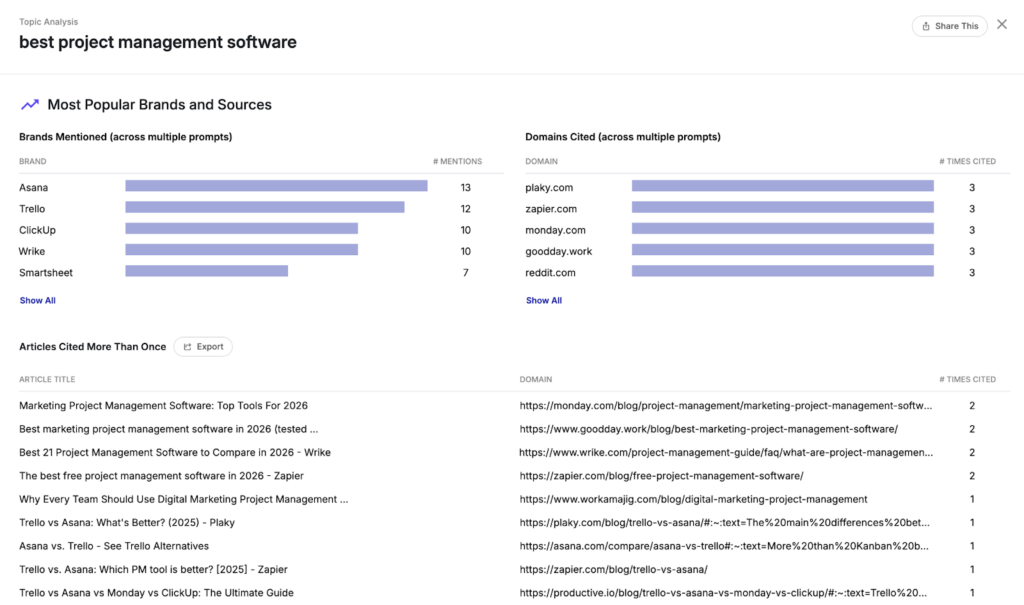
Analysis of the most commonly cited domains, articles and brands for “best project management software” from our AI Visibility tool traqer.ai
This is essentially the same concept as getting included in listicles for SEO, but with the added benefit of influencing AI-generated recommendations.
For most SaaS companies, we recommend treating AI visibility as an extension of your SEO strategy rather than a separate initiative. If you’re executing Pain Point SEO well, you’re already building the foundation for AI visibility. Citation outreach and content structure optimization can amplify those results, but they don’t replace ranking in traditional search.
To learn more about our approach to link building, check out our article on content distribution strategy.
Measuring Traffic, Keyword Rankings, and Conversions
Finally, you need to actually track the results of your SEO efforts in order to know if your strategy is working. Most SEO teams and firms track keyword rankings and organic traffic, that’s easy, but far fewer track product conversions from SEO traffic.
Without that last step — knowing if your SEO efforts are generating trials, demo requests, or sales form fills — you’re essentially conceding that your SEO strategy is traffic-focused and you are completely unaware if or how much it’s contributing to new revenue.
At our agency, we do the following to track and measure results:
- Conversions: We track and report on conversions using the Model Comparison Tool in Google Analytics.
- Keyword Rankings: We use Ahrefs rank tracker to monitor rankings progress for each article’s target keyword. (You could also use Semrush, Google Search Console, etc.)
- Overall Pageviews and Organic Traffic: We set up traffic dashboards in Looker Studio (formerly Google Data Studio) that measure overall pageviews and organic traffic to our articles.
Check out our article on tracking conversions in Google Analytics 4 to learn more about how to measure conversions from SEO content.
Want to Work with Us or Learn More About How We Approach SaaS SEO?
- Our Agency: If you want to hire us to execute SEO in this way, you can learn more about our service and pricing here. We also offer a PPC service which you can learn about here.
- Join Our Team: If you’re a content marketer or writer and would love to do content marketing in this way, we’d love to have you apply to join our team.
- Our Content Marketing Course: Individuals looking to learn our agency’s content marketing strategy and become better marketers, consultants, or business owners can join our private course, taught via case studies, and presented in both written and video content formats. We include several details and examples not found on this blog. Our course is also built into a community, so people ask questions, start discussions, and share their work in the lesson pages themselves, and we, along with other members, give feedback. Learn more here or watch our video walkthrough here.
Join the Grow and Convert Newsletter
Get our marketing ideas emailed weekly.
Explore Articles By Categories


Explore our Videos