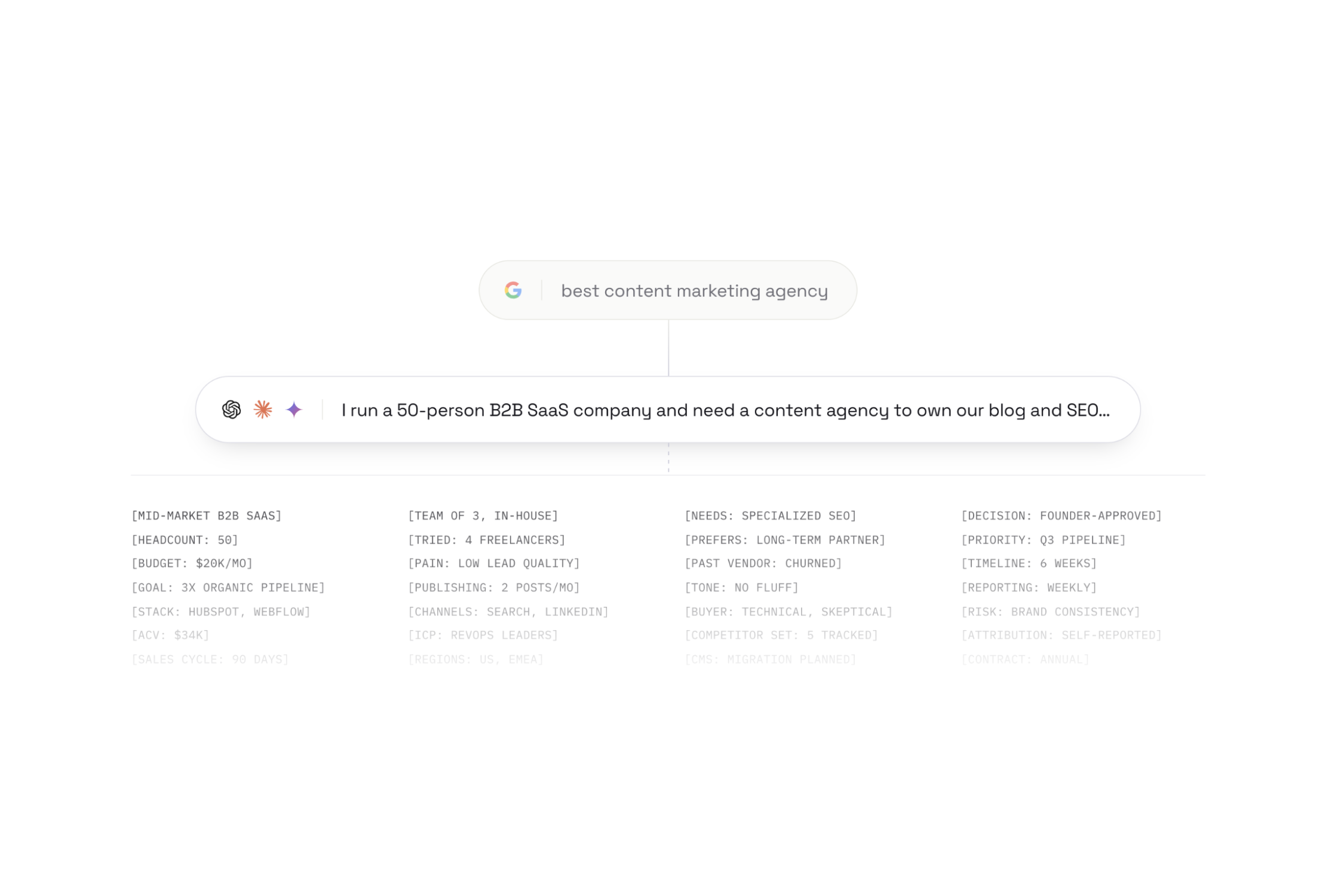
Here’s a key difference between traditional SEO and AI search:
In SEO search, people generally use short keywords, and their results tend to overlap. For example, if you and I both search for “best project management software,” we’ll likely see similar results:

Yes, some personalization can happen based on location and browsing history, but by and large, two people searching for this keyword will see similar results.
That’s what makes rankings so valuable in SEO. If you’re #1 for “best project management software,” most people searching for it each month will see your listing, and many will click through to your site.
SEO’s Personalization Limitation
But what if you work at an enterprise company switching from Jira and need a specific feature it lacks, while I’m a small business owner currently using pen and paper and looking for my first real project management tool?
Those details absolutely affect what project management software makes sense for you versus me, but a search for “best project management software” doesn’t tell Google any of that. So it serves us the same ten blue links.
In SEO, the traditional approach has been to target longer-tail variants that have search volume, like “enterprise project management software” or “project management software for small business.”
While that helps give you and me slightly more appropriate results, it still doesn’t capture the nuance I mentioned above: you’re already using Jira and need something it doesn’t offer, while I own a small business and am looking for my very first project management software.
Sure, you could try to add even more clarifying words to the query (“enterprise project management software jira alternative”), but every SEO knows that as queries get longer, search volume drops to near zero.
The point is, traditional Google search has limited ability to handle all this personal context.
But AI search lets you provide that context directly. And the amount of context it can use is unprecedented.
AI Search Is (Extremely) Personalized
AI search can personalize recommendations in two ways traditional Google search can’t.
1: Conversations, Not Keywords
In AI search, users don’t just enter short keywords; they have conversations.
And I don’t just mean prompts versus keywords. It’s not that “best project management software” simply turns into “I’m looking for project management software. What do you recommend?”
The difference isn’t just prompt length. Users can have long, meandering conversations with multiple back-and-forth exchanges. At some point, the topic of a solution to their problem might emerge, and the LLM may recommend a product or service.
That’s the moment that matters to brands. You want the LLM to associate your product or service with the right users’ pain points.
But the context leading up to that moment can’t be reliably reproduced. It’s personalized to that user.
In SEO terminology, these user-LLM interactions have a search volume of one.
2: Massive Prior Context
Second, when memory is enabled, the LLM draws on context from prior chats whether a user has a long conversation or enters a short prompt.
Continuing our project management example, someone could open a new chat thread and ask, “What project management software do you recommend for us?” The recommendation is tailored to them because the tool already knows a ton of background information about that user from prior chats.
In fact, Benji did exactly that with Claude:

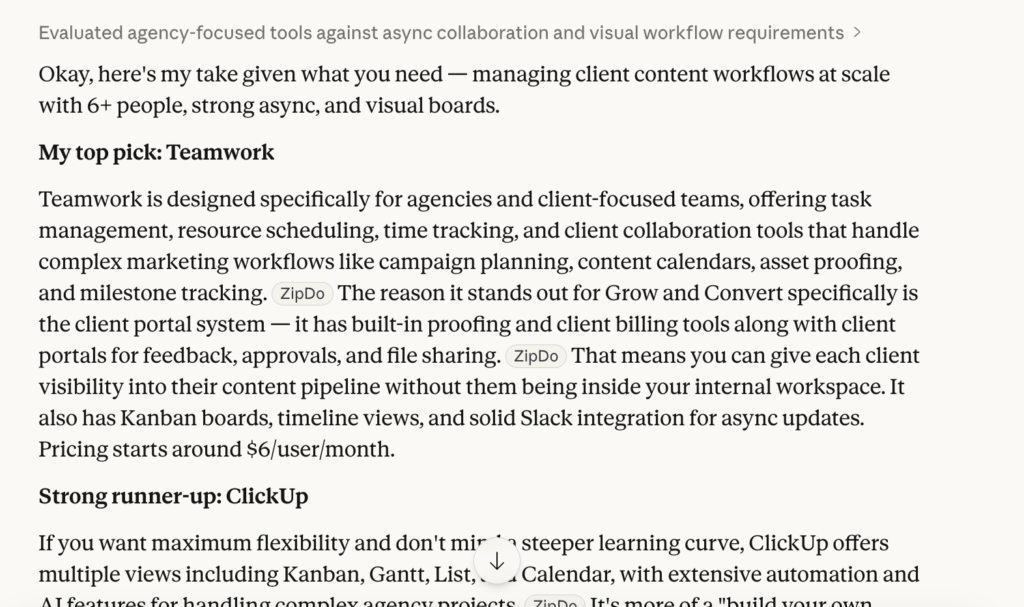
Look at how Claude knows what our company is, its size, and more. Benji didn’t type any of that into that prompt, but it knows.
So Benji’s literal prompt isn’t that important here. What the LLM is responding to isn’t just the literal prompt he typed in. It’s responding to what’s effectively a much longer prompt full of a ton of context personal to Benji.
We call this phenomenon Invisible Prompts. The user may type in one short prompt, but the LLM is responding to much more context — and that context is invisible to brands trying to understand why they were recommended.
What LLMs Do with Personal Context Is Also Different From Google
Finally, what LLMs do with this personal context differs from traditional SEO search.
Look at the response to Benji above. Claude isn’t just giving him articles to read like Google has for the last 30 years.
It’s reading(*) the articles for him and making recommendations.
*We don’t know exactly how much of an article an LLM uses during a live search. The industry understanding is constantly evolving, but the current consensus is that most LLMs scan headlines, then subheadlines, then grab useful segments from within articles they deem relevant.
LLMs can use what they know about a user, search the web for relevant solutions, and bring that information together to recommend a product or service that fits that user’s specific pain points.
That’s a fundamentally different dynamic than traditional SEO where Google just surfaces results and the user evaluates the options.
When the search tool does more of that filtering and evaluation for the user, the content strategy that works best changes, too.
The Content That Helps You Show Up in Personalized AI Search
If you want LLMs to recommend your product, you need to give them enough detail to recommend you in the right scenarios. Generic “what is project management” content won’t do that.
You need to publish detailed, highly specific product-related content covering:
- What types of customers your product is best for
- What specific use cases and scenarios it handles
- What pain points it solves and for whom
- The features that matter and when they matter
- The benefits and outcomes customers experience
- How you compare to competitors and what makes you different
- Case studies that prove you’ve delivered results
Importantly, this content shouldn’t just be SEO blog posts. Long-form written content for SEO is a great way, but not the only way, to show LLMs which problems your product solves and for whom.
Your answers to the above questions can, and should, show up in other formats, including the rest of your marketing site (homepage, product pages, solution pages, etc.), non-SEO content like case studies, and even in your off-site outreach like PR, guest posts, and link or citation outreach campaigns.
How We Implement Personalized GEO for Clients
While we’re not going to give away everything about the specific GEO strategy we execute for our clients, here’s a high-level overview of how all of the above manifests in our engagements.
1. We interview the people who know your customers best.
We sit down with your sales team, your customer support team, your product team, your founders, all of the customer-facing roles inside your organization. We ask them exactly what users are telling them are their pain points and use cases.
Then we extract the specific positioning, features, and differentiators that make your product the right choice in each scenario. These details are not something you can get from Google research. AI-generated copy will not by default produce this. The details required to produce this kind of content have to come from the people inside your company who talk to customers every day.
2. We produce content for each angle at the depth of a sales conversation, not an intro guide.
There’s this long-standing culture in content marketing where everything is written at an introductory level. “Intro guide to this.” “Beginner’s guide to that.” That came from everyone chasing high-volume SEO keywords that were by nature beginner-leaning.
But beginner-level content won’t help you when your customer asks an LLM advanced and specific questions. It wants to recommend brands that talk at that customer’s level. So your content needs to meet the customer there. Think about the level of depth and detail that happens in a sales conversation: detailed discussion of features, screenshots, specific scenarios where your product applies, use cases, case studies. That’s how we write this content.
3. We target Google keywords if and when it makes sense.
As we wrote in Prioritized GEO, traditional search (SEO) is the most efficient near-term way to influence LLMs. It helps them discover and use your content during live searches, without waiting for it to become part of their training data.
So, one of the first ways we look to expose our client’s brand message to LLMs is via SEO keywords that map to the correct pain points.
That means if some of the pain points we uncover in our interviews with your team match a known Google search term, we’ll target those search terms with our content so you get two inbound channels (traditional search and AI search) in one go.
For most businesses, there are plenty of these product recommendation keywords (what we call bottom-of-funnel queries) on Google. Keywords like: “Best [category] software,” “[competitor] alternatives,” “how to [solve specific problem].”
We’ve found time and again that this works. LLMs cite these pieces and even parrot back the arguments we include inside the pieces in their responses.
Here’s one example where ChatGPT recommends our client InnovationCast as one of the “best ideation platforms for innovation managers” and cites our exact blog post that targets the SEO keyword “best ideation platforms”:
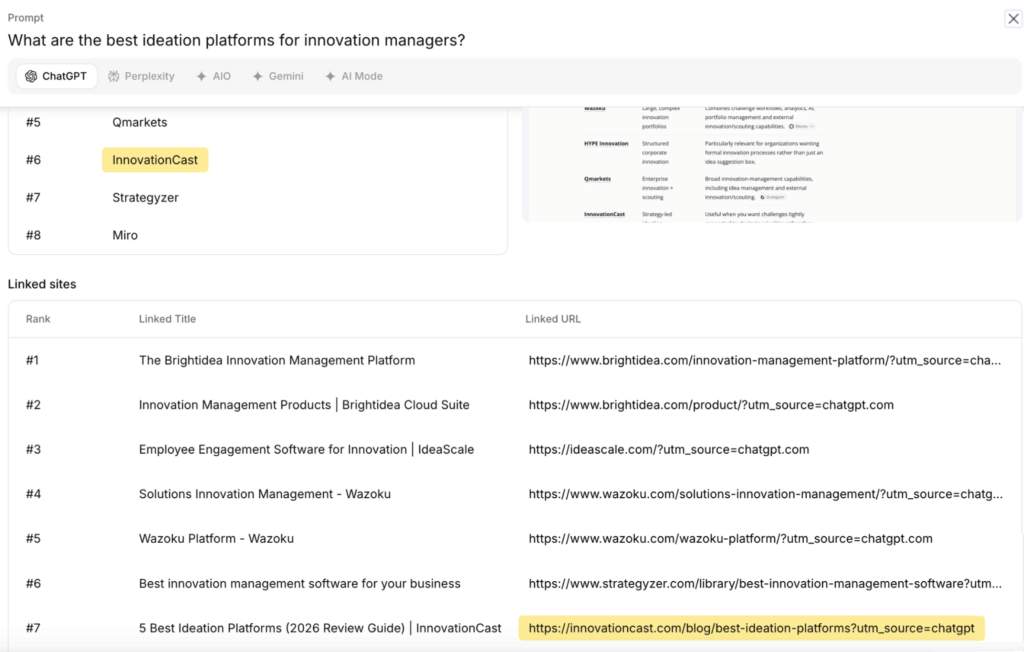
We have countless more of these examples, some of which are shared in case studies like this one and this one. LLMs are absolutely influenced by what’s ranking on Google. We prioritize owning these rankings for clients, first and foremost.
4. We produce case studies.
LLMs are smart enough to connect the dots between a story of your product helping someone and their user who is asking them about a similar issue. So it’s our experience that case studies help. They naturally have the elements of specificity and pain point/solution pair elaboration that we’re talking about here.
These case studies are not typically “SEO pieces.” They don’t target keywords. But they include several specific details of who the product or service helps and why.
5. We do citation outreach to get mentioned on other sites.
We use our AI visibility tool Traqer to see what sites influence answers across each LLM for the topics that are most important to a business and run outreach campaigns to try to get brands included in the most influential articles.
For example in the InnovationCast example above you can see the sites linked as sources for that prompt. But you can also get that analysis for all prompts in a given topic, or the most cited sources across dozens of times a prompt was run:
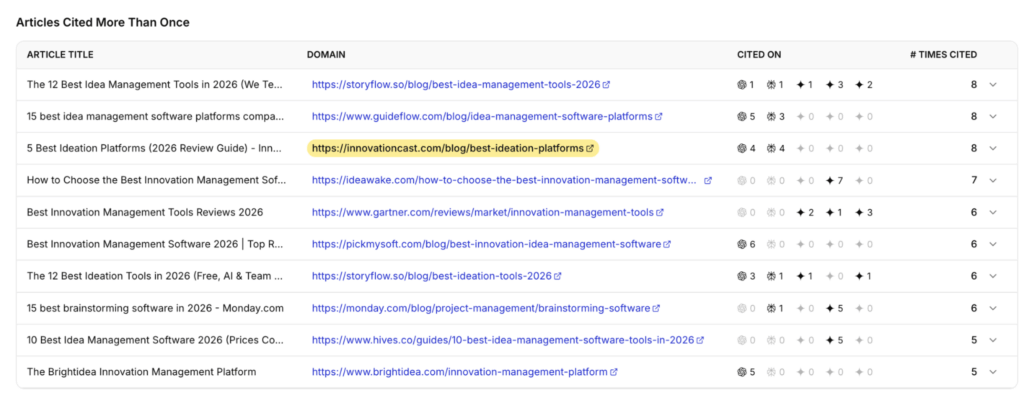
In this case, our own blog post on the client’s site is already one of the most cited, but we would also do outreach to the other websites cited by LLMs to see if we can get our client mentioned in those articles as well.
This is extremely targeted outreach. It’s not general-purpose PR that you hope helps GEO somehow. We know from this data that LLMs are actually citing these pages.
Ultimately, getting these offsite mentions while LLMs are also citing your own content gives LLMs multiple signals associating your brand, your product, or your service as a solution in this topic area.
Pro tip: We also make sure your messaging and product positioning are consistent across all of these touchpoints.
6. We track your AI visibility at the topic level.
To make this process work, you need to measure success the right way. That means tracking visibility at the topic level, rather than relying on individual prompt results alone.
Unfortunately, most AI visibility tools (like Peec, Profound, and Scrunch) default to measuring success on an individual prompt basis. But we built our tool, Traqer.ai, to be consistent with this topic-based property of GEO. That’s how we track improvement in visibility for clients and ourselves: which topics are we visible in and how is that growing?
If you’d like to work with us on your brand’s GEO strategy, reach out here.
You can also read more of our articles on GEO strategy at our AI search hub or join our newsletter to get updates of new articles as they come out.
Join the Grow and Convert Newsletter
Get our marketing ideas emailed weekly.
Explore Articles By Categories


Explore our Videos