We’ve been running our content marketing agency, Grow and Convert, for over 10 years now. In that time, we’ve worked with dozens of SaaS clients, both startups and enterprises, and talked to countless more.
From our work and these conversations, we now have a good sense of what SaaS companies are looking for in content marketing agencies, what they’re disappointed by in the ones that don’t work out, and what real success in an engagement looks like.
This article is meant to summarize those findings.
Specifically, we’re going to discuss 4 key factors that companies should consider when evaluating SaaS content marketing agencies:
- Factor #1: Which of these do you want from content marketing: traffic growth, email newsletter growth, or product signups (trials and demos)? And is the agency’s content strategy optimized to achieve that goal?
This is the #1 factor you need to be clear on. In our experience, content marketing drives growth for SaaS companies if it generates product signups, while most content agencies are built to grow traffic and email newsletter signups. This mismatch causes problems.
- Factor #2: Do they have a process for gaining product and domain expertise, and expressing that through content? Or are they using AI to scale content production with very little human intervention?
- Factor #3: Do they have an AI search strategy (GEO) to improve visibility in LLMs like ChatGPT and Perplexity?
- Factor #4: Do they have detailed case studies that demonstrate the effectiveness of their strategy?
Below, we’ll explain how our agency addresses each of these factors. We’ll also address a question that many companies grapple with as they consider hiring an agency: Should you even hire a content marketing agency? Or would you be better off hiring someone in-house?
Lastly, since some companies like to evaluate multiple content marketing agencies, we’ll share profiles of eight other content marketing agencies who we’ve heard come up a lot over the years.
4 Factors to Consider When Evaluating SaaS Content Marketing Agencies
When evaluating SaaS content marketing agencies, most companies focus on surface-level questions like pricing and turnaround times. But the agencies that actually deliver results differ in four fundamental ways.
Below are the key factors we’ve found that separate effective SaaS content agencies from those that don’t work out.
Factor #1: What’s your goal from content (traffic, emails, trials, or demos)? And is their content strategy optimized to achieve that goal?
SaaS companies have different mindsets regarding the goal they hope to achieve from content marketing. In our experience, most want product signups — whether that be trials or demos — because that’s what they want out of all their marketing channels, including content. This makes sense.
But there are some, for example, later stage companies with existing large lead generation numbers, that may want to use content for traffic and email signup growth. Others just have a vague idea that they want to do content, and may not even realize that this is a choice they can make (i.e. they assume content is solely for getting traffic and brand awareness).
The first thing to understand is that this is a choice. You can optimize content around metrics like traffic and email signups (whichat most agencies do), or you can optimize content for generating trial and demo signups that drive actual SaaS growth (what our agency does).
If you just want traffic, it will be much easier to find a content marketing agency whose strategy aligns with your goal.
However, most SaaS businesses ultimately want to see ROI from content, which means seeing qualified leads, i.e., trial and demo signups attributable to content and meaningful increases in monthly recurring revenue (MRR) over time.
In our experience, this requires a very different content marketing strategy (like the one that we use and have explained at length in previous articles like this and this).
That’s why we think this is the first and most important consideration when evaluating SaaS content agencies: Know your goal and figure out if the agency is built to satisfy it.
If your goal is customer acquisition, then ask the agencies you evaluate if that’s what their strategy is optimized for. Ask them to be very explicit about this:
- Is their process designed to produce content that gets trial and demo signups?
- How does it work to actually achieve that goal?
- Can they prove that it works and show you a track record of results?
Obviously if an agency is asked if their process produces trials and demos, they’re going to say yes, so you have to be very specific in your questioning. Focus on the second and third questions above, see if they can explain exactly how their process generates product signups (not email signups, those are very different) and if they can prove it works and give examples that make sense to you. Use your gut instinct — if you can’t figure out how their process will really get trials or demos to increase, it probably won’t.
The biggest complaint we hear from companies who’ve had bad experiences with agencies — and frankly the biggest complaint we had in our past experiences working with agencies — comes down to misalignment between what the agency optimizes content for, and what the company actually wants. So don’t skip this factor.
Factor #2: Do they have a process for expressing product and domain expertise through notably high-quality content? Or are they using AI to scale content production with very little human intervention?
Second, regardless of what your content marketing goal is, it’s important for whoever is producing your content to be able to express domain expertise in a way that feels native to your brand.
This is especially true for B2B SaaS companies whose target audiences are often advanced industry experts who need to be communicated with at an expert level. If you don’t speak to them at their level, you risk reputational damage and turning off potential customers.
Furthermore, if you choose to optimize your strategy for trial and demo signups, the topics you’ll write on will be very product-centric. This means whoever is writing your content will need in-depth knowledge of your product’s features, the nuanced pain points that they solve for customers, and the ways in which your product is differentiated from competitors.
Most outside agencies or freelance writers will not have this product and domain expertise, and therefore need to have a process for getting this information out of the minds of the experts at your company, and expressing it through your content.
We’ve also started to see many agencies using AI to scale content production for their clients. While AI can help with efficiency, it can’t replace the deep product understanding that comes from interviewing your team, and most agencies aren’t investing the time needed to make AI-generated content truly differentiated.
Many agencies and freelancers end up doing what we call “Google research papers.” Like a high school student doing a research paper, they Google around the topic they were given and regurgitate what everyone else is saying on a given topic, and use AI to generate content based on that surface-level research.
This produces content that lacks differentiation and fails to demonstrate the depth needed to convert qualified leads. In fact, we’ve seen the consequences of 100% AI-generated content across several websites, including some of our own clients before our engagement.
For established websites with existing authority, publishing large volumes of AI content might go unnoticed initially, but Google has explicitly identified this as “scaled content abuse” which eventually leads to a penalty. For newer sites without established authority, the consequences are often more immediate and severe—we’ve seen most of these pages fail to get indexed at all, or in some cases, entire domains become invisible in search results.
So, when evaluating agencies, make sure you ask them:
- What is their process for being able to write and convey your value props, benefits, messaging, and differentiators in a way that feels native to your brand?
- Do they even have one?
- And if so, how does it work?
- Are they using AI to scale content production, or do they have a human-driven research and writing process?
Is it a one-off interview at the beginning of the engagement? Is it a few one hour calls? Do they regularly interview experts at your company on a piece by piece basis?
We have found the latter approach — doing interviews on a piece by piece basis — to be both extremely rare when working with outside agencies, yet the most effective approach for expressing product and domain expertise through content. This is the approach we take at our agency, which we’ll discuss more below.
Factor #3: Do they have an AI search strategy (GEO) to improve visibility in LLMs like ChatGPT and Perplexity?
Content writing is just one facet of the content marketing process. For content marketing to work, it’s also necessary to rank on traditional search and get visibility in AI engines like ChatGPT, Perplexity, and Google AI Overviews so that your customers can find you wherever they are searching.
So, another key thing to understand is what the agency offers beyond just traditional SEO. Do they have a real AI search strategy, or are they just doing SEO and hoping it also works for AI engines? Is it included in their service? Sold separately? And what exactly do they do?
What you should look for is an agency that has an intentional, defensible GEO strategy grounded in data – not just agencies that do content marketing as normal and hope that somehow turns into AI visibility, nor agencies that chase the latest GEO tactics being touted online. For example, many marketers talked about implementing “llms.txt” files in sites to help LLMs crawl your site. It’s been well established now that LLMs don’t use or pay attention to llms.txt – in other words it does nothing.
Also an understanding between the links between GEO and SEO is a green flag when choosing an agency. LLMs search the web to formulate their responses, which means ranking in Google is still the foundation of getting AI visibility. The best agencies prioritize GEO tactics properly: owned content that ranks first, then off-site citation outreach, which we’ve shared in detail in our Prioritized GEO guide here.
When evaluating agencies, ask them:
- Do they have a strategy of what topics or prompts you should aim to get visibility on, or is it spray and pray? When they answer pay attention to if they can discern between bottom and top of funnel prompts and topics. ? (Top-of-funnel content doesn’t drive traffic from AI tools because users stay in the AI tool to get their answers)
- Do they do citation outreach to get your brand mentioned on the specific sites that LLMs actually cite for your topics? (Not just generic “Reddit marketing”)
- Can they identify which domains are most cited for the prompts and queries relevant to your products?
- Do they have a way to monitor your visibility in AI tools like ChatGPT, Perplexity, and Google AI Overviews?
- How do they report on GEO performance?
If an agency can’t explain a clear, prioritized approach to GEO, one that starts with ranking content in traditional search first, they’re likely just doing SEO and hoping it works for AI tools too.
Ensure They Don’t Use a “Keyword Sprinkling” Strategy and Call That AI Search Optimization/GEO
We’ve spoken with several clients who’ve had bad past experiences with SaaS SEO agencies. And after digging into the content those agencies were producing, we’ve learned that often agencies use a “keyword sprinkling” strategy.
Essentially, they’ll create “SEO” articles by simply “sprinkling” a bunch of keywords throughout articles. But as we’ve explained in our article on SEO content writing, ranking highly for valuable keywords takes a significantly more strategic approach than this — specifically, for the most valuable and competitive keywords, you need to have one single article completely optimized for a single keyword.
Similarly, with AI search optimization, we’ve started seeing agencies take a superficial approach to query fan-out. Query fan-out is when AI models break down a user’s query into multiple related sub-queries (for example, “best project management software” might fan out into “project management for remote teams,” “PM software integrations,” “project management pricing,” etc.).
Some agencies will use LLM optimization tools to identify these sub-queries, then simply add headings or FAQ sections for each one without actually understanding the intent behind those queries. They don’t ask: Does this sub-query warrant its own separate article? Can it be naturally integrated into an existing article on the site? Does it only need one new section, or does it require comprehensive coverage?
This results in thin, fragmented content stuffed into articles where it doesn’t naturally belong—content that doesn’t genuinely help users or perform well in AI search results.
If an agency says that they primarily rely on SEO and AI search optimization to drive traffic, be sure to have them explain to you how they go about ranking content for specific keywords. Ask them:
- What’s your process for doing keyword research?
- How do you choose keywords to target?
- What’s your process for analyzing search engine results pages (SERPs)?
- How do you reflect those analyses in your writing to get articles to rank?
- Can you show us examples of articles you’ve written that are ranking highly in Google?
- What’s your backlink strategy? Do you actively build links, or do you only rely on organic mentions?
- How do you approach AI search optimization? What tools do you use to track visibility?
- When you identify sub-queries through query fan-out, how do you decide whether to create new articles, update existing ones, or integrate content into current pages?
Agencies worth hiring will be able to answer these questions in detail and show you results they’ve gotten for other clients.
Note: We’ve published a detailed article on our SEO writing process, which you can read here. We’ve also published a detailed case study on SEO rankings data from 20 active and former clients, which you can find here.
Factor #4: Do they have detailed case studies that demonstrate the effectiveness of their strategy?
It’s very common for agencies to share a lot of theoretical advice and information, but show little to no data or case studies that back up what they say and prove that their strategies work. It’s also common for them to just put up quotes from past clients or random stats like “we grew X company’s organic traffic by 200%.”
These types of testimonials and unsupported claims are not reliable proof that an agency can do what they say. And importantly, traffic growth alone doesn’t prove they can deliver what SaaS companies actually need—more qualified leads and product signups.
So, an essential thing to look for is whether or not an agency has published the results they’ve achieved for clients, and specifically explained the details behind how they achieved those results. Look for agencies with a proven track record of delivering results, not just marketing claims.
Otherwise, you just have to blindly trust their level of competency, which leads to very inconsistent experiences with agencies.
When reviewing agency case studies, look for details about the work behind the results. For example, if they’re claiming they increased traffic by some percentage for a past client, figure out:
- How many articles did it take?
- Did one article produce most of that or was it spread out?
- What keywords did they rank for?
- How and why did they choose those keywords?
- How long did it take to rank?
- What was the domain authority of that client at the start and end? Did they do link building?
- Did traffic increases lead to actual business growth (more trials, demos, or revenue)?
- What didn’t work?
The more transparent agencies are with the results they’ve achieved and the ways in which they got those results, the more you can trust them to be able to replicate those types of results for your business.
Now, let’s walk through how different agencies address each of these factors. We’ll start with our own agency and explain our SaaS content strategy, writing and promotion processes, and 5 long-form SaaS case studies we’ve published. Then we’ll profile 10 other leading SaaS content marketing agencies with their approaches, pricing, and ideal client profiles.
Best SaaS Content Marketing Agencies
Here are the SaaS content marketing agencies to consider, starting with our own. For each, we’ll explain their approach, what they specialize in, and what types of companies they work best with.
1. Grow and Convert
Grow and Convert is our content marketing agency, and we’ve spent over 10 years specializing in content strategies that drive trial signups and demo requests for B2B SaaS companies, not just hollow traffic. Unlike agencies that optimize for top of funnel metrics like traffic or rankings, we focus on bottom-of-funnel content that generates qualified leads and measurable ROI through our Pain Point SEO and Prioritized GEO frameworks.
We work with SaaS companies at various stages, from startups seeking their first scalable content strategy to growth-stage companies that are looking to scale growth in traditional SEO and AI engines through content, SEO, and AI search strategies.
Our approach is built around the four factors we outlined above, and we’ve documented our entire process publicly through detailed case studies.
Here’s how we address each factor:
1. Our Content Strategy Is Optimized to Drive Trial & Demo Signups
We’ve optimized our SaaS content strategy to drive trial and demo signups (versus traffic and email signups) for two key reasons:
- Saas marketing teams want to generate pipeline from content. Sooner or later, most SaaS brands that invest in a content agency want to see some form of measurable ROI–not just website traffic, but qualified leads that convert to revenue. We learned early on that if we can show ROI to clients (in particular management and executive teams), the engagements last longer, allowing results to compound while making everyone happy.
- There’s a significant volume of people actively looking to buy SaaS products. For almost every SaaS company, outside of rare category-creating products, there is some significant volume of people who are already actively looking to buy that type of product — or solve pain points that product solves. These people are Googling (or ChatGPT-ing) terms that indicate they are ready to buy. Our perspective is that it makes way more sense from a business standpoint that a content strategy goes after these ready-to-buy-now people first, before trying to reach the people higher in the customer journey. Note this is the inverse of what has been long standing convention in content marketing circles: start at the top of funnel, capture their email, drip them info to get them to convert.
We’ve written at length about how top-of-funnel first content strategies don’t work well and how we more directly drive trials and demos through content. Check out these SaaS-specific articles for detailed walkthroughs on our philosophy and process.
Philosophy
- SaaS content marketing: Why you should focus on bottom of the funnel first to drive signups
- Mini-Volume Keywords: Why targeting small search volumes makes sense
Strategy and Writing Process
- How to create a SaaS content strategy that drives product signups
- SaaS content writing: How to write content that gets leads & signups
How We Hold Ourselves Accountable
For every one of our clients, we create an ROI graph like this one (a live graph from a B2B SaaS client we’ve been working with for over 2 years):
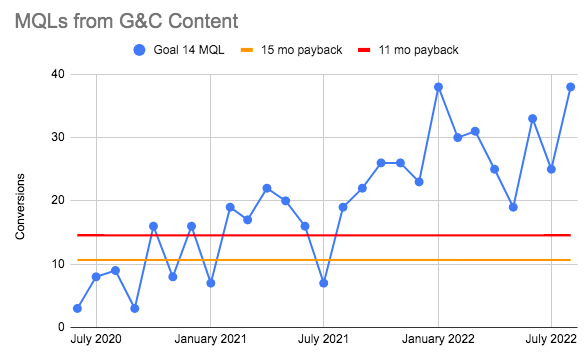
The horizontal lines represent the number of leads this client needs per month to break even on their monthly spend with us. Each month, we plot the number of leads from our articles on this graph. Then we report on our progress in relation to that break even number so clients can see when they begin to have positive ROI.
We’ve written extensively about how we do this here and here, including more case studies and client data. Before we started our agency, this is the type of thing we were looking for but could never find. And we feel this is the number one differentiator of our agency.
2. We Use an Interview-Based Writing Process to Express Product and Domain Expertise Through Content
We don’t produce articles in the “Google research paper” style we described above (where we just self-research a topic and write up what we found or use AI, trying ourselves to become the experts).
Instead, our writers start by interviewing people inside your organization who have the know-how and expertise to speak on that topic and convey how your product and your company has innovated or differentiated itself in the topic area of the article.
Thus, the writer is not asked to pretend to be an expert themselves. This is a massive shift from traditional content services and is essential to producing genuinely high-quality content that demonstrates real domain expertise.
We’re not talking about grabbing a few quotes from experts to throw into an article. We’re talking about hour-long recorded interviews where we shape an entire article around the viewpoint and knowledge of an expert inside your company, who can not only speak to the topic area but also tie-in your product.
This changes everything. It creates true thought leadership content, and adds genuine product expertise into our BOTF pieces discussed above because we’re able to include all the detail and nuance of how your product is differentiated, what it replaces, why features were designed in certain ways, and more that only product experts inside your company would know.
3. We Use a Three Pronged Content Promotion Process
To drive traffic to your articles as we wait for them to rank in organic search, we use a three pronged promotion strategy to drive both short and long term traffic. Specifically:
- Paid Ads / PPC Marketing Campaigns (short term traffic): We use paid ads to promote content using two targeting methods: Cold audiences (using interest and demographic based targeting) and lookalike audiences (based on the client’s existing customer list or website visitors). We test paid channels such as Facebook, Twitter, Linkedin, and Google Ads based on each client and where we’re most likely to reach their audience.
- Manual Link Building (long term traffic): When certain pieces start ranking for keywords, we strategically build backlinks to build authority and boost them to page 1 or the top of page 1 in Google.
- Building Citations from AI-Referenced Sources: We track which sources AI tools like ChatGPT, Perplexity, and Claude are citing when answering queries relevant to your industry. Then we work to get your content published on or mentioned by those same authoritative sources. This ensures that when AI tools answer questions in your space, they’re more likely to cite content that mentions or links to your brand.
The combination of these two steps gives our pieces a short term boost in traffic followed by long term sustainable organic traffic that adds up from different articles and grows over time.
We do all of the above from our own budget, with no extra spend for our clients, making us a truly full-service agency. This is markedly different from other marketing agencies and something we’re very proud of offering our clients.
4. We Publish Detailed SaaS Case Studies to Demonstrate and Prove the Effectiveness of Our Content Strategy
Here are 5 case studies you can read to see how we’ve executed our content strategy for real SaaS businesses:
- How we scaled Leadfeeder’s signups to over 200/month
- Scaling content: Expanding from bottom of funnel content to top of funnel (Geekbot Case Study)
- Scaling SEO traffic from 920 to 14,577 sessions in 6 months (Circuit Case Study)
- How to Do B2B content marketing without domain expertise (Rainforest QA Case Study)
- How to create a keyword strategy for a new, innovative product (Case Study of a video editing software client)
These case studies show our track record of delivering measurable results—not just traffic growth, but actual trial signups, demo requests, and sustainable growth for B2B SaaS companies.
Finally, if you’re interested, you can learn more about our agency, pricing, and reach out about working with us here.
To help SaaS businesses weigh different agency options, here are a few other content marketing agencies whose names we’ve heard repeatedly either through clients having worked with them in the past or just through colleagues in our marketing agency.
Note: We haven’t directly worked with any of these agencies, so we can’t independently vouch for the quality of their work. But that’s why we outlined the 4 key factors for evaluating a SaaS content marketing agency above, so you can evaluate them. If you want to reach out to these agencies, we recommend you ask them about each factor and evaluate for yourself if and how they have a process to address them.
2. Animalz
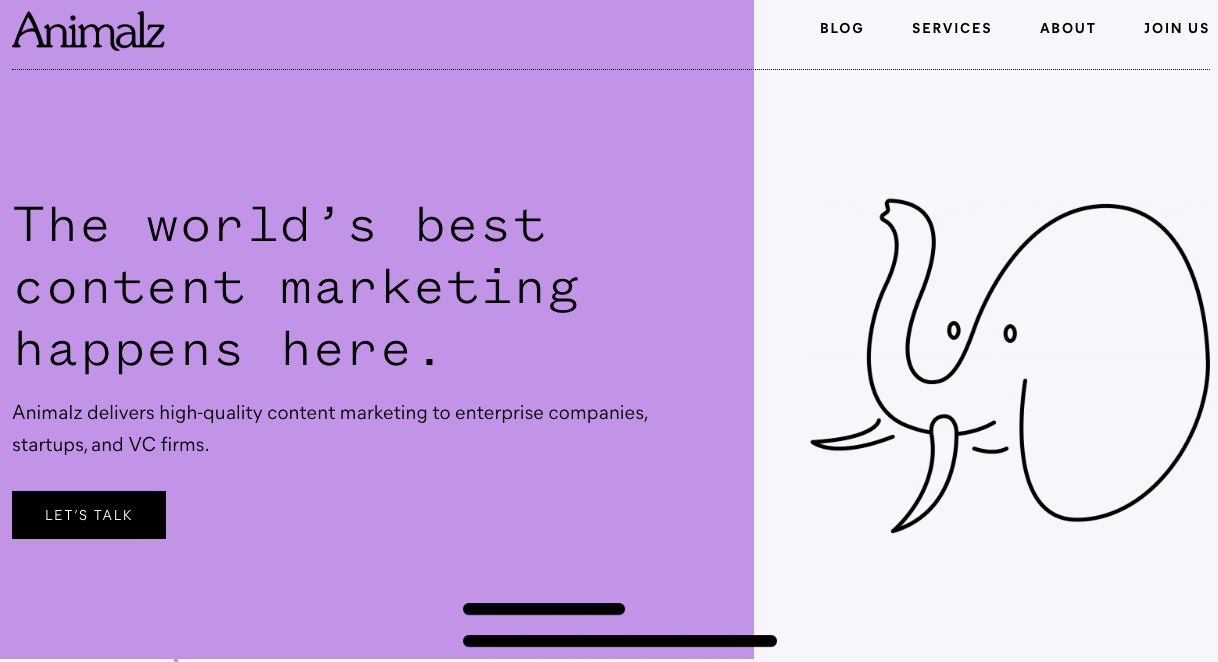
Animalz is a content marketing agency that specializes in thought leadership content for B2B SaaS companies. Their approach emphasizes quality over quantity and long-term growth through organic search rather than high-volume content production.
They offer comprehensive services, including content strategy, writing (such as blog articles, white papers, case studies, and research reports), technical SEO, Answer Engine Optimization (AEO), content audits and refreshes, and LinkedIn campaigns. They also developed Revive, a free tool that helps marketers identify content decay and find opportunities to refresh outdated articles.
Their methodology follows a four-step framework: building context about your product and industry, formulating custom strategy playbooks, crafting content through multiple review rounds, and analyzing performance through customized dashboards.
They’ve worked with companies like Amazon, Google, Microsoft, Dropbox, Intercom, and Zendesk.
Visit their site for more information about their services, team, podcast, and more.
3. Siege Media
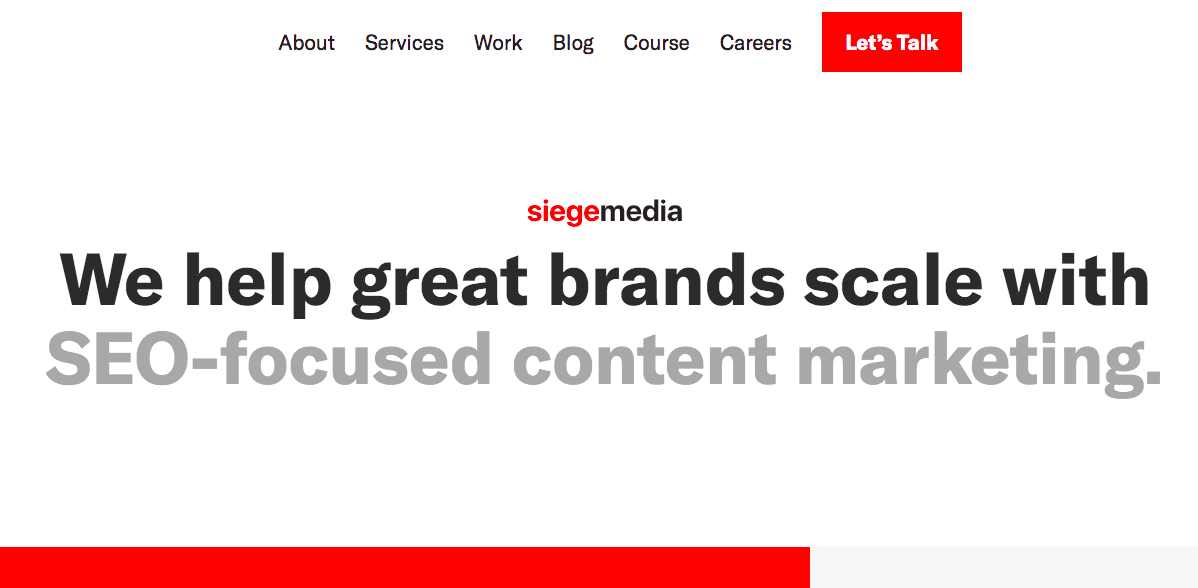
Siege Media is an SEO-focused content marketing agency founded in 2012. They specialize in content creation, link building, and digital PR with an approach that emphasizes data-driven content strategies to drive organic search growth and backlinks from authoritative sites.
They offer comprehensive services including content strategy, SEO and GEO (Generative Engine Optimization), link building, digital PR, technical SEO, and graphic design. What sets them apart is their focus on a design-heavy content approach with visual elements, and interactive content like quizzes, maps, and calculators.
Their methodology focuses mostly on SERP analysis to find high traffic value keywords after which they build content assets to rank for those opportunities. They also openly share their methods and conduct original data studies on different marketing trends.
They’ve worked with companies including Zapier, Figma, Shutterstock, and Zillow.
Visit their site for more information.
4. Optimist
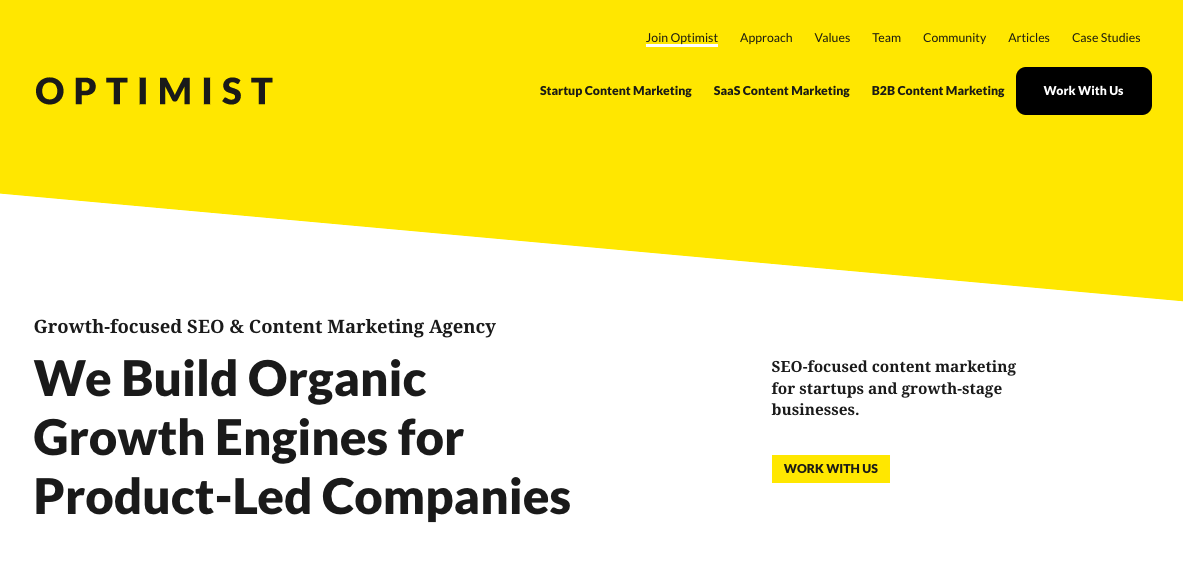
Optimist is a full-service content marketing agency that specializes in working with B2B technology and SaaS companies, particularly product-led growth businesses. They operate as a hybrid collective with a network of vetted content experts rather than traditional agency structure.
They offer comprehensive services including content strategy, research, writing, design, SEO-focused content, sales enablement, customer marketing, social media, email marketing, white papers, ebooks, data reports, and LinkedIn executive ghostwriting. According to their website, clients work directly with experienced creators (no account managers or layers), and they build bespoke teams for each engagement.
Optimist focuses on measuring success in demand, pipeline, and revenue rather than just website traffic. They also run “Top of the Funnel,” a free community for content marketers.
They’ve worked with companies including Semrush, ZoomInfo, DreamHost, HelloSign, Superhuman, Contentstack, Plytix, Glide, and Popmenu.
Visit their site for more information.
5. Omniscient Digital

Omniscient Digital is an organic growth agency founded in 2019 that helps B2B software companies turn SEO, content, and LLMs into growth channels. Their leadership team includes former growth leaders from HubSpot, Shopify, and Workato who have built and scaled organic search programs at major tech companies.
They position themselves as focused on revenue-driving outcomes, including qualified leads, pipeline, and conversions, rather than just traffic volume.
They offer comprehensive services like SEO strategy development, audits, content strategy, content production, content optimization, link building, digital PR, Generative Engine Optimization (GEO), programmatic SEO, and technical SEO.
Their approach balances quality content with high velocity production while building content distribution systems tied to attributable conversion metrics. They optimize content throughout the customer journey to fill pipelines with qualified leads and users.
They’ve worked with companies including Jasper, Loom, HotJar, Order.co, Vendr, Simon Data, and RightCapital.
Visit their site for more information.
6. ABHMedia
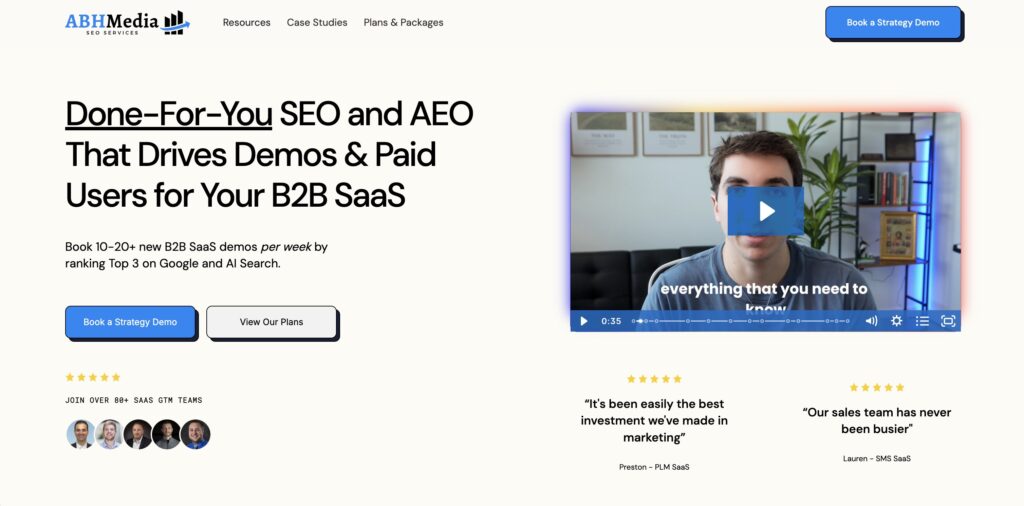
ABHMedia is a B2B SaaS SEO agency that focuses on turning organic search into a revenue channel. They work exclusively with SaaS companies and emphasize driving demos, signups, and paid users rather than traffic or rankings.
Their approach starts with understanding your ICP and targeting keywords with commercial or transactional intent, terms that indicate users are ready to sign up or learn more about your product. They handle the entire SEO process on a done-for-you basis, including technical SEO audits, keyword and content strategy, content creation, and link building.
They target backlinks to pages for specific keywords you’re trying to rank for, rather than general backlinks to your homepage. They also write content tailored to Google’s requirements for each keyword, rather than following fixed content templates.
Their services include technical SEO audits, keyword and content strategy, content creation and optimization, link building campaigns, programmatic SEO, and conversion rate optimization.
They’ve worked with companies including Activepieces, TextUs, Briefpoint, Talkroute and Odin AI.
Visit their site for more information.
7. Skale

Skale is a B2B SaaS growth and SEO agency built to help software companies scale pipeline through data-driven organic acquisition. They specialize in SEO strategy, content production, revenue-focused link building, and product-led content designed to drive qualified signups—not just traffic.
They offer a full suite of services, including technical SEO, content strategy, programmatic SEO, GEO (Generative Engine Optimization), digital PR, and ongoing growth experiments grounded in attribution data. What sets them apart is their focus on ARR impact, using a performance-led approach that ties every deliverable to revenue, pipeline, and ICP alignment.
Their methodology is anchored in deep SEO opportunity modeling, competitor gap analysis, and bottom-funnel content designed to accelerate paid-to-organic efficiency. They frequently publish insights on SaaS growth, including breakdowns of search intent, category creation, and AI-driven search behavior.
They’ve worked with companies including Pitch, Miro, PandaDoc, and Attest.
Visit their site for more information.
8. Concurate
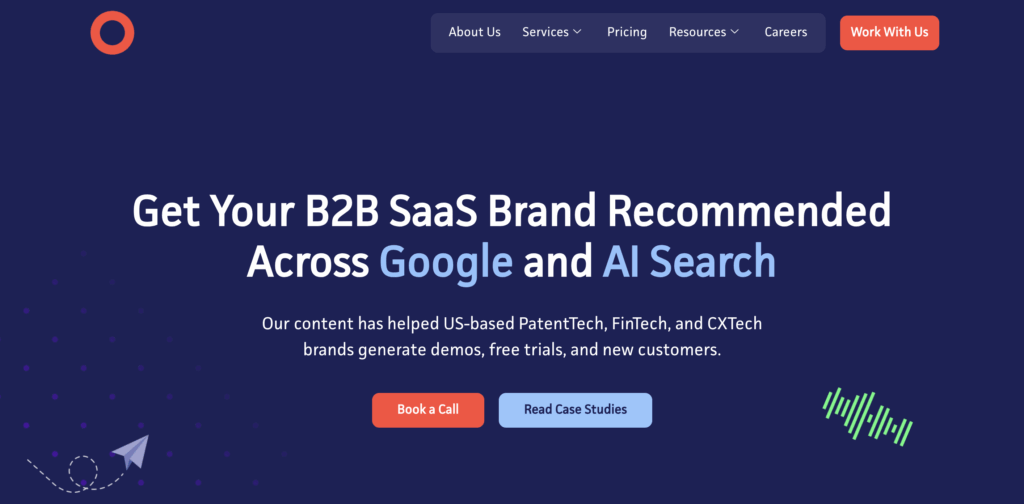
Concurate is a B2B SaaS content marketing and GEO agency founded in 2019. They work primarily with companies that have achieved product-market fit and want content to generate qualified leads rather than simply increase traffic.
Their services include content strategy, Generative Engine Optimization, thought leadership content, programmatic SEO, case studies, knowledge base creation, and LinkedIn account management for executives and brands.
As part of each engagement, they begin by understanding the client’s target audience, pain points, and existing visibility across traditional search and AI platforms. They use the Perfect Match Framework to identify content and citation gaps, develop a content roadmap, and manage the entire execution process.
They have worked with B2B companies like PQAI, InspireIP, Enghouse Interactive, Athena Security, and Ratio Tech.
Visit their site for more information about their approach and services.
Should You Hire a Content Marketing Agency or Build a Team In-House?
Over the years, we’ve spoken to many companies who are considering hiring us and at the same time considering bringing someone in-house. And very often, companies lean toward making an in-house hire.
We think the biggest reason for this is that by hiring someone in-house, they feel the content marketer will more deeply understand the details of their product and their company — and therefore be more trusted and capable of acquiring the product and domain expertise we discussed above. This is in contrast to agencies, where most of them assign articles to writers without domain knowledge or any process to acquire and express expertise through their content.
However, because of the interview-based content writing process we use at Grow and Convert, this isn’t a problem when you work with our agency. And in fact, if this problem is solved, there are actually many additional benefits of hiring an agency compared to an in-house employee.
Specifically:
- Speed to Get Up and Running: If you hire an in-house content marketer, it may take 3 to 6 months for them to create a content marketing plan and get content production up and running, let alone the time it will take for that content to begin producing results. Whereas, an agency has processes in place to get up and running immediately, speeding up the time it takes to get results from content. In contrast, as shown in our post on how long it takes to rank in Google, we typically have 25 – 35 articles ranking on page 1 of their intended keywords in the first 12 months.
- A Team vs. an Individual: Effective content marketing takes a variety of digital marketing skills and areas of expertise, and often one person won’t have all of the skills to execute the strategy, the writing, and the promotion, etc. Companies often think they can hire just a writer, or just a strategist, and later realize that they actually need more than one individual to carry out their content marketing efforts. In contrast, when working with our agency, there are often 3 to 5 people with different areas of expertise working together on your account — which has distinct advantages over relying on a single person. For example, we have content strategists, writers, a paid ads specialist, project manager, and designer ready to deploy for each client.
- Strategy & Deep Expertise: Particularly for companies that want to optimize their strategy for driving product signups, it’s difficult to find and hire an in-house content marketer with experience developing that type of content strategy and writing pieces that both rank for valuable keywords and sell products. This is in part due to a culture in content marketing — most content marketers subscribe to the belief that content is just for driving traffic and brand awareness, and so that’s how they operate and what they know. In contrast, when working with our agency, we have established hiring and training processes that ensure our strategists and writers have the expertise to execute signup-driven content strategies.
It’s perfectly understandable to want to hire an in-house content marketer instead of an agency, but it is worth considering the advantages that agencies can offer.
Want to work with us or learn how to implement our B2B content strategy?
- Our Agency: You can learn more about working with us here.
- Our Content Marketing Course: Individuals looking to learn how to grow their SaaS business with content can join our private course, taught via case studies, here. We include a lot of information and examples not found on this blog. Our course is also built into a community, so people ask questions, start discussions, and share their work in the lesson pages themselves, and we and other members give feedback. We also get on live Zoom calls about once a month and dissect members’ actual content strategies and brainstorm ideas on how we’d form content strategies for their businesses.
- Join Our Content Marketing Team: Alternatively, if this style of B2B content marketing appeals to you, consider joining our content marketing team as a writer or content strategist. We have awesome clients. We’re a remote company. We pay well. And you won’t have to stress about getting your own clients or spend a bunch of time doing outreach to get them.
Questions? Comments? Feel free to share them in the comments below and we’ll respond.
Join the Grow and Convert Newsletter
Get our marketing ideas emailed weekly.
Explore Articles By Categories


Explore our Videos