How to choose a GEO agency: The quick answer
Choose a GEO agency on evidence that they can generate brand mentions and visibility across LLMs and AIOs for topics that lead to trials, demos, or pipeline. Also, look for agencies that focus on both on-site and off-site strategies (i.e., not just chasing Reddit mentions), while reporting on AI visibility by topic and per LLM.
Almost every SEO and content agency has added generative engine optimization (GEO) to its services in the past 2 years.
The industry is also flooded with information on what GEO actually is, how it’s different from SEO, and if we should even call it GEO or Answer Engine Optimization (AEO), AI SEO, AI search optimization, or something else.
We lived through this transition firsthand and know how confusing it can be to choose an agency in this context. Teams often come to us confused, saying they’ve tried a collection of GEO “tactics” without any coherent strategy, often as a result of bad but popular GEO advice, like:
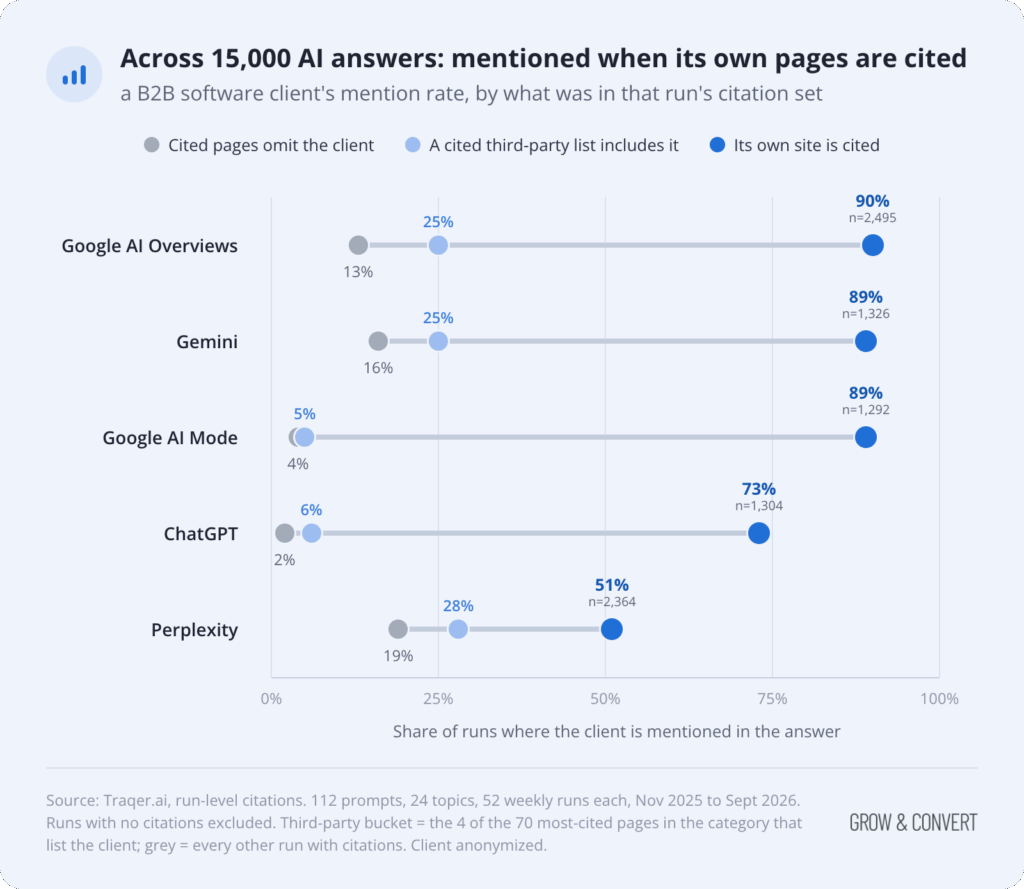
- Chase third-party mentions because “most” citations come from third-party pages. We studied 15,000 AI answers for a B2B software client. Yes, third-party pages made up 85% of the citations, because obviously most citations won’t be from a single site! But 87% of the LLM responses that mention a client (the real goal of GEO) cite the client’s own site. So, an agency that’s hyperfocused on off-site work like “digital PR” and Reddit may improve your citation rate but not your pipeline.
- Track individual prompt visibility. Many agencies and the visibility tools they use treat prompts like SEO keywords, even though they’re very different. The prompts that drive business are actually long and personalized conversations, so you can’t see or predict them (see Invisible Prompts). The answers the LLM gives are also personalized around the user’s context, which you don’t know and can’t predict, so they also aren’t as stable as SEO keyword results. That’s why measuring visibility on a topical level is a much better way of tracking GEO success than “We showed up for this prompt”.
- Focus on on-site techniques like structured data, llms.txt, or chunking. In our experience, none of these are particularly important. LLMs can read and understand natural language and navigate websites with straightforward and common-sense site and page structures just fine. The real difference is whether a company’s site has content that explains to LLMs all the situations and personas where they’re a good fit and why they’re a good solution. If you do that, in our experience, you don’t need to care about chunking or schema.
In short, finding a good GEO agency today can be tricky because what makes for a good GEO strategy is not well known in the industry yet, and the common advice you find online doesn’t make it easier. Even our advice above may need to be read twice for it to really make sense, but that’s the point: This is a new field with a lot of unsubstantiated claims being thrown around.
So this article serves as a way for us to write down what we’ve learned while 1) Doing GEO for dozens of clients for the past year and more, and 2) Studying GEO through our own data, packaged in a way that lets you evaluate GEO agencies.
Here’s everything we cover below:
- What to look for in a GEO agency
- 6 questions to ask during your talks
- What red flags to consider when evaluating
- Industry-specific advice for finding GEO agencies for B2B SaaS, enterprise tech, fintech and crypto, cybersecurity, and healthcare
- How to think about your GEO agency’s results and when it might be time to consider a switch
What to look for in a GEO agency (5 factors)
1. The agency has a thorough strategy for producing owned content that matches what your ideal buyers are looking for
Getting an LLM to recommend your product or service to a user (the ultimate goal of GEO, which is very different than just “getting cited”) means teaching it how and why your product or service is a good fit for all the different customers, situations, and pain points where you are a great fit. This is only possible with in-depth content published on your site that LLMs can pull from and use to understand your business.
As we explain in Personalized GEO, the fundamental difference between SEO and GEO is that LLM responses are heavily personalized to the user. LLMs have far more context about the users’ unique situation and pain points than traditional Google ever did.
As a result, the GEO agency’s job is to help LLMs make the connection between your product, the problems it solves, and the right people searching for solutions. Doing that takes space, words, and content that’s only really available on your site. You need more room to make those arguments than is afforded by getting a link on some industry site or a sentence in a Reddit comment.
Even if you’re in the decision set of possible solutions via some off-site mention, LLMs will go to your site to really verify if you’re a good fit for their user. They need to ensure you have the right features, you’ve solved similar problems for others, and so on.
Take our work with Constitution Lending as an example. One of our most valuable SEO keywords is “best LLC mortgage lenders,” where we currently rank #1 on Google using owned content that we wrote. We also rank for close variations, including “mortgage loans for LLC” and “mortgage lenders for LLC.”

Using Traqer, our AI search visibility tool, we can also see that Constitution Lending appears as a top recommendation in ChatGPT (Column #1), Perplexity (Column #2), and Google AIO (Column #3) when users ask for LLC mortgage lenders.

This increase in AI visibility for crucial, high-intent purchase topics is heavily based on the content we produced, where we explain in extreme detail how Constitution Lending’s services are tied to specific problems. In turn, LLMs took that content, used it to build their responses, and tied our client to the right problem, use case, and audience.
2. The agency creates content at the depth of a sales call
Your content needs to tie your product to a problem and explain how to solve it clearly, and in such detail that LLMs can make that connection. Generic content doesn’t have the detail necessary to do that.
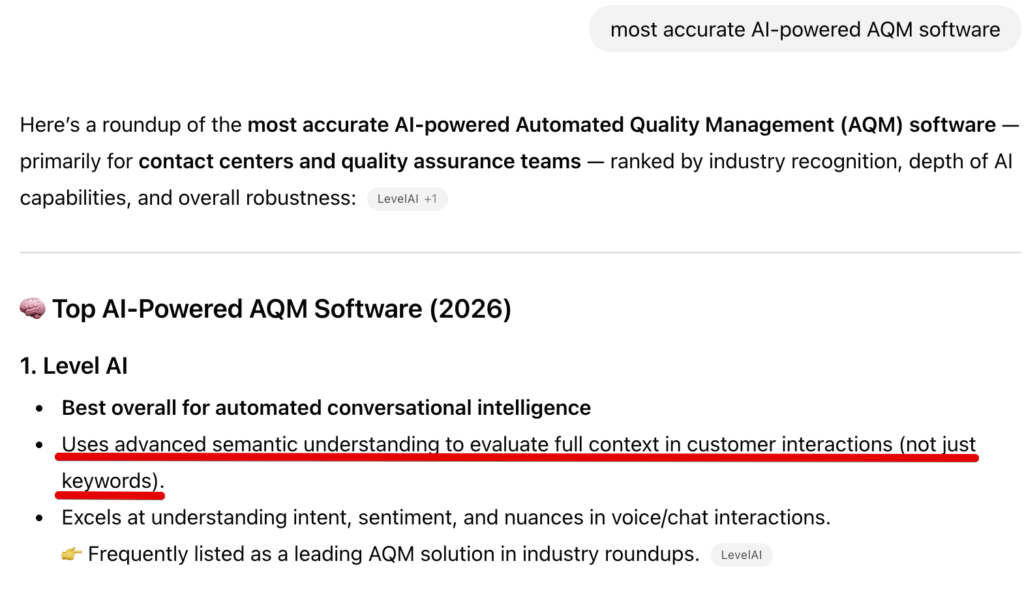
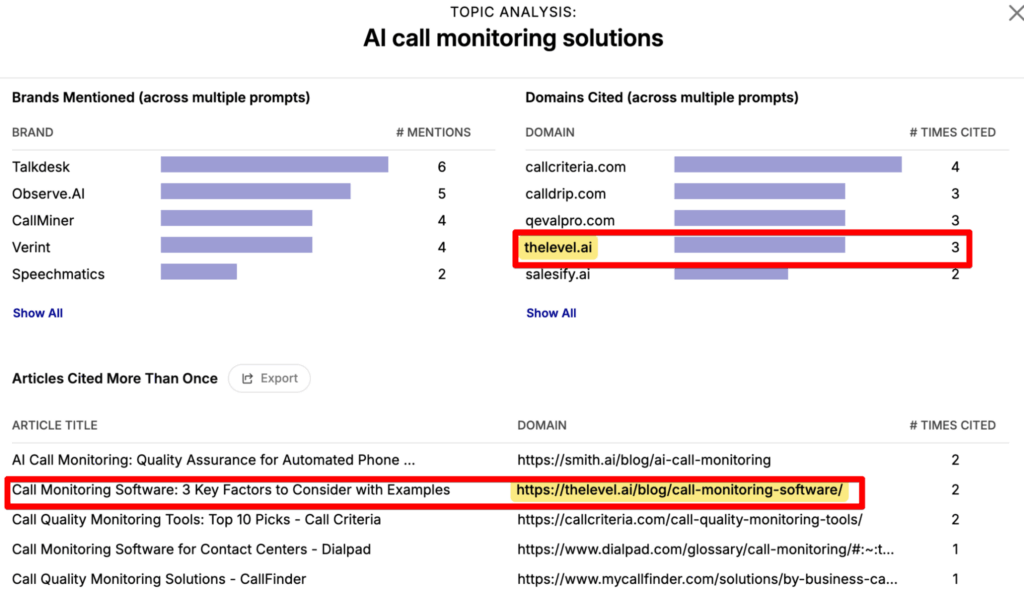
For example, our work with Level AI focused on highlighting very specific value propositions, like its use of semantic intelligence, the ability to detect emotions in customer conversations, and more.
Over time, LLMs started using our framing and text almost word-for-word in their responses. The result is not only increased AI visibility but consistent product framing and positioning.
There are no GEO hacks here. The agency has to get a deep understanding of your customers’ problems and how your product solves them to produce content like this.
We’ve done this for 10+ years by interviewing subject matter experts (SMEs) from every company we work with. We also use questionnaires, Looms, Slack threads, and any other tool that makes it easy for SMEs to share the specifics we need to create content at this level.
Learn more: Why Ultra-Specific, Bottom of Funnel Content Wins in AI Search
3. The agency measures brand mentions by topic and LLM
Your brand being recommended by LLMs for a specific topic is the entire point of GEO, so your agency should have a way to measure that.
(Yes, citations are nice and can be a secondary confirmation, but they’re not as valuable as getting your brand mentioned at the exact point potential customers are looking for solutions).
From our experience, most teams make a crucial mistake here by treating AI visibility as a single brand-level metric because it’s easy to report on. The problem is that AI search visibility is only a function of the specific topics and prompts being measured.
You might be mentioned or cited for hundreds of topics that have little to no purchase intent behind them, while being completely absent from ones tied to the problem your product solves. Plus, as we said above, prompts are often long, personalized, and usually have a volume of exactly one, so you can’t see or reproduce them (while answers naturally vary by run).
Here’s a real-life example to demonstrate this: Mirascope (one of our clients) has strong visibility on the topic of “prompt engineering tools” across ChatGPT, Perplexity, and Google AIOs:

However, on the topic of “context engineering platform,” they have far less visibility, even though that’s also an important theme for their business.

Now, imagine reporting on Mirascope’s AI visibility using a single branded score. The result might look okay to leadership, while missing the fact that the brand is almost never recommended when people search for context engineering platforms.
Situations like this are a big part of the reason why we built Traqer, our own AI visibility tracking tool. We built it for both per-topic and per-LLM tracking of brand mentions and citations, so you have actionable information on where to focus on your content and off-site efforts.
We’ve also added the ability to see how brand mentions and citations evolve over time and across different runs, so you get a sense of the recent trends, i.e., whether you’ve started gaining or losing traction for important topics over the last days, weeks, and months.
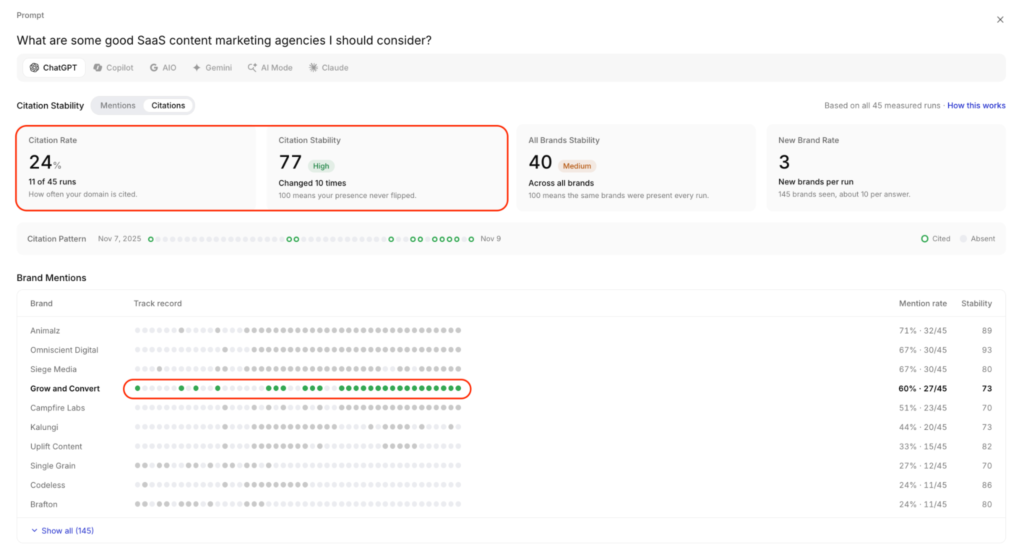
Learn more: Topic-Based Visibility: Why Single AI Visibility Percentages Don’t Make Sense
4. The agency’s off-site efforts support priority topics and target relevant pages
Outreach should be focused on the pages that are cited by LLMs for the topics you care about. For most B2B product topics, focus on industry publications and competitor roundups more often than Reddit, Wikipedia, or Forbes.
Unfortunately, the hype around third-party citations has led many teams to build mentions and links for the sake of it. Getting on Reddit, Wikipedia, or Forbes just because LLMs cite them most often for queries that have nothing to do with your industry or customers’ problems is a great way to waste your time and money.
As we explained in this study of our client data, out of all the LLM citations:
- ~59% came from direct industry sources (1,444)
- ~26% came from industry-adjacent domains (649)
- ~14% came from general domains (347)
Put differently, about 86% of all citations came from within the industry ecosystem, and only 14% came from general or unrelated sources.

5. The agency has a broad and nuanced approach for reporting on trials, demos, pipeline, and revenue
Your GEO agency should report on the business impact of its efforts. Today, this requires multiple different reports, as direct attribution is unreliable in the age of AI search. These can include all homepage conversions from organic, direct, and AI referrals, plus self-reported attribution and the classic directly attributable conversions per URL.
This is necessary because people often don’t click on links when researching products in LLMs. They have conversations, ask follow-ups, and either Google brands or go to the website directly. On a standard website analytics setup, this shows up as branded organic or direct, even if the LLM was influenced by your content when creating its response.
Any good GEO agency should understand this nuance and still try to tie their work to important business outcomes, like a free trial in your SaaS tool, booking a demo with your sales team, or making an appointment for your service.
For example, when reporting on conversions, we often look at:
- Homepage conversions from organic, direct, and AI referrals. An increase in these buckets could be the result of increased AI visibility. In fact, in 2025 and 2026, we’ve seen the direct bucket (and in some cases, unassigned) grow for many clients and become one of the biggest traffic and conversion sources.
- The classic first- and last-touch attribution report, which is still important for tracking conversions for users who click on links. Even though this happens much less than before, we still see a decent number of conversions reported this way.
- Self-reported attribution, if available. Asking your customers to tell you where they found your business is another simple way to add more nuance to the way you think about AI visibility. Answers like “on ChatGPT/Claude/Gemini” should increase as your GEO agency executes its strategy.
The specific tools your agency uses to report aren’t that important; we have clients using GA, HubSpot, WhatConverts, and many other tools. The key is to have at least some sense of how their GEO efforts are contributing to trials, demos, and pipeline.
6 questions to ask any GEO agency during your evaluation
| Question | A strong answer | A weak answer |
|---|---|---|
| Can you show me multiple examples of client brands being recommended in AI answers from your work? | A client (ideally not anonymous), the topics it shows up for, and the strategy they used to get them there | No concrete example, examples of increasing citation rate only, or a single visibility score without any topical or business context |
| What did that visibility do for the client’s business? | Evidence of increases in trials, demos, pipeline, or revenue (if possible) from the engagement | Brand awareness, share of voice, or AI citation frequency |
| What will be your 6-month strategy for increasing our AI visibility and why? | Bottom-of-funnel topics tied to the pain points and use cases your buyers bring up on sales calls | llms.txt, schema, FAQ blocks, or other simple “hacks” as a main deliverable |
| What is your process for creating owned content? | Sales, product, customer success, and founder interviews on a consistent basis | A one-time kickoff questionnaire or random online research |
| How will you report progress and how often should we expect progress reports? | Visibility by topic and by AI engine, plus conversions every week, month, or on another schedule | One brand-level visibility percentage or random visibility metrics from Ahrefs, Semrush, and Profound |
| What will the off-site strategy be for increasing visibility? | Specific pages AI tools already cite for your topics | Reddit or other generic suggestions that don’t match your topical needs |
GEO agency red flags
If you hear one or more of these during a call with a potential GEO agency, chances are you’re talking to the wrong one:
- Its main deliverable is a technical checklist. If the plan centers on llms.txt, schema markup, entity optimization, and “AI-ready” page formatting, it overlooks the majority of work that actually gets your product recommended by LLMs.
- It sells a dashboard and strategies instead of doing the work. Tracking shows you where you stand and changes nothing. You don’t need an agency just to measure or pontificate on possible ideas. The hard and impactful work is in building the right strategy, executing it consistently, and reporting on the results.
- It leads with Reddit and PR before even understanding your product. Off-site mentions help most when they’re on pages already getting cited by AI tools for your industry. Plus, they don’t have the huge impact most GEO agencies promise if your own pages don’t match the topics you want to own.
- It reports one visibility score. As we explained, a blended, brand-level number is a horrible way to determine GEO success. It overlooks topic-based visibility and doesn’t account for the differences across LLMs.
- Its case studies stop at citations and traffic. A lack of reported conversions, brand mentions, or business results for any client should be cause for concern. An agency that doesn’t at least acknowledge the potential business impact of their work can easily sell you vanity results like citation rates, share of voice, and impressions, while generating little to no pipeline.
- It guarantees incredibly fast placement in AIOs, ChatGPT, or another LLM. Nobody controls what an AI tool recommends, let alone how quickly it will start to mention a tool. An agency should only guarantee the strategy, deliverables, and reporting based on your needs, while being honest about how long real compounding results take.
How to choose a GEO agency by industry
B2B SaaS
In many B2B SaaS scenarios, the agency’s job is fairly straightforward (that doesn’t mean quick or easy!).
Determine the right categories and content types to focus on, prioritize them based on business impact, and execute the right mix of on-site and off-site strategies to drive AI visibility. This is almost always the case in B2B SaaS because:
- Buying topics are usually well-defined across categories, alternatives, comparisons, use cases, and integrations.
- AI tools often search the web for those topics, plus customer reviews relevant to the customers’ conversations.
While the maturity and acquisition model (self-service, demo-based, or a mix) might change from company to company, the work always boils down to turning you into the recommended shortlist choice for solution-aware buyers.
At Grow & Convert, most of our clients have historically been B2B SaaS companies — including Level AI, Brandfolder, Pollfish, Clearscope, LastPass, CrazyEgg, and dozens more — so we understand this process inside out.
For a recent GEO example, check out our case study with Level AI, an AI platform for customer intelligence and customer service automation, to see how we drove both AI visibility and traditional Google search rankings for high-purchase intent topics.
Enterprise SaaS and tech
Large companies start with the advantage of being well-known in their category, so the GEO agency’s job is less about getting the platform mentioned and more about being recommended for the right use case and buyer, and having LLMs position the brand and their products the right way.
Because enterprise SaaS companies almost always have tons of features and serve different verticals, it’s essential for the agency to track visibility separately for each product and buyer type.
This means leaning into personalized GEO and topic-level tracking principles is even more important because:
- There’s tons of potential context behind a searcher’s conversation with an LLM. A buyer for a simple self-service SaaS product might care about 2-3 features, a simple use case, and pricing. Enterprise buyers and committees care about highly specific features, security, data hosting, industry-specific case studies, customer service, volume discounts for hundreds of user seats, and much more. Your content has to be incredibly specific to maximize your chances of LLMs associating your product with the correct audience in the correct situations.
- Tracking visibility separately for each product and buyer type is the only way to get an accurate view of where you stand. A blended AI visibility score for an enterprise product would miss tons of important subtopics and scenarios where the brand might be losing visibility. Organizing your tracking around the different products, features, and use cases your platform supports is the only way to keep a reliable pulse on the success of your GEO efforts.
Enterprise engagements are also slower and dependent on reviews from legal, brand, and other teams.
Access to product experts and coordination with an in-house SEO team that owns the site all slow content down, which the agency should understand and work around. Again, this is something we’ve experienced in our work with enterprise SaaS and tech companies like Wrike, ServiceTitan, Insider, and Yelp, so we know the importance of preparing for multi-approval workflows.
Fintech and crypto
Financial topics fall under what Google calls Your Money or Your Life, so quality guidelines (including across AIOs, AI Mode, and Gemini) hold content to a higher standard. That’s why you should ask any GEO agency how it works with compliance, who updates figures when terms change, and whether it has worked in a process that requires every named competitor to pass legal review.
The agency’s ability to gather and present details in the content it produces is critical here.
Every claim about rates, fees, approval odds, or closing times must be accurate and up-to-date. Otherwise, those claims go stale, while AI tools keep repeating them. For example, ChatGPT repeats the loan-to-value and closing-time claims from our articles for Constitution Lending almost word for word, so they have to stay current.


In the example below, you can also see how Google AI Overviews use our content to generate an AI summary for the query “LLC mortgage lenders” — an important topic for Constitution Lending, as a large portion of their target market consists of borrowers looking to secure mortgages under an LLC structure.

Cybersecurity
Security buyers are technical, skeptical, and often buy as a committee. Start by asking to see technical pieces the agency wrote for another security or infrastructure company, if possible. Only consider the ones that will interview your product team directly and write content that holds up to that reader’s standard.
Again, Personalized GEO principles are the foundation here — you need deeply technical and specific content that speaks to a highly critical audience. We know from our work with security and infrastructure companies like LastPass, Armor, Resilio, and Rainforest how important it is to have the right writers tackling these complex topics.
Like for most other B2B product topics, AI tools cite industry publications far more than general sites like Reddit or Wikipedia, so the off-site work belongs in the publications and roundups security buyers already read.
Healthcare
Health is also Your Money or Your Life territory, and healthcare marketing adds its own review layers for medical accuracy, regulatory claims, and patient privacy in case studies. Again, consider if the GEO agency you’re talking to has the process and experience to handle that level of detail in their content, plus the multi-step approvals and revisions that will inevitably be a part of publishing.
The type of exact healthcare company also matters when it comes to GEO strategy:
- Health tech companies sell to providers, payers, or employers. These businesses behave like B2B SaaS, with a heavy layer of clinical and compliance review added.
- Patient-facing services behave more like B2C, where location and personal situation shape the prompt. This usually means targeting local keywords and prompts, plus building out location-based pages and directories.
In both cases, the GEO agency needs clinical or compliance review, named reviewers on content, and the discipline to keep claims inside what you can support.
We know this from our work with Cognitive FX, a concussion treatment center in Utah, which we’ve worked with for 7+ years now. We created content that holds up to strict guidelines and helped the clinic grow consultations while competing against giants like WebMD, Healthline, the CDC, and Mayo Clinic.
How to think about your GEO agency’s results and when it might be time to switch
Regardless of the agency you pick, a GEO strategy will need some time to produce results. Most of our clients see results within 3 to 6 months, but that’s never an exact science (although we can say that Google is usually faster to influence than ChatGPT).
Obviously, leads and revenue come first, so when those are going up, most teams don’t ask too many questions. However, before that happens, here are a few things to consider when evaluating your GEO progress:
- Is your content ranking on Google? If the content behind your topics isn’t even ranking on Google, it will likely have a hard time getting into AIOs, AI Mode, and Gemini, at the very least. It might be thin, unoriginal, or just not up to Google’s standards in another way, which means it will be impossible to get cited, let alone get your product recommended across all LLMs.
- Is the content specific enough? If the articles or landing pages your agency wrote could have been written by someone who never spoke to your team, AI tools have nothing distinctive to say about you. This makes it impossible for them to recommend you to the right buyers and in the right context.
- Is the agency tracking topics that matter? Visibility on easy, low-value, or automatically generated prompts can look good in a report but produce no leads. Consider whether the visibility scores you’re seeing are actually tied to problems your customers would spend money to solve.
- Are website traffic and conversions growing as a whole? Check AI referral traffic, direct traffic, organic, and self-reported attribution together. Many AI-influenced buyers never click a link, but you should be seeing at least a little movement across one or more of these buckets. Plus, your sales team should be hearing phrases like “I found you on ChatGPT” when talking to prospects.
If the answer to some of these questions is “no” after working with the agency for 3 to 6 months, it might be time to consider a switch. This doesn’t mean changing agencies blindly — a brand-new business breaking into a competitive field will almost certainly take a long time to get results — but you should at least be ready to have conversations about the strategy and potential adjustments the agency needs to make.
Grow Your Brand’s LLM Visibility with Grow and Convert
If you’d like us to improve your brand’s GEO and grow AI visibility for crucial topics that drive conversions, get in touch for a quick call.
Frequently asked questions (FAQs) about choosing a GEO agency
How much does a GEO agency cost?
It depends on the provided services, but most reputable agencies offer packages for $5,000–$15,000/month. At the lower end, that usually means more strategy and audits, while higher tiers usually deliver actual GEO work around owned content and third-party citations.
Should a GEO agency guarantee mentions in ChatGPT, Gemini, or another LLM?
No. AI tools decide what to recommend. A good GEO agency can recommend and execute a strategy for influencing those recommendations, but considering how personalized prompts and responses are, it’s impossible to accurately predict when your product will be recommended. A credible agency guarantees the work it controls — mainly owned content and off-site mentions — while reporting on how visibility and conversions are moving.
Should I get a GEO agency, consultant, or one-time audit?
| Model | Best when | The trade-off |
|---|---|---|
| GEO agency on monthly retainer | You have a proven product and positioning but don’t have a team that can publish content and get off-site mentions | Highest monthly cost of the three options, but the bulk of the work is taken off your plate |
| GEO consultant | You have an in-house content team that can execute a plan but lacks specialized GEO skills around strategy or reporting | Cheaper, but results depend on your team’s output as the bulk of the work falls on them |
| One-time GEO audit | You want a baseline and a prioritized plan before committing to anything | Tells you where the gaps are but doesn’t do anything to close them |
What’s the difference between AI mentions and citations?
A mention is your brand named in the AI’s answer, usually as a recommendation. A citation is your page listed as a source for an answer. Mentions drive conversions, so they’re the ultimate goal of GEO. Citations may increase the chance of people going to your website. In our study, when a client’s own site was cited, it was mentioned 90% of the time in AI Overviews but only 73% in ChatGPT and 51% in Perplexity.
How should GEO agencies track AI visibility?
The best way is to group prompts into topics, so you can see which buying situations you show up for and which you don’t. That will tell you where to focus your content and off-page efforts. The inaccurate (and often misleading) way is to use a single brand-level score across all large language models and topics, which is a common practice across agencies and internal marketing teams alike.
Can an SEO agency also do GEO?
Yes. In fact, most GEO agencies come from an SEO and content background, before LLMs became the default way of searching for products and services. For example, at Grow and Convert, we’ve worked on our process of ranking for bottom-of-funnel SEO content for 10+ years, which translated into getting great AI visibility results for customers like Constitution Lending, Level AI, and others. We also tailored our writing and reporting process to the new realities of search and built Traqer to help with AI visibility tracking.
Join the Grow and Convert Newsletter
Get our marketing ideas emailed weekly.
Explore Articles By Categories


Explore our Videos